
Industry Insights
How to Solve Common Sensor Integration Challenges in Motion Control
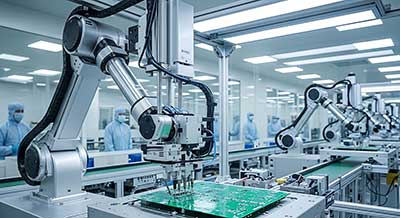 “If you are of a certain age, you grew up watching ‘The Jetsons’ cartoon. It all seemed so far-fetched and unbelievable. But here we are in 2026, right in the middle of that innovation with self-driving cars, autonomous moving robots, and other things that seemed impossible. Technology is making the impossible possible. It’s an exciting time.” – Ed Tullar, President, Kübler Inc.
With the continuing innovation of all things “smart” from rings to watches to consumer devices to industrial automation, powered by growth in the Internet of Things (IoT) and the Internet of Industrial Things (IIoT), the demand for the technology that powers the “smart” and feeds the information has grown exponentially. According to a March 2026 report by Fortune Business Insights, the global sensor market is projected to reach USD $258.47 billion in 2026, and could reach an estimated USD $527.94 billion by 2034.
Sensors provide critical information to the operator and the operating system. They can detect malfunctions and identify and correct safety issues, including motion, heat, and environmental dangers. They provide real-time analytics and performance data and troubleshoot issues. They can detect errors and off-specification products, performing on-the-spot quality control. They provide vision, alignment, and position, and track speed, orientation, and distortion.
As the demand for sensors continues to increase, so do the end-user expectations for reliability, performance, security, and stability.
Environmental Challenges
Location, location, location. Sensors play a pivotal role in transmitting information that allows robots to operate. The environment within which the sensor operates has a significant role in how well the sensor can perform its function. “A humanoid robot gets very hot when it is operating. If it is working in surgical technology or a medical laboratory, the end-of-arm tool (EOAT) could be alternating between reaching into an incubator, oven, or refrigerator. Not only does the EOAT need to be calibrated to dynamic temperature ranges, but the sensors operating the effector must also be robust enough to allow the EOAT to adapt the grip to grab the glassware strong enough not to drop it, but also not so strong as to break it. The sensors will also need to be monitoring the temperature of both the environment and the robot operating system,” stated Robert Brooks, CEO and founder, ForceN.
Sensors and encoders that provide feedback for any type of repeatability, such as a slip ring at the end of an EOAT that is designed to move 360°, (a turbine blade, for example) face a number of challenges. In addition to the precise location, noise, electrical vibration, radio frequency, and static noise can all interfere with the performance of the sensor. In a continuously operating manufacturing line, delays and stoppages mean profit, and real-time data can proactively prevent problems. “It’s essential to have the right control and the right cables to get full benefit of a sensor. When the sensor is monitoring temperature, the performance of the equipment, and mean time to failure on an apparatus such as a wind turbine, any kind of interference can lead to huge problems. There is more and more demand for accuracy and precision,” said Ed Tullar, president, Kübler Inc.
Manufacturing facilities present other challenges for sensors. Dust or moisture on the sensor lens will impede operation. Sensors can be equipped with dust suppression or water droplet suppression detection, which allows the sensor to adjust to contaminants on the lens and to send real-time data when it reaches a point where it is no longer operating properly. “Sensors that are monitoring jam detection, conveyors, or autonomous mobile robots need to be able to determine what is coming down the line, where it needs to go, whether it needs to be diverted left or right and when the conveyor needs to be stopped. Sensors cannot do that if there is dust or moisture, so sending real-time analytics and data is crucial, not only for safety but also for efficiency,” said Jonathan Baldassarra, territory sales manager, Leuze USA.
The right sensor for the job may seem like common sense. Still, factors such as safety, reflectivity and light distortion, and spatial limitations can all play a role in how successful the sensor is, and there may be more than one solution. A sensor monitoring a robot filling a bin may not detect that one area of the bin is being underfilled because it cannot “see” it; an area scanner could be a better solution rather than simply adding more sensors. Ultrasonic sensors may seem like a good solution in a dusty environment, but if the sensor is monitoring a conveyor with plastics or shiny surfaces, the ultrasonic wave will bounce off the reflective surface and not provide good readings. “There are a million ways to solve the problem; it just needs to be the right one for the customer,” concluded Baldassarra.
Signal Noise
One of the most pervasive challenges with sensors in motion control is signal noise and distortion. Data received from a sensor is only as good as the signal that provides that information, and distortion can come from many sources.
Determining the source of the signal noise in a manufacturing environment can be difficult. It can be caused by electrical interference pushing towards discreet or analog signal which prevents the sensor from transmitting to its outsource. It could be due to electrical wiring, a component or another machine. “Sometimes it’s a calibration issue. Sometimes it’s a matter of adjusting the distance to ensure a proper light beam, and sometimes it’s an issue with an operator adjusting the signal gain after installation,” said Baldassarra.
One of the challenges with compensating for sensor signal noise is how the noise is measured, with a goal of true noise-free resolution. Electronics typically measures signal noise peak to peak, with no outlier events. In reality, true noise-free resolution is generally 6-8 sigma, and RMS noise gives noise density but may not provide useable information. Many sensors are tested in the factory pre-installation. However, until the motor is operating at full capacity, the data about signal distortion will be inaccurate. “Industrial robots are made of iron or steel frames, which contains noise and magnetic fields. Collaborative robots, humanoid robots, and other robots are increasingly being made with aluminum frames, which are lighter weight. There is also a trend towards frameless motors and extruded aluminum frames that allow the magnetic field to flow where they may, including into the sensors as well as polluting power lines. This can cause the sensors to use dirty power. The way to compensate and calibrate for this is to not only bench test the sensor in the lab, but also to field test dynamically at maximum operation,” explained Brooks.
Certified Motion Control Professional Program
Strengthen Your Skills and Enhance Your Career
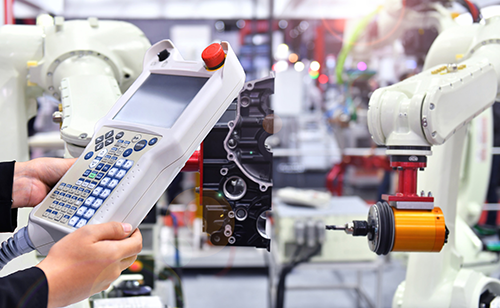
Become a Certified Motion Control Professional (CMCP) and join the elite group of system integrators, machine builders, manufacturers, end-users and others recognized in the industry for their professional knowledge and expertise.
Calibration Challenges
Industrial robots are built to be installed in a location on a factory floor and stay put. Bad things happen when a crane or gantry move the wrong way. Sensors in industrial robots could be calibrated at the factory, and then checked periodically to ensure they were still operating correctly.
Enter autonomous, humanoid, and collaborative robots, and calibration becomes more challenging. A humanoid robot equipped with a 6 degree of freedom (6DOF) robotic hand will have multiple sensors monitoring the torque, movement, vision, and force control. A packaging machine tending robot that loads and seals boxes needs to be able to detect when a label or tape spool needs to be replaced, locate the end of the new label or tape, and load it correctly. “What does the robotic hand need to locate and pull the end of the spool? How much dexterity is required and how much grip is required? What is the minimum iteration, how much articulation and how many DOF are required? Each of those conditions could require a different sensor, and each sensor needs to be calibrated precisely,” said Brooks.
Of course, the best calibrated sensor is no match for human interactions. A sensor can be moved during cleaning or by vibration from an adjacent machine. An overhead sensor monitoring a conveyor belt is typically set at a 45° angle to catch the leading edge of the conveyor, and as little as 1 degree of change can affect how the sensor performs. Operators may tinker with the sensor settings after installation, or adjust the signal gain. “One trend we are seeing is IO Link, which has a ‘lock out’ button that prevents settings from being changed after calibration. Only authorized individuals can make the changes,” said Baldassarra.
Brooks added that there is a trend in the industry to calibrate at the factory. As the degree of integration becomes more complex, solutions are becoming more custom, and there are less standard parts. “Customers are demanding a sensor solution with guaranteed absolute accuracy. We are no longer sending uncalibrated systems; we pre-calibrate our solutions. Customers are expecting to buy a sensing solution with guaranteed accuracy for their entire life, because they could be designing the machine learning operations around that accuracy and capability. Machine vision is being delivered pre-compensated, temperature compensated, and pre-calibrated. Customers can plug in and go.”
Trends in Motion Control Sensors
“With all the changes happening in the industry, it’s important to gauge what direction trends are heading in. We have to catch the innovation before the customer gets there, and determine how to make it happen and where it will be in five years,” said Tullar. “How is artificial intelligence (AI) and machine learning (ML) going to impact the industry — how do we get there faster, what is the speed to application, speed to market, speed to integrator, and speed to customer, and how do you manage the customer expectations along the way. That’s going to be a big issue to manage in the coming years. We also have to navigate and manage how customers are coping with all the data these integrated sensors are producing.”
A human is “spoiled by the amount of sensory data and how we can use it,” Brooks explained. A person can reach into their backpack, for example, rummage around in the bottom and grab an object that “feels like a pen,” using a sophisticated search and classification process on the fly to produce the desired result. That “rummage and find” technology doesn’t exist yet. In addition, a person lifting a box off a shelf and realizing that the object is heavier than it seemed will react and put it down before they drop it or hurt themselves. While robots are equipped with failsafe and emergency stops to prevent overload, they cannot “feel” and may not react in time to prevent damage. “One of the hallmarks of machine learning is reinforcement learning; an autonomous robot ‘learns’ from bumping into things and remembering the obstruction. It will be a delicate balance between managing customer expectations, innovation, and finding more dynamic, intelligent unstructured automation to advance the industry.”
The I/O Link is causing a significant shift in communication protocol, because it allows the sensor to function more like “plug and play.” It shows up as a “node” in the system, it is assigned and then any changes can be made in-house. In the case of a failed sensor, for example, a customer could remove the old sensor, plug in the new one, and the I/O Link will automatically recognize the new one.
“Customers are demanding higher accuracy, more robust performance in challenging environments and better compatibility. Industries such as food and beverage that have stringent regulations about clean environments and cross contamination prevention are driving innovation in how a sensor is mounted or is able to withstand power washing. Each industry is driving unique innovation to meet their challenges. Our goal is the value-add; how can we keep up with the drive for better technology and manage customer expectations into the future,” concluded Baldassarra.

Association for Advancing Automation
Discover how Association for Advancing Automation can support your automation journey with their complete range of solutions and expertise.
Visit Company Website


Playing the Field
Field-programmable gate arrays provide an economical alternative to application-specific integrated circuits for motion control applications.
Making piCOBOT® even more collaborative
Piab’s clever end-of-arm (EOAT) vacuum tool piCOBOT® is now configurable for any cobot. Piab’s cleverly designed vacuum operated end-of-arm-tool (EOAT) piCOBOT®