
Industry Insights
Man With Hockey Stick Can’t Stop Boston Dynamics’ Atlas From Completing Complex Tasks
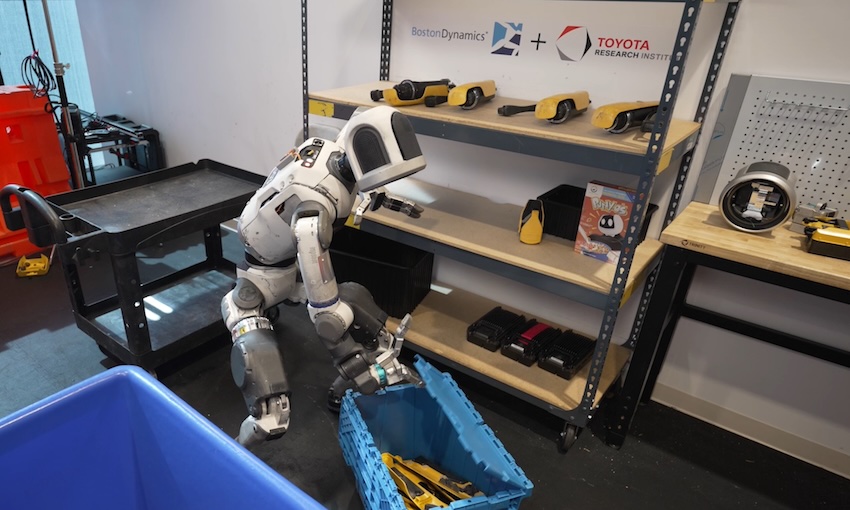
The team at Boston Dynamics pulled out the old hockey stick to showcase recent progress from its Toyota Research Institute (TRI) collaboration. The sports equipment has been something of a chaos agent in the robotics stalwart’s labs over the years, doing its best to disrupt high tech systems as they go about their work.
Here the lumber is directed at the electric humanoid, Atlas, the subject of the joint TRI research. Positioned just out of frame is an employee using the stick to be, in a word, “annoying,” making the humanoid robot’s job slightly more difficult, one swing at a time.
In the video, Atlas is tasked with picking Spot components off the ground, before placing them in a bin. The hockey stick intervenes multiple times, first closing the top of the bin after Atlas opens it and then pulling the bin out of the robot’s reach. Undeterred, the system adjusts and completes the job.
Atlas waits in front of an empty cart ahead of a second job, before someone drops Spot pieces down on top. Here the robot lifts up a dismembered Spot leg and appears to briefly examine it before folding it in half and placing it on a nearby industrial shelf.

Get the Training You Need for a Safer Workplace!
Autonomous mobile robots are one of the fastest-growing segments of the robotics industry. During this live virtual training, you'll be introduced to safety protocols and best practices for working with mobile robots in industrial settings.
Learn more and register now for upcoming training dates.
What’s notable in both of these examples is the robot’s ability to execute a complex string of full-body tasks, while adjusting for real world challenges. According to the teams, both jobs were executed using large behavioral models (LBMs), rather than coding.
“One of the main value propositions of humanoids is that they can achieve a huge variety of tasks directly in existing environments, but the previous approaches to programming these tasks simply could not scale to meet this challenge,” TRI’s Russ Tedrake notes. “Large Behavior Models address this opportunity in a fundamentally new way – skills are added quickly via demonstrations from humans, and as the LBMs get stronger, they require less and less demonstrations to achieve more and more robust behaviors.”
The work is the result of a Boston Dynamics/TRI collaboration announced in October.
Association for Advancing Automation
Discover how Association for Advancing Automation can support your automation journey with their complete range of solutions and expertise.
Visit Company Website


Automating by Numbers
How many robots constitute a pilot? What does scale really look like for humanoid robots?
Apptronik tops $935M in Series A Funding, Ahead of New Humanoid Launch
After partnering with Mercedes and Google, the Austin firm is readying its next robot.
Bridging the Gap: Advances in Human-Robot Interaction
Robots are evolving quickly in the manufacturing space, becoming more intelligent, adaptable, and collaborative —