
Industry Insights
How Embodied AI Fits into the Future of Manufacturing
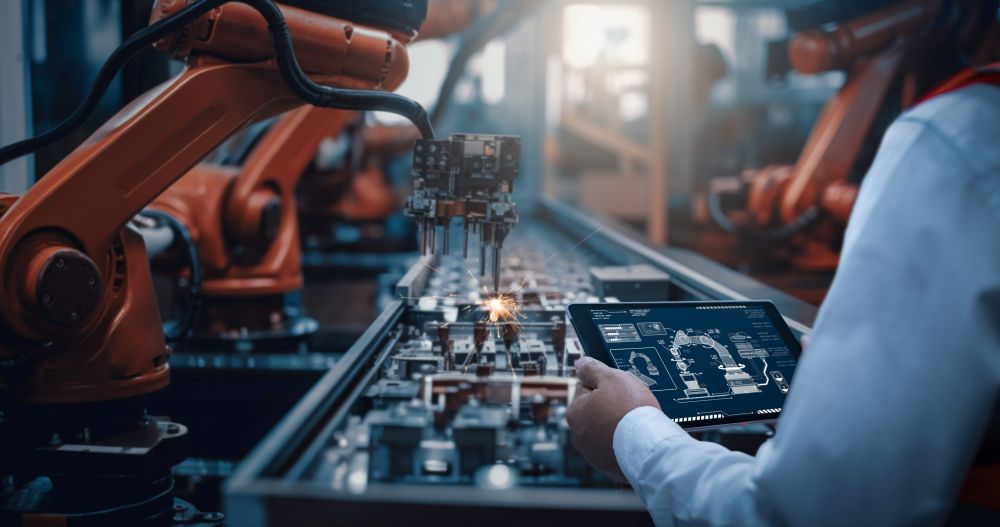 Embodied AI isn’t just another new industry buzzword, and it doesn’t only refer to AI-powered robots walking around a factory. Embodied AI is a framework for defining and describing systems already in place in industrial environments and distinguishing them from other AI applications.
Embodied AI refers to AI models that control machines using a combination of sensors to perceive, reason, and interact with the task in real time. Embodied AI applications combine real-time environmental perception with machine learning capabilities, enabling models to effectively operate robots, vehicles, or tools in dynamic environments. Stefan Nusser, chief product officer at Intrinsic gives an example, “Consider, for example, an electronics assembly workcell that can be re-programmed to perform different steps with current and future parts. This fundamentally changes the economics of automation.”
Variability is a key challenge embodied AI can greatly improve. A spokesperson from Boston Dynamics explained further, “Traditional automation performs well in highly structured, repetitive environments, but it struggles as variability increases. Embodied AI delivers value by enabling robots to adapt, reason, and respond in real time.” Embodied AI implementations, such as industrial-robot assembly tools in manufacturing and autonomous mobile robots (AMRs) in logistics, are becoming well-established, and the growth of embodied AI in industrial settings has only just begun.
Current Applications
Embodied AI is delivering value in industrial applications currently. Boston Dynamics’ spokesperson gives an example of how embodied AI can improve performance without having to make any changes to the hardware. “Our humanoid robot, Atlas, can autonomously sequence parts, deciding how to react to unexpected variables in real time rather than following a rigid script. Similarly, we used reinforcement learning to help our quadruped robot, Spot, master slippery surfaces in environments such as breweries. Using reinforcement learning, we ran thousands of simulations to develop a new walking gait that enabled the robot to traverse slippery surfaces without falling. This was then rolled out as a software update to all Spot robots, requiring no hardware changes.”
There are other industrial applications from companies like Amazon, Tesla, and Siemens where AI systems are interacting with the physical world currently:
- Adaptive robotics includes pick-and-place robots that use sensors to accommodate variations in object orientation as well as robots designed for autonomous assembly tasks.
- Tactile quality inspection, adjusting sensor angles, and leveraging learning-based anomaly detection.
- Warehouse logistics robots, both humanoid and in rolling form factors, move, lift, and place goods while observing the environment, practicing obstacle avoidance, and adapting as needed for task completion.
- Industrial cobots assist human operators in industrial environments.
Embodied AI isn’t just a concept; it’s delivering value in industrial applications today. Intrinsic’s Nusser expands, “We are at the very beginning of the embodied AI journey, and we expect exciting new embodied AI solutions to emerge over the next couple of years. In recent years, we have seen embodied AI solutions enter the market that deliver compelling ROI, particularly in machine vision and ‘robot perception’. That industry has carved out incredible value already, especially in verticals like logistics and, increasingly, assembly.”
Emerging Applications
Embodied AI is rapidly evolving as solutions enter the market, Nusser shares. “In the future, we will see implementations of embodied AI that are more versatile, such as a mobile base with an arm that can move from one application to another, or a dual-armed workcell that can do a variety of manipulation tasks without requiring fixturing, and ultimately a humanoid robot that has the versatility of a human worker. This is a significant change from a special-purpose cell with a clamp to hold the workpiece in a known location and a position-controlled manipulator.”
Emerging industrial applications on the horizon:
- Production-ready humanoid robots are currently being unveiled for industrial applications. These are among the most promising flexible robotics solutions that can augment an existing workforce to fill gaps in tasks designed for a human form factor.
- Enhanced general-purpose cobots that can sense, plan, and assist human workers on the fly based on interpreting natural language in real time, acting as a shop floor collaborator.
- Fully autonomous production lines and, ultimately, fully autonomous facilities represent the pinnacle of embodied AI: a factory in which each process step and component can operate with minimal oversight.
Function-Driven Design
Humanoid robots receive the most media attention and are clearly an important emerging application, but embodied AI in logistics, supply chain, assembly, quality control, security, and factory flow will not necessarily be best served by a humanoid form. Embodied AI in a fixed work area is an obvious example: a workcell may include dozens of robot arms and eyes that perform dynamic tasking based on work orders. As factories are increasingly designed for embodied AI, there may be less need for humanoid robot form factors. The factories currently in operation were designed for human workers, and, often, the most effective way to fill the required roles is with a robot that mirrors the human form. Greenfield applications can leverage simulation in machine design to optimize production lines with embodied AI solutions in mind. Mobility (e.g., wheeled, legged, or fixed-track), manipulation (e.g., arms, clamps, interchangeable tools), and perception can be customized to application-specific requirements, thereby optimizing space and cost.
Embodied AI on the Factory Floor
There are many considerations when implementing any AI solution, and embodied AI has unique requirements beyond those of other AI solutions. Nusser explains, “In the case of embodied AI, we may be controlling machinery like a mobile robot or a robotic manipulator. Safety, predictability, and traceability are significantly more important in this case. The benefit of starting in manufacturing is the high safety standards and the structured/ semi-structured environments in which we operate. Embodied AI works well in these scenarios first, and with infrastructure that integrates well with existing safety systems.”
AI lifecycle management, model training, safety, space constraints, process flow, irregular floor conditions, and effective integration with legacy systems are among the factors that may need to be accounted for in addition to the typical data and compute considerations for AI solutions.
Embodied AI as a Service
Planning for AI implementation requires understanding and implementing robust model training and lifecycle management processes. Nasser compares AI to software in that it regularly needs updating based on new data learnings. He explains, “AI is inherently connected and has an element of continuity. Unlike traditional automation, it has a lifecycle more similar to software than hardware. AI needs to be refreshed as the technology evolves and, more importantly, as the data underpinning the models at the core of embodied AI evolves. These models ‘drift.’ This is why embodied AI requires connectivity and is, in our view, best delivered as a service.”
On Robot Training
Training the embodied AI on the specific robot it will control is key for Boston Dynamics. “Embodied AI requires what we call a ‘zero embodiment gap’: AI must be trained on the robot’s specific sensors and actuators,” they say. Unlike digital AI, we use specialized platforms to process complex, multimodal models locally for real-time manipulation. Training requires good-quality data from teleoperations and simulations to ensure the robot understands the space it takes up and how to operate in real-world situations where environmental factors are always changing.”
Safety by Design
Safety by design is an essential aspect of embodied AI employed in industrial settings. When machines operate autonomously, particularly mobile robots that may interact with human-occupied workspaces, safety must be a primary consideration. Traditionally, safety has often been viewed as a requirement that increases costs and undermines efficiency. With automation enabled by embodied AI, safety-by-design increases efficiency and reduces costs by minimizing risks and downtime, lowering insurance premiums, and minimizing potential legal fees and regulatory fines. Embodied AI is already sensing its environment and adapting based on changing conditions. By planning for safety as an integrated design element, embodied AI can increase throughput while reducing the risk of operator injury.
Identifying process steps where issues may occur can be critical. Nusser outlined, “Embodied AI is more generalized, more 'multi-purpose' than traditional automation. A common source of friction we see is when an embodied AI solution transitions from one application to the next. In an intelligent implementation, the robot uses perception and AI-based detection, grasping, motion planning, and insertion to adjust to the different parts on the fly. However, some friction remains. As hardware and software become more powerful and generalized over the next few years, this friction will diminish.”
Physical space can be a challenging consideration for mobile solutions. Humans naturally adapt to irregular lighting, changes in surface coatings, cracks, slopes, or stairs. If temporary structures, clutter, or excess stock are placed in what are typically open paths, people immediately understand how to adapt to that change. Embodied AI solutions require comprehensive mapping and design considerations to understand and adapt to dynamic environments.
Data Visibility
is an important consideration for any AI solution. A unified data architecture that integrates standardized, contextualized data from all available IT and OT systems enables organizations to feed models and simulations to generate insights and optimize operations. Data visibility is essential for the efficient operation of embodied AI systems. Beyond the data they collect with their own sensors, understanding information from other parts of the process and facility enables the synchronization and optimization of all production tasks.
Workforce Adoption
One less frequently discussed aspect of integrating embodied AI is cultural buy-in. For AI deployments to succeed, operators need to leverage the AI to its full potential and trust the AI solution to perform tasks competently. One opportunity to secure that buy-in is when an organization is working to understand all aspects of the existing process from every level when initially considering AI solutions. By creating an evaluation team that includes operators, managers, maintenance staff, IT experts, and automation engineers, solutions can be evaluated, commissioned, and managed to incorporate input from all levels of operations. This team delivers value beyond evaluation by guiding and monitoring the solution through a phased implementation.
The Industrial Evolution of Embodied AI
As embodied AI becomes standard, it will quickly become a requirement to compete effectively. The market for AI solutions has expanded dramatically, and embodied AI deployments are expected to follow that trend, with numerous products coming to market in 2026. Nusser shares Intrinsic’s vision for the future. “We see the emergence of more generalized automation solutions as the main trend line: software solutions will become more ‘intelligent’ and better able to adapt to changing circumstances in real time. We expect that agentic AI, especially conversational HMIs, will make AI and robotics easier to manage and more accessible to non-experts. Hardware is also gradually becoming more general-purpose, driven by a slower-moving trend constrained by the laws of physics. For example, there is no universal ‘hand’ ready for production use in automation; currently, robot arms must be carefully selected to meet application-specific requirements.” As hardware and software evolve and have greater capability to deliver efficient solutions, embodied AI will become common in industrial environments.
The development of embodied AI solutions is ongoing and will continue to expand the range of applications they are suited to. Boston Dynamics’ spokesperson describes a future with general-purpose humanoids with human-like perception. “The main technological hurdle is perfecting visual learning to bridge the gap between human and robot movement. From an industry perspective, the transition from industrial sites to service industries, and eventually to the home, will be a long process.” Industrial deployments are incredibly complex, but that complexity allows embodied AI providers to develop in the most demanding environments, paving the way for future commercial applications.
Embodied AI is creating a shift from rigid, rules-based automation solutions to agile, software-defined production processes. Value is already being created across numerous applications, and the capabilities of embodied AI solutions are expanding rapidly. Competitive advantage will hinge on data integration, safety-by-design, and lifecycle management. The factories that plan for embodied AI today will define the next era of industrial performance, where adaptability, resilience, and continuous optimization become the new baseline.
The A3 Humanoid Robot Forum is Happening at Automate 2026!
As humanoid robots transition from experimental labs to the factory floor, the Humanoid Robot Forum provides the blueprint for what comes next. This intensive two-day event, taking place from June 23-24 at Automate in Chicago, explores the cutting-edge insights into the performance constraints and measurable outcomes of today's most advanced bionic systems. Learn more and join us there!
Association for Advancing Automation
Discover how Association for Advancing Automation can support your automation journey with their complete range of solutions and expertise.
Visit Company Website


Agility Takes on AI Generalization and Humanoid Safety as it Looks to Go Public
Agility's CTO breaks down the humanoid company's strategy ahead of its SPAC.
Humanoid Robots Are Evolving
Humanoid robots are still in their early stages, yet evolving fast.
Humanoid robots take to the skies
A team of researchers at IIT have built a humanoid robot with jet engines for hands.