
Blog
3 Clever Automation Bootstrapping Strategies
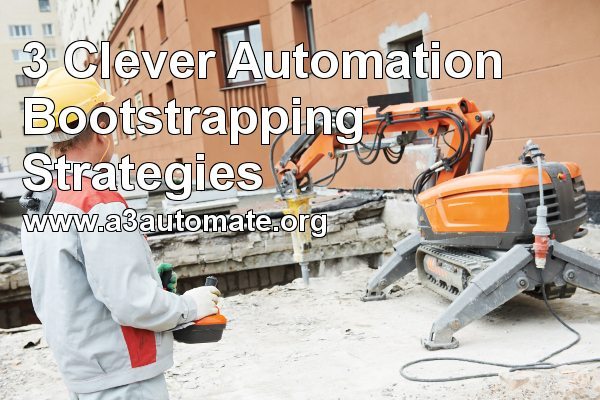
Automation lets companies move products to market with greater efficiency than traditional production and allows U.S. companies to compete with emerging, low-wage industrialized nations. Manufacturers who do not make use of automation may be concerned that price tags and the cost of training are high.
It's possible to bootstrap one's way by purchasing systems that are configured with the company's needs and goals. Here are 3 strategies to use.
Strategy 1 Learn Your ROI
Select one key area in the operations to automate. There may be one piece of equipment that breaks down easily or there may be a few different areas in a facility that can share an automation upgrade.
Prepare for the cost of automating by knowing your most immediate needs, the purchase price of a system that works best for the present time frame, and the costs to expand the use of automation over time.
Reasons to automate will influence the type of system that is needed. Automation can provide a competitive advantage in the marketplace because of improved quality. Labor costs can be reduced so the finished product will also have a competitive price.
Automation can provide a lower price-per-unit on goods produced, greater sales, and fewer customer returns.
Factor the return on investment by projecting the overall cost of automation. One time costs are the purchase of robotics, training, and possible physical plant reconfiguration, plus operating costs that include electricity, routine maintenance, and staff re-training.
Strategy 2 Be Flexible
Use flexible systems that can be purchased one unit at a time and moved from one workstation to another. Fixed automation can lock a company into a particular product mix and can become outdated with today's on-going advances in technology. A fixed system may not be able to respond quickly to changing market conditions.
Consider how robots like these have traits designed to fit with specific needs.
- KUKA's LBR intelligent industrial work assistant (iiwa)The LBR iiwa was introduced in Germany in April 2013 performing a bushing assembly task. It's particularly adept at assembly tasks such as gear meshing, peg-in-hole insertion, and snap fitting. It's manufactured by KUKA which has a full line of space-saving small robots that operate from the same PC-based control platform.
- Universal Robots 6-axis single-arm robot This equipment handles the repetitive, mundane tasks that a person would have to do by standing at a machine all day or sometimes all night. It can easily be picked up and moved around a facility. Made by Universal Robots USA Inc., the equipment is easy to use and set up.
- Baxter by Rethink Robots This robot is suited to handle repetitive tasks that are low-skilled but require common sense. One type of use is examining a part to determine if it’s in spec and if it passes, then it's placed in an approved group; otherwise, it is set in a rejected pile. It's the creation of Rethink Robots.
- Dexter Bot by Yaskawa Motoman This collaborative robot has been in the manufacturing space for more than two years and is available in different payloads from 5 kg up to 20 kg per arm. The Yaskawa machine is more geared toward process and assembly, where a connector has to be fit into a particular slot.
Strategy 3 Look to the Future
Establish an automated system and make sure the costs are under control. The first one or two years require a Return on Investment period during which the cost of robots, machine vision and automation are recouped against the savings achieved from manual labor. But from then on, the cost of manufacture per hour is lower than the cost of producing in countries of low cost labor.

Once costs are understood and the investment begins paying back, the next step is to see how increased automation can generate more income from increased production of the same product or allow a company to diversify into serving different industries.
Automation requires an investment but a wise one-step-at-a-time approach recoups the money spent and positions the company for future growth.
Recent Posts