
Industry Insights
Social Studies: How Design Impacts Human-Robot Interaction
I start by congratulating Kayla Matheus on her new job — I’m fairly certain listed on her LinkedIn profile when we’d first discussed setting up an interview.
She thanks me, adding, with a bit of a laugh, “I did the slightly masochistic thing of defending my PhD, immediately going to a conference and then coming back and moving across the country and starting a job the next day. But when there's a really interesting opportunity, you have to seize it. So here I am.”
A quick glance at her CV shows that Matheus has taken her own advice to heart. She had seemingly lived a couple of lives by the time she launched Moti in late 2014. The social robot won IEEE’s CES pitch off, earned $110,000 on Kickstarter, and garnered mentions in Fast Company, Inc, Engadget, and TechCrunch.
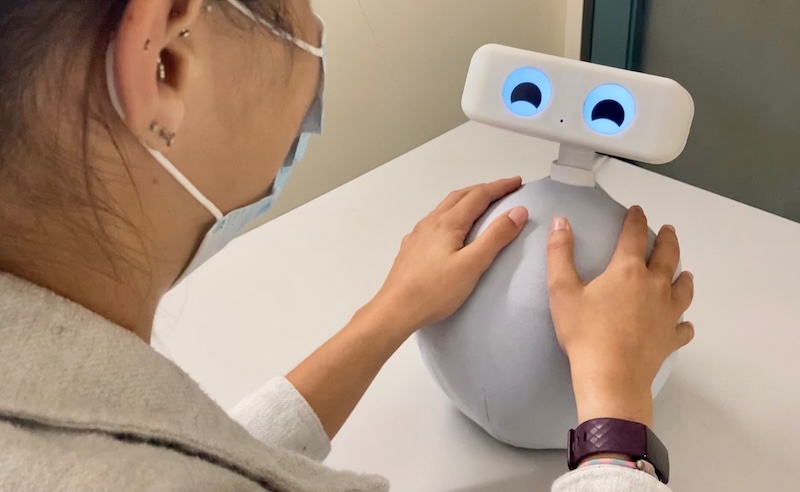
Next, it was five years spent on a doctorate in human-robot interaction (HRI) at Yale, which ran concurrently with stints at both EV charging startup Volta, and Amazon’s Lab126. The latter saw her team tackling big questions about little Astro. The Yale work centered around Ommie, a robot designed to help individuals deal with severe anxiety.
That was the thesis she successfully defended in February, before officially joining up as head of HRI and UX for physical AI unicorn, Rhoda AI, the following month. Matheus notes that, while more than a decade of work in HRI gives her ample background, the new gig will present unique challenges.
“All of my previous robots are not humanoids and they are not in industrial environments,” says Matheus. “That's definitely a gap for me, or at least a jump. I will say that I have been in the mind space of looking for what are the sustainable business models for a consumer robot. I've poked at this from my own startup. I've poked at this from inside of a large tech company. I've poked at this from a research perspective. I find so much value in terms of supporting human health, happiness, and whatnot.”
Astro is undoubtedly the best-known robot Matheus worked on previously. Amazon delivered an ambitious vision of home robotics after the Roomba, in the form of a wheeled smart assistant with a telescopic security camera. Matheus says she took a break from her PhD to work with a small team made up of academic researchers and Amazon employees. Understandably, she doesn’t offer much in the way of detail.
“I'd say at a high level, my work was a bit more on understanding how learned human preferences might impact robot behaviors in a home environment,” she explains. “It was less building a new robot from scratch, which is what my previous work had been, more on using an existing robot platform and an existing architecture, but looking specifically at learning and adapting of robot behaviors.”
Moti, on the other hand, was a study in minimalism. A table-top social robot with no moving parts, it was designed to help users “build healthy habits.” The product pitch notes, “There are plenty of apps and wearables for habit formation, but we know that humanity isn't just about knowledge and data — it's about emotion. Based on the latest insights from behavioral science and social robotics, MOTI works by being more than just a device: he's a friend who sets up the right types of reminders, celebrations, and accountability seamlessly into your life.”
Learnings from the product would inform her work on Ommie, years later. This time, much of the robot relied heavily on breathing and haptics to center users. Breathing exercises are an important tool for cognitive behavioral therapy (CBT), as they can activate the parasympathetic nervous system to relax the body after bouts of stress. With Ommie, Matheus and team explored a way to engage with these therapeutic practices outside of practitioners’ offices.
“Social robots offer a promising interface modality for addressing this need,” she writes in her thesis abstract. “As physically embodied social agents, they can provide motivational cues and situated support in the environments where practicing a behavioral technique is most relevant. However, a number of open questions remain about how robot embodiment, interactions, and autonomy should be shaped for vulnerable populations in daily life. This dissertation accordingly asks: How can we design, develop, and validate social robots that effectively support mental health behaviors in real-world contexts?”
Ultimately, however, Ommie is designed to render itself obsolete. If a user is successful, they will be able to engage with breathing practices independent of a human practitioner or robot.
“We want to make sure that our users are bonding with the robot enough where the robot's able to provide behavioral support and motivation in order to practice deep breathing regularly,” says Matheus. “However, what we do not want is for users to only be able to deep breathe with the robot. The end goal is not even to use the robot. The end goal is users in their daily life, they experience distress and they're able to call on this practice very easily because they've practiced it at home.”
Association for Advancing Automation
Discover how Association for Advancing Automation can support your automation journey with their complete range of solutions and expertise.
Visit Company Website


Yaskawa Motoman Announces Partnerships with Teams for the Amazon Picking Challenge
Yaskawa Motoman has selected three organizations to each receive a Motoman® dual-arm robot.
Bipedalism's Baby Steps
The former Amazon exec discusses early explorations with the humanoid form factor and why his current company went a different
Amazon is Testing Augmented Reality Glasses for Delivery Drivers
The glasses give walking directions, help located packages, and alert them to dangers.