
Industry Insights
How Coco Robotics Hit the Ground Running Amid a Global Pandemic
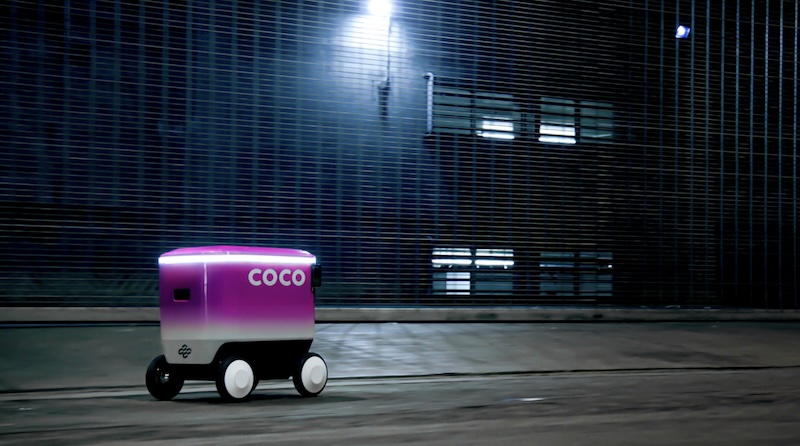
The first week of March 2020 was a “complicated” time to launch a robotics startup, Zach Rash admits. The global pandemic would ultimately spell doom for countless promising startups, as a once-in-a-century event turned all al wisdom on its head. And then there were those that thrived amid the chaos — providing goods and services that made the strange new way of life a little more livable.
“It ended up, I think, also being a good time in a lot of ways,” Coco’s cofounder and CEO adds. “Delivery was very front of mind for restaurants and for the community. When we started, some of our first customers were the elderly and retired community of Santa Monica. We were getting them groceries. We were like working with the city to get people contact-free groceries during the first few weeks of the pandemic when everyone was super concerned about whether [Covid-19] was transmitted through packages.”
Rash and fellow recent UCLA grad, Brad Squicciarini, began building robots — and a company–– in their shared Los Angeles living space.
“We were building [delivery robots] in our living room,” says Rash. “The first people we hired were in our COVID bubble, because we all kind of just like lived in the apartment together, making robots. We didn't have this like transition to remote moment, because of when we started the company. We've never been remote, ever.”
While some early pandemic artifacts — like the fear of transmission via packages and surfaces — are a distant memory, others have had a more permanent effect. Years after restaurants reopened their doors to the public, food delivery remains popular. While Coco was hardly the first robotics startup to explore sidewalk delivery, the company continues to benefit from that initial momentum.
Beyond the luck of timing, Rash says the company’s decision to work directly with restaurant partners was an important factor in its early success.
“We always set out to really focus on building a great service, not just a great piece of robot technology,” says Rash. “The first day of the business, we did real deliveries with a real business. We really built the product with restaurants — all of these little details. How does a restaurant go out to use the robot? How do they want to interact with the robot? What are all the ways to make our dispatch and order processing software as seamless as possible for them? That wasn't some second-class product decision that happened down the road. That was all incorporated on day one.”
ROI Calculator

Discover the potential cost savings of robotic automation over a 20-year system life
This calculator compares your current manual labor costs against the total cost of owning and operating a robotic system over its 20-year lifespan.
It was those relationships, says Rash, that led Coco to quickly diversify its then-small staff beyond its existing base of robotics engineers.
“One of the first employees at the company was a restaurant general manager,” he says. “I was pitching a restaurant and he decided to leave the restaurant and come and join us. And you know, he's been here the whole history of the company. He's really instilled this culture of hospitality and service at the company that you just don't get when you hire a bunch of robotics engineers. I think that got instilled very quickly to have this sort of service culture at the company. And then that compounds.”
Pricing, too, was a key priority. Margins are thin in restaurants, and any perceived convenience from new technologies amounts to little if it eats significantly into profits. Rash says the company was focused on building low-cost systems that were as accessible as they were useful.
“There's a huge tendency for robotics people to massively over-engineer everything,” he notes. “I think for certain cases, like in a self-driving car, I can buy that argument. You know, if you want to like commercialize a robot taxi service quickly, you can charge a lot more for a robot taxi service than you can for food delivery. You're like human safety is like incredibly critical. So start overkill and work your way down.”
Coco’s approach is diametrically opposed, according to Rash, starting bare bones and adding complexity over time. The startup’s second major robot, Coco 2, was built to address some of its predecessor’s perceived shortcomings. The system sports a higher power NVDIA process, designed for more autonomous navigation, coupled with a front-facing, solid-state LiDAR sensor to help it better navigate around objects.
As the company has expanded its reach from perpetually sunny Southern California to Chicago, Miami, Jersey City, and Helsinki, the system has been built to accommodate a broader range of weather systems.
“In these millions of miles we've done, we've learned a lot,” says Rash. “We have been underwater in Miami, we have been freezing in Chicago, we've had heavy winds in Chicago, we've had snow buildup on the cameras. We've learned a lot in all these different operating environments. We've added hundreds of things to the vehicle to make it superhuman levels of reliability in the worst conditions. The glass on the cameras is heated, so it melts the snow off. We have what we call an air blade. It's like a little blast of air that shoots down to clear the cameras from rain and from snow buildup.”
Association for Advancing Automation
Discover how Association for Advancing Automation can support your automation journey with their complete range of solutions and expertise.
Visit Company Website


Dramatic increase in demand for CW Bearing’s flex bearings over the last few years
While CW Bearing has experienced difficulties brought on by the global pandemic like other companies, the demand for their flex bearings has hit triple-digit level
ARO to support Ottonomy's Ottobots
ARO to support Ottonomy's Otttobots, the World's First Fully Autonomous Delivery Robot Delivering in Both Indoor and Outdoor Environments.