
Industry Insights
Gritt Is Betting the Future of Construction Will Be Built on Data, Not Robots
.jpg)
Construction is the world's largest industry by value and one of its least automated. A typical building project today still relies on fragmented subcontractors, manual labor and workflows that would be familiar to a contractor from the 1970s. While manufacturing and logistics have steadily increased productivity through automation, construction has remained largely unchanged.
Gritt believes that is finally beginning to change.
The company recently emerged from stealth with $32.4 million in funding, including a $26 million Series A led by Obvious Ventures, to commercialize an artificial intelligence platform that enables existing construction equipment, including skid steers, forklifts and industrial robotic arms, to perform complex physical tasks autonomously. Rather than designing a new robot from the ground up, Gritt is building what it describes as an intelligence layer that can operate across the machines contractors already own.
The announcement comes as investors increasingly shift their attention from robots themselves to the software and data that make them useful. Across the physical AI landscape, the competitive race is becoming less about hardware specifications and more about who can build the largest, highest-quality datasets from real-world deployments.
"There is no existing dataset for construction," the company told A3. "You can't recreate a 10,000-acre jobsite in a laboratory. The only way to build that intelligence is to deploy on real projects and do real work."
That philosophy has pushed Gritt toward what it describes as a deployment-first strategy. Instead of waiting until systems are perfected in controlled environments, the company places them on active jobsites where every hour generates new operational data.
The Data Flywheel Construction Never Had
Building on Existing Equipment
Unlike many robotics startups, Gritt is deliberately separating intelligence from hardware.
Rather than asking contractors to purchase specialized robotic systems, the company's software is designed to run on equipment already common across construction sites. By making its intelligence hardware-agnostic, Gritt believes deployment can scale at the pace of software rather than the pace of manufacturing new machines.
The company argues that technological advances, not changes in construction itself, have created the current opportunity.
"What makes construction hard hasn't changed," Gritt told A3. "Outdoor sites are unstructured, lighting and weather vary constantly, terrain is uneven, and the environment literally rebuilds itself every day."
Instead, Gritt credits three advances for making physical AI commercially viable.
NEW ONLINE TRAINING COURSE
Designing Industrial AI Agents
Gain the skills to orchestrate advanced AI agents that learn, adapt, and collaborate like experts in real-world automation environments
First, representation learning has matured enough to build foundation models that understand construction environments instead of individual tasks. Second, simulation environments can now be generated directly from real jobsite data, dramatically expanding the amount of training possible from every deployment. Third, intelligence has become increasingly independent of hardware, allowing AI models to operate across multiple types of industrial equipment.
For the company, software — not robotics hardware — is becoming the primary product.
.jpg)
From Pilot Projects to Commercial Scale
Gritt says that strategy is already producing measurable commercial results.
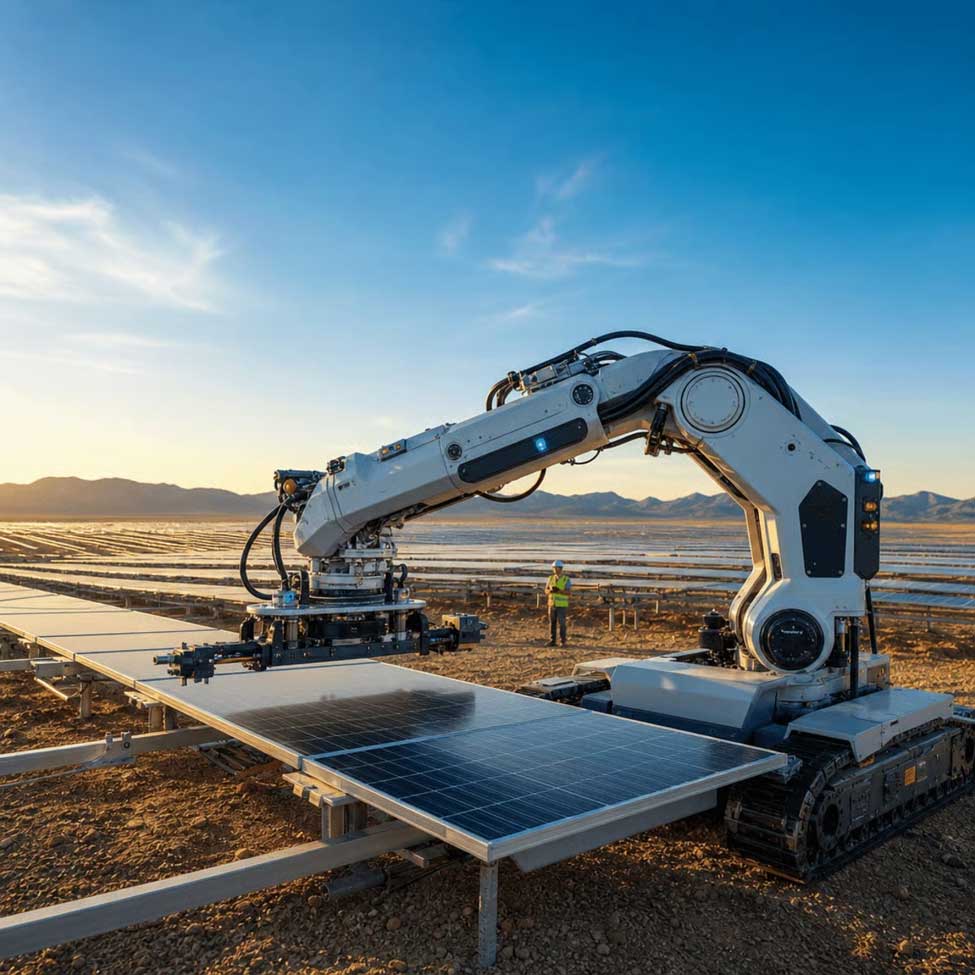
According to the company, its systems have autonomously installed more than 30,000 solar modules without a reported breakage while operating across more than seven active deployment sites. Each robot collects terabytes of operational data daily, creating what the company believes is one of the industry's largest proprietary construction datasets.
The company also says customers have reported productivity improvements of approximately four times compared with traditional methods. Gritt says three of the top 10 U.S. power contractors now use its platform, with approximately 20 megawatts of solar infrastructure completed and 2.8 gigawatts of contracted solar construction in its deployment pipeline.
Those figures have not been independently verified. Still, they illustrate why investors are paying increasing attention to construction automation. Global construction spending exceeds $13 trillion annually, yet the industry continues to struggle with chronic labor shortages, rising infrastructure demand and productivity growth that has remained largely stagnant for decades.
Whether Gritt ultimately succeeds will depend on more than its ability to automate individual construction tasks. The larger question is whether proprietary data gathered from thousands of hours on active jobsites can become a durable competitive advantage.
If it can, the next generation of construction companies may compete less on the machines they deploy than on the intelligence those machines acquire. For physical AI, construction is becoming one of the industry's most important proving grounds and companies that own the data may ultimately shape how the world's future infrastructure gets built.
Watch below how Gritt is using AI-powered robots to work on construction projects.

Association for Advancing Automation
Discover how Association for Advancing Automation can support your automation journey with their complete range of solutions and expertise.
Visit Company Website


PickNik Robotics and SKA Join Forces to Revolutionize Unstructured Robotics
PickNik Robotics the leading software company specializing in unstructured robotics environments, is thrilled to announce its collaboration with SKA Custom
Why Generalist is Starting With Robotics' Hardest Problem
The startup's CTO discusses breakthroughs and training for real world settings.
NVIDIA Declares 'Big Bang of Physical AI' at GTC 2026
The chip giant made big announcements across autonomous driving, robotics, manufacturing, simulation, and more.