
Tech Papers
The Business Case for Track, Trace, and Control
Learn how TTC solutions help manufacturers cut cost, cut waste, automate critical manufacturing processes, and increase yields—all critical elements in today’s economic environment.
By François Monette, Cogiscan Inc. and Matt Van Bogart, Microscan Systems, Inc.
First, a TTC system provides real-time visibility of all work-in-progress (WIP) and materials on the factory floor. Second, a TTC system eliminates the risk of human errors associated with material handling and equipment setup. Finally, a TTC system provides a complete history of the product lifecycle to enable precise troubleshooting and to minimize the number of products that need to be returned if a recall occurs.
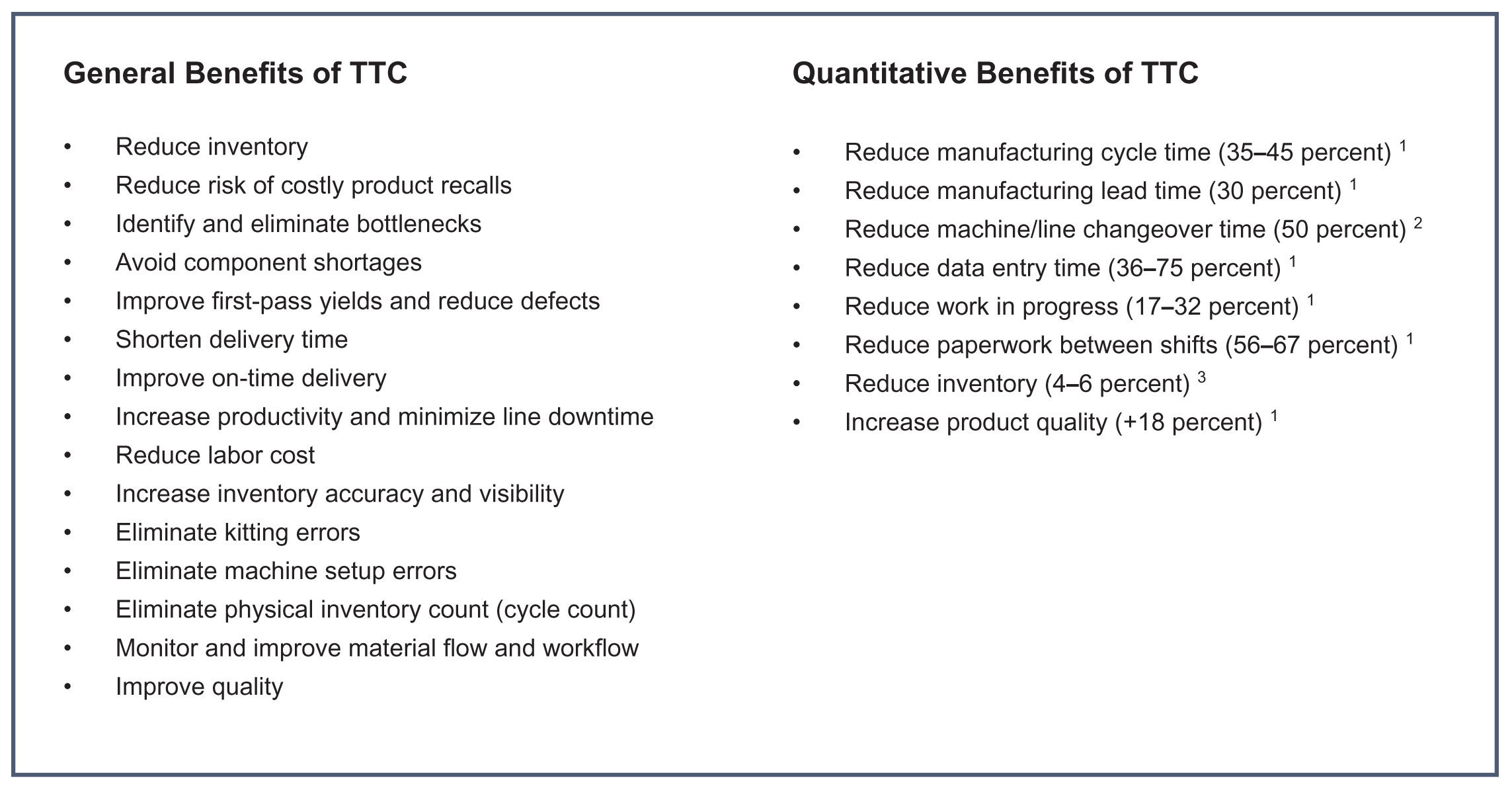
In the cost structure of most manufactured products, materials constitute 50 percent of the total cost. For complex products, such as electronic printed circuit board assemblies, the sum of individual components can represent up to 80 percent of the cost of the finished product. A good TTC system will eliminate all waste of time and materials, enabling savings up to 10 percent of the total product cost, which goes straight to a manufacturer’s bottom line.
A typical payback analysis for a good TTC system is less than one year. In a globally competitive manufacturing industry, one could argue that the cost of opportunity associated with this investment is a simple matter of staying in business.
Every manufacturer requires some level of WIP tracking on the factory floor. In many instances this is achieved with paper-based procedures. Although this type of solution can work, it typically is not the most efficient. Production data is not available in real-time. Also, since the basic production data is not digitized, it is not practical to perform any kind of performance and quality analysis, and/or create traceability records.
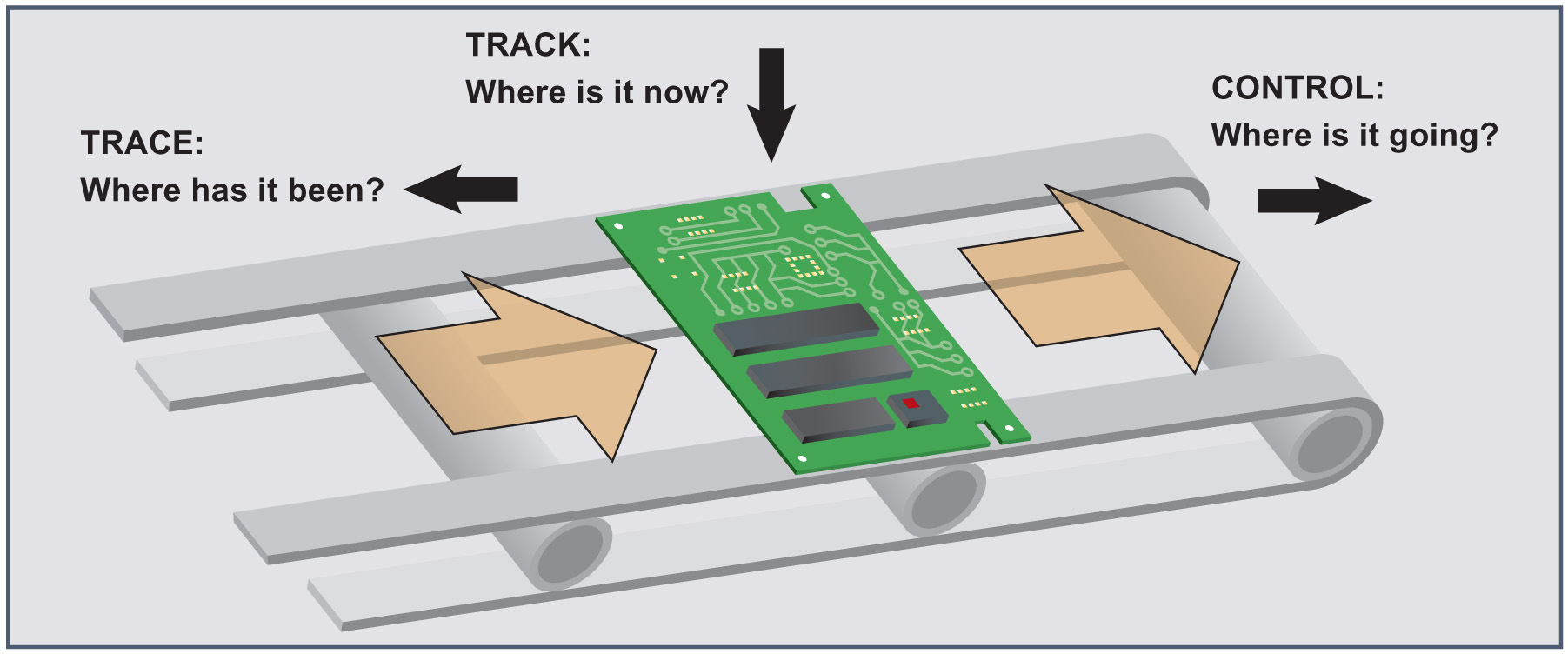
 Automated WIP tracking provides real-time visibility of all open orders on the production floor. In the simplest form, this can be done at the job or work order level simply by scanning a barcode label on the traveler sheet at each operation. The highest level of precision can be achieved by tracking individual production units if they are serialized with 1D or 2D symbols or RFID tags.
In addition to basic product tracking, all related production materials required for a specific job can be identified with unique ID barcode labels or RFID tags. Scanning these parts as they move from one location to another provides real-time visibility of all production materials on and off the assembly line. In some factories a significant amount of time is spent each day searching for specific components or sub-assemblies. Everyone knows that they are out there somewhere, but no one knows precisely where.
In addition to the direct cost of human resources, this has a direct impact on productivity. In some cases complete assembly lines sit idle while someone tries to find the missing part. In other cases, the whole line must be changed over to another product because the necessary material cannot be located and additional parts must be ordered. This can amount to hours of lost production time and missed deliveries.
Knowing and controlling the precise location of all WIP and materials on the production floor enables a much higher level of control over critical parameters such as ontime delivery, cost, and quality. Additionally, once the data acquisition infrastructure is in place, additional software applications can be easily implemented to realize additional benefits.
The topic of traceability is not often associated with a specific return on investment (ROI) because this requirement is driven by the end customer, by a specific industry standard, or by legislation. In these instances, a traceability system is a prerequisite to doing business.
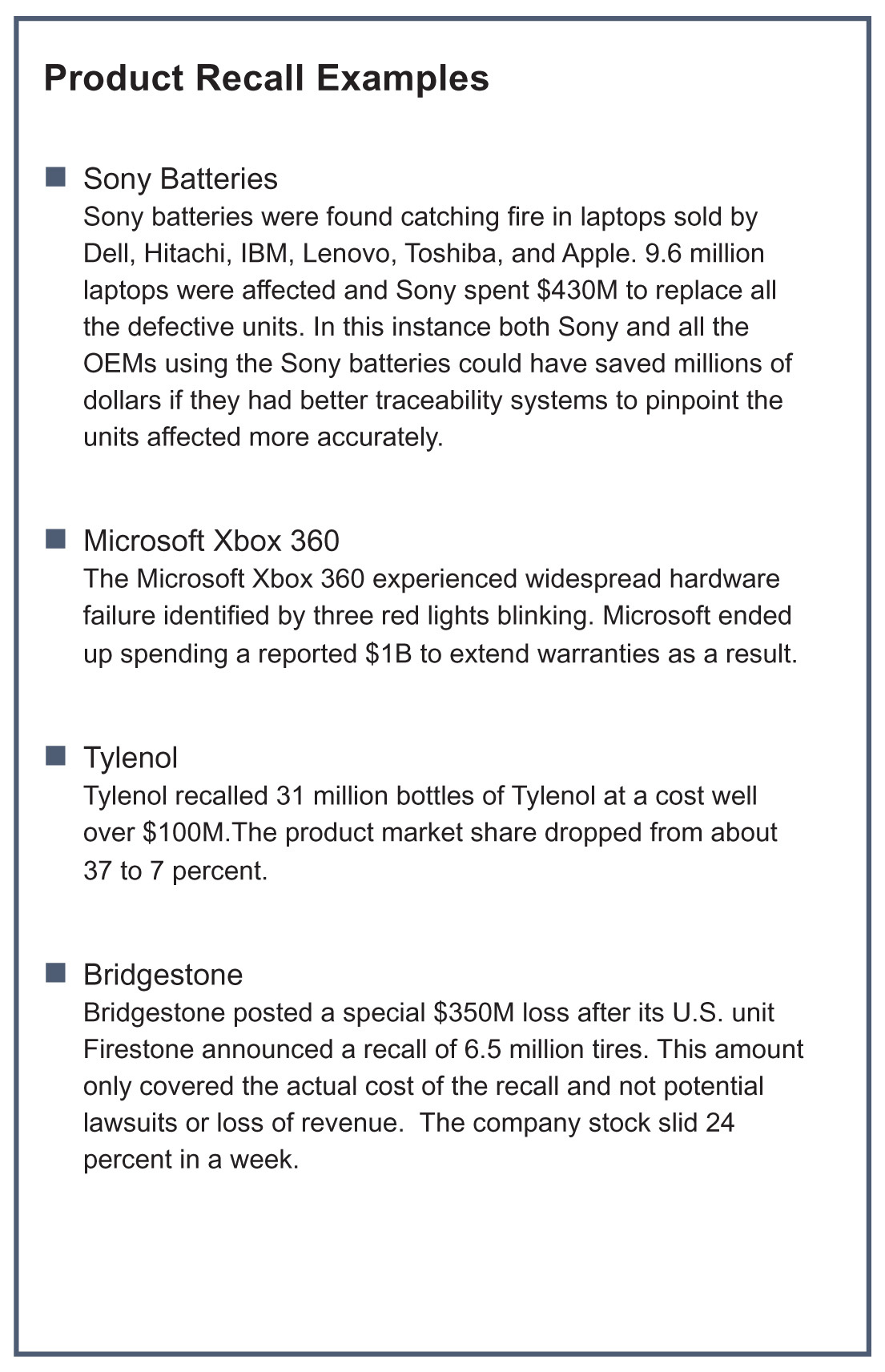
Considering the very large number of variables and human beings involved throughout the complete assembly of a product and its lifecycle, the opportunity for something to go wrong is very high. It is not a question of knowing if something will go wrong, it’s a question of when it will happen and how bad it will be. In the case of a serious product failure or security issue, having a basic traceability system in place can reduce the number of products to be recalled by orders of magnitude.

Some people like to compare a traceability system to an insurance policy. It is a small investment that can make an enormous difference when something does go wrong. There are different levels of traceability that can be achieved, from production batch or date code down to serialized units, and from manufacturing site and date-only to full process and material information. The challenge for each manufacturer is to define which level is most appropriate for the specific situation. It becomes a matter of balancing the actual cost of acquiring and storing traceability data against the cost of a potential recall.
In a typical TTC historical database, it is possible to determine precisely when and where a defective product was built simply by scanning the serial number. It also is possible to retrace every single lot of parts that was used to produce that specific unit. If the defect is related to a faulty batch of parts, it is possible to identify the list of all products that were built using the defective parts. As a result, any product recall is reduced to the smallest possible impact.
The true cost of a traceability system may be far less than expected. If traceability is considered in the context of a complete TTC system, full process and material level traceability will be a natural by-product of the TTC system.
Production control is the third but not the least critical aspect of TTC software. The word “control” refers to all aspects of error-proofing. It is certainly important to get real-time visibility of WIP and materials, and to be able to trace historical data, but it is even more important to build the product correctly in the first place. If the TTC system is primarily intended to gather traceability data, the control functions will ensure that operators are using the correct product and materials and are scanning the correct production information in the historical database, guaranteeing 100 percent accuracy of traceability data.
When tracking serialized products, basic cycle time information can become a powerful database for monitoring operational efficiency. It is possible to compare real-time information against calculated throughput and even generate warnings and alarms when the process slows down below a certain threshold. This type of control leads to better machine utilization and overall equipment effectiveness (OEE).
Similarly, while tracking material on the assembly line, the TTC software can verify that the correct parts are set up in the correct location to build a specific product. Again, warnings and alarms can be generated during initial machine setup to eliminate the risk of human errors and the associated waste of time and materials. Optional light towers and physical interlocks also can be tied to the TTC software to provide more visible and audible warnings and to stop the production line in case of critical errors.
Tracking materials on and off the assembly line also enables the following applications:
- Offline setup validation to accelerate changeover
- eKanban to pull parts before running empty
- Material reservation/kit management
- Perishable material tracking to avoid using expired material
This leads to more efficient use of materials as well as improvements in machine utilization/OEE.
Manufacturing floor automation prevents errors by eliminating as much human intervention as possible. This can be achieved in TTC systems by replacing handheld barcode readers with fixed-mount readers integrated in machines, workstations, and conveyors. Various types of interlocks can be connected to the readers and TTC software to stop the assembly process in the event of a misread or when the product is out of sequence.
In some cases, replacing barcodes with RFID tags also can enable completely hands-free data acquisition and setup verification. RFID technology is commonly used to create intelligent systems in which tags are attached to different pieces of tooling, fixtures, or pallets, and RFID antennas/readers are strategically integrated inside machines.
A good TTC software package should be highly modular and scalable because, in most cases, manufacturers want to solve a specific problem by implementing a small project in a short time frame. A targeted TTC project will typically cost between $15k and $50k and will be implemented in a matter of a few days, providing a very good ROI and quick payback. The basic TTC system can be expanded in phases over time, each phase increasing benefits and ROI.
3 Return on Investment Calculation, Dynamic Systems Inc.
1. Technology Fails: 8 Extreme Electronic Disasters, Computerworld, October 2009
2. www.recalls.gov – One stop shop for U.S. Government recalls
3. Return on Investment for WMS project, Dynamic Systems Inc.
4. MESA International Survey
5. Materials Management, Profit Centre, Indian Institute of Materials Management
6. Survey of Successful RFID Case Studies in Electronics Manufacturing, Cogiscan Inc.
www.microscan.com
Product Information:
[email protected]

OMRON Automation - Americas
Omron Automation is an industrial automation solution provider that creates, sells and services fully integrated automation solutions that include sensing, control, safety, vision, motion, and more.
Discover how OMRON Automation - Americas can support your automation journey with their complete range of solutions and expertise.
Visit Company Website


Omron Automation is an industrial automation solution provider that creates, sells and services fully integrated automation solutions that include sensing, control, safety, vision, motion, and more.