
Tech Papers
Particles in Motion
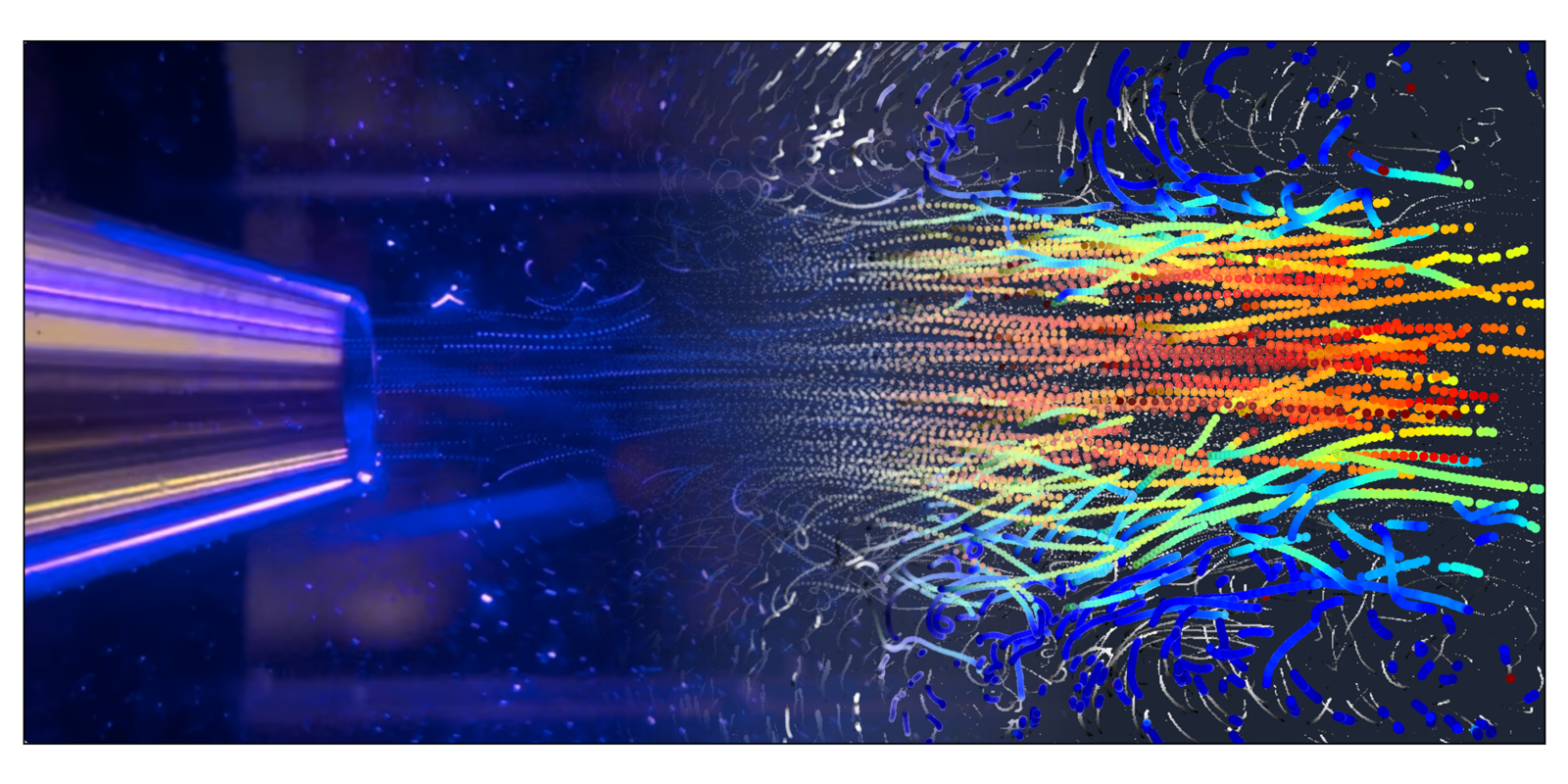
Event-based cameras in 3D flow diagnostics
How can the movement of air or water be made visible in three dimensions? Industrial cameras with event-based sensor technology provide a completely new database for this purpose: They only record what actually changes, enabling precise flow analysis with minimal effort. It becomes particularly exciting when several of these cameras are combined – for example, to track thousands of particles in real time in 3D.
New perspectives for flow diagnostics
The precise analysis of flows – whether of air, water, or other media – is a key tool in research and development. Until now, expensive highspeed cameras have mostly been used to visualize the movement of individual particles. Although these deliver impressively detailed images, they generate enormous amounts of data that must be stored, transferred, and processed at great expense. And even at high frame rates, the results are highly dependent on the correct choice of exposure time, lighting conditions, and optical configuration. Without extensive imaging expertise, motion blur, dark image areas, or incomplete scanning can quickly occur – significantly compromising the quality of the measurement data.
A new technology promises to remedy this situation: Event-based cameras do not continuously capture complete images, but only register changes in the field of view – with microsecond precision. This neuromorphic sensor technology drastically reduces the data stream while enabling highly dynamic motion analysis. It becomes particularly exciting when several of these sensors are combined: This makes it possible for the first time to perform complex 3D flow analyses – cost-effectively, scalable, and with unprecedented efficiency. A true "enabling technology" that opens new doors for research institutions and industrial applications.
With multiple perspectives into the third dimension
Flow diagnostics relies on the ability to accurately capture movements – ideally not only in two dimensions, but in three. Event-based cameras offer a completely new approach here. Unlike conventional image sensors, they only detect contrast changes in the field of view and do so with response times in the sub-millisecond range. The resulting data volume is not only significantly smaller, but also highly relevant. Combined with their high light sensitivity and compact design, this opens up new applications that were previously only possible with significantly more expensive high-speed systems.
It becomes particularly exciting when several event-based cameras are combined with each other. Only by viewing particles from different angles can they be clearly identified in space and their movement reconstructed in three dimensions. Applications such as established particle image velocimetry (PIV) or the visualization of complex compression shock configurations, for example, between engine blades, benefit enormously from this technology. The reduced data stream even allows real-time evaluation, enabling new concepts for active flow control based on imaging measurement technology to be implemented.
The methodology presented here is based on several years of research into event-based image processing in flow diagnostics, as pursued in particular by the "Optical Engine Measurement Technology" department at the DLR Institute of Propulsion Technology in Cologne.
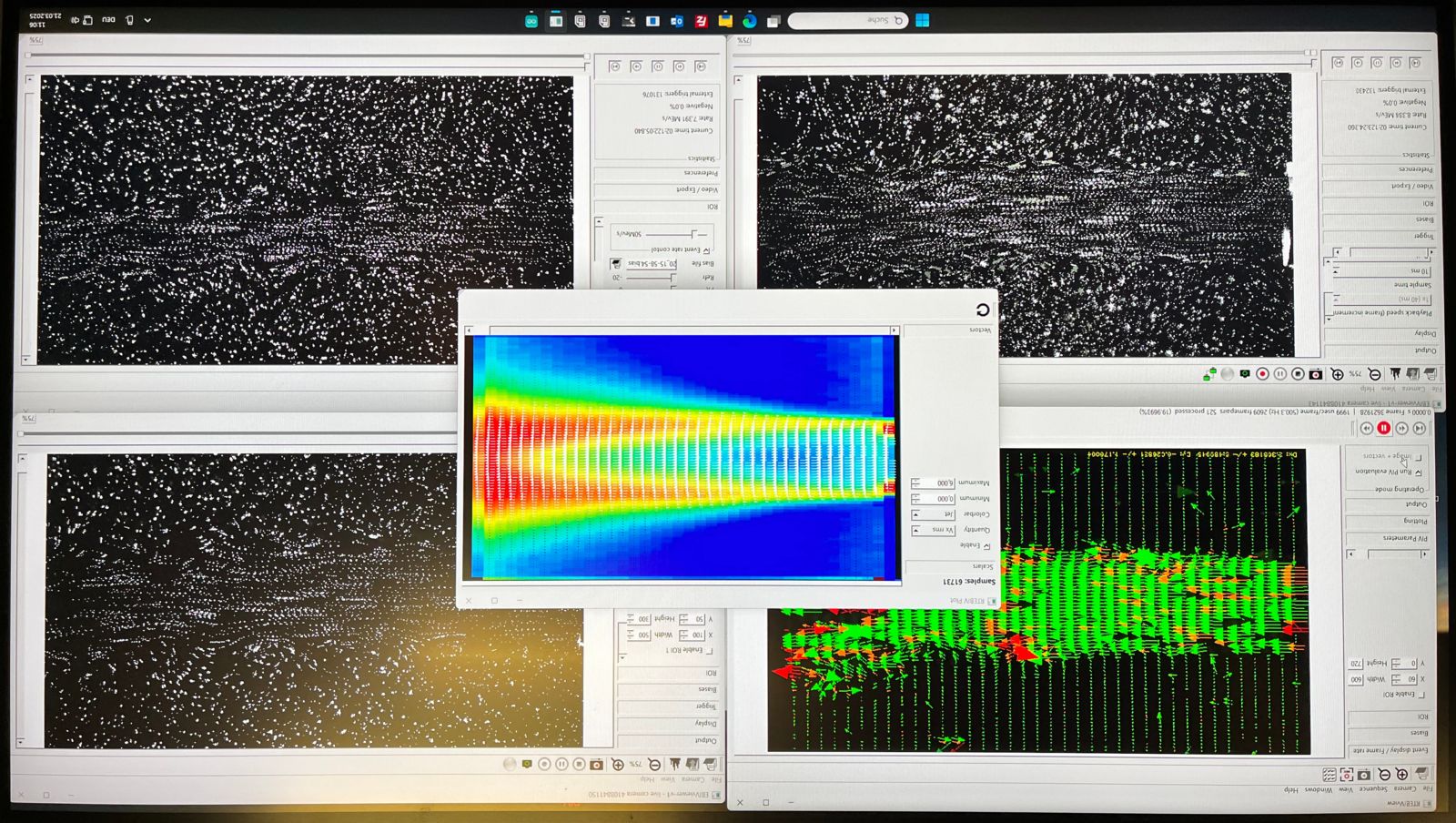
From events to 3D data
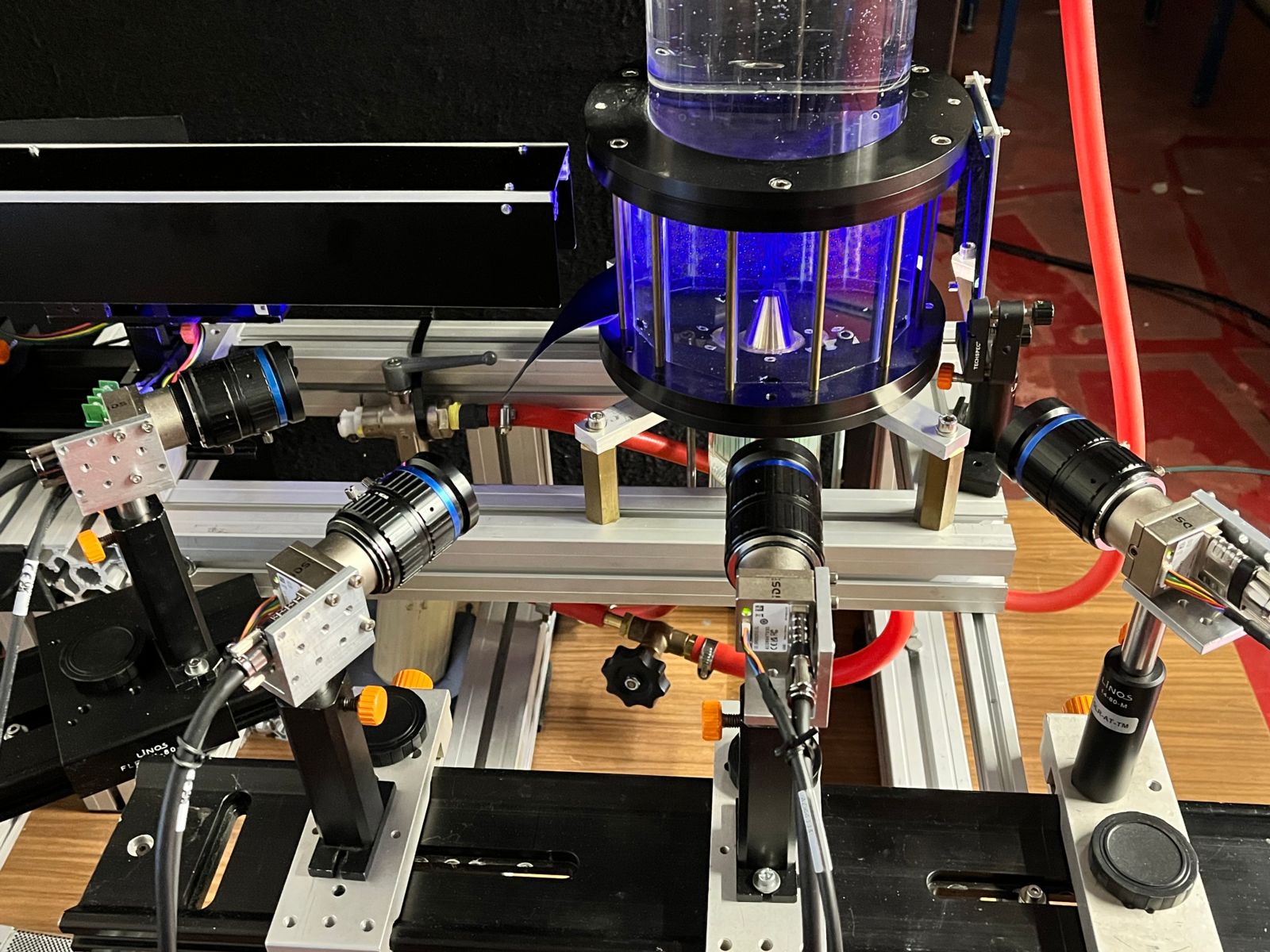
A single camera is not sufficient to capture the movement of individual particles in a flow field in three dimensions. Only by combining multiple perspectives, typically three to four cameras, can the particle positions in space be clearly determined. The cameras are placed in a photogrammetric arrangement so that they capture the same volumetric object from different perspectives with slightly overlapping image areas. The 3D position of the particles can be calculated in space using triangulation based on the corresponding pixels and the known camera positions. The more viewing angles are available, the more precise and robust the reconstruction of the particle trajectories becomes.
Precise synchronization is crucial to ensure that the data from the cameras can be correctly merged later on. The four event-based industrial cameras from IDS used for this purpose offer two particularly helpful interfaces:
- Trigger input: It enables a unique timestamp to be placed in all data streams so that events can be precisely assigned to each other later.
- Hardware inhibit (TDRSTN): This function allows all cameras to be started simultaneously – even if they are operated on different computers.
Once the data has been collected, the real challenge begins: The events of the individual cameras must first be geometrically registered with each other (camera calibration). The particles are then localized in space, either directly from the synchronized events or using a two-step process in which the particles are first tracked in the individual views and then their movement paths are reconstructed. The positions and timestamps of individual pixel events are accumulated over a defined period of time – in other words, they are merged in terms of time and space. The result is a kind of "motion trail" in space that shows how particles move within a volume over time.
ROI Calculator
Discover the potential cost savings of robotic automation over a 20-year system life
This calculator compares your current manual labor costs against the total cost of owning and operating a robotic system over its 20-year lifespan.
This form of visualization is particularly helpful for understanding complex flow patterns: You can see whether particles are moving in paths, whether turbulence is occurring, or how shock waves are spreading. Backflows, vortex formation, and local velocity changes can also be visualized in this way. Such qualitative representations are not only of great value for research and teaching, but also for the development and optimization of technical systems, for example in aerospace, fluid mechanics, or microfluidics.
Event-based cameras offer an exciting alternative to traditional highspeed systems. Even though they do not yet achieve extreme temporal resolution, they already enable significantly more cost-effective and simplified flow analysis – making 3D PTV measurements accessible to smaller laboratories and research institutions as well.
— Dr. Christian Willert, German Aerospace Center (DLR) —
Advantages, limitations, and challenges
The performance of the system depends, among other things, on the temporal and spatial resolution and the sensor. The Sony IMX636 sensor used offers a temporal precision of approximately 100 microseconds. This allows up to 10,000 particles to be tracked simultaneously at a clock rate of 1 kHz – at 10 kHz, the number is around 1,000 particles. These figures illustrate the potential, but also the limitations, of the technology: Although a higher resolution would allow for more particles, it would also increase the data stream and processing requirements.
However, event cameras offer a cost-effective alternative to highspeed systems. They generate less data, require less storage space, and thus enable even smaller research institutions to access precise motion information for applications such as 3D flow analysis. Thanks to their compact design and low energy consumption, EVS cameras are ideal for mobile and autonomous systems due to their minimal peripheral requirements, thus opening up new areas of application.
A particularly innovative aspect is the ability to evaluate flow fields in real time with over 250 fields per second. Each "field" represents a complete snapshot of particle movement within a defined volume. This high temporal density not only allows for precise analysis of dynamic flows, but also provides the basis for adaptive systems in which the flow can be actively influenced – for example, by controlling flaps, nozzles, or other mechanical components. For Dr. Christian Willert from DLR, this real-time evaluation is a real milestone in the further development of image-based measurement technology.
Enabling instead of revolution
Event-based vision does not compete with traditional image-based systems – it does not replace them, but rather complements them in a meaningful way. While highspeed cameras continue to demonstrate their strengths in situations where maximum spatial resolution and complete image information are required, event technology offers a new, low-threshold option for efficiently capturing dynamic processes. It makes precise motion analysis accessible – even for laboratories and research institutions with limited budgets or infrastructure.
IDS uEye EVS cameras offer a suitable camera platform for this purpose: compact, energy-efficient, and with low peripheral requirements. They enable the creation of scalable multi-camera systems without complex hardware setups and work seamlessly with the Metavision SDK from Prophesee, the manufacturer of the innovative EVS sensor technology. This opens up new fields of application, for example in mobile flow diagnostics, wind tunnel models, or even on drones.
Prophesee's continued involvement in the embedded sector also demonstrates that event-based vision can be understood as an enabling technology: A specially developed kit allows high-speed event data to be processed directly on a Raspberry Pi 5 with low latency. This makes the technology usable for compact, embedded systems as well, for example in robotics, industrial automation, or autonomous flight platforms. This transforms specialized high-performance technology into a flexible tool for a wide range of new applications.
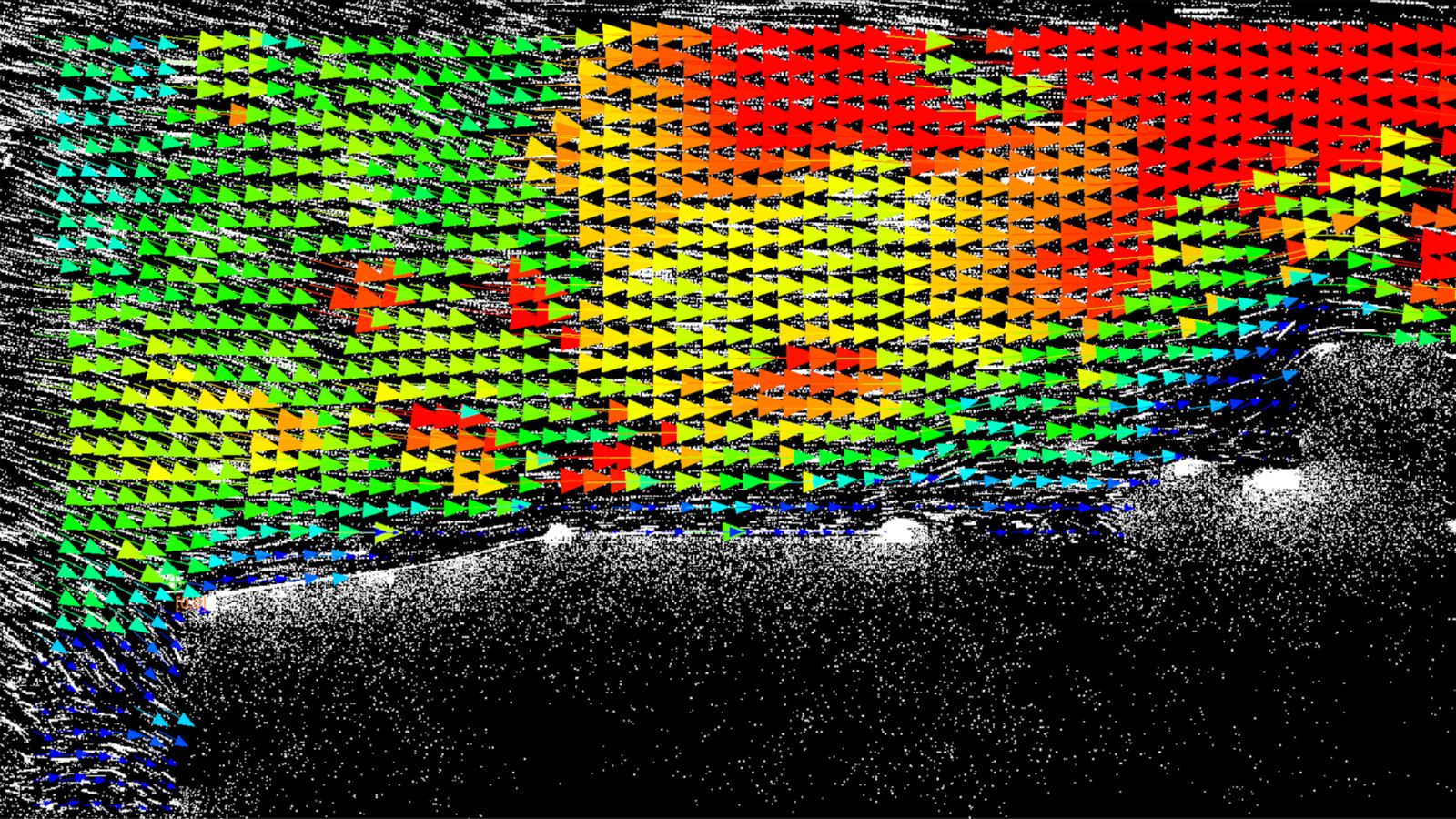
Flow visualization and quantification through accumulation of event-based data
Further information
- You can read more about event-based flow visualization in our application story: Event-based flow visualization.
- Find out more about the uEye EVS cameras: Camera family

IDS Imaging Development Systems, Inc.
The IDS product lines include 2D and 3D cameras with different interfaces and capabilities, as well as a wide selection of image sensors for a wide variety of applications. Additionally, the company develops custom cameras and provides the appropriate software.
Discover how IDS Imaging Development Systems, Inc. can support your automation journey with their complete range of solutions and expertise.
Visit Company WebsiteIDS Imaging Development Systems, Inc. 

The IDS product lines include 2D and 3D cameras with different interfaces and capabilities, as well as a wide selection of image sensors for a wide variety of applications. Additionally, the company develops custom cameras and provides the appropriate software.
Colour Recognition with EyeCheck Smart Cameras
Colour is often the only characteristic that can be used to differentiate clearly between two otherwise completely similar objects.
Neousys Launches USB 3.1 Gen 1 Frame Grabber Card PCIe-USB381F, an Faster and Reliable Expansion Option for Machine Vision Applications
Neousys unveiled today its new generation USB Frame Grabber Card PCIe-USB381F with eight USB 3.1 Gen1 ports hosted by four independent USB Controllers.
Components Express Introduces Index Mount Adjustable Camera Mounts
CEI has announced its Index Mount adjustable camera mounts. Two different models are available—the Index and the Index Max.