
News
Mitutoyo Glass Thickness-Compensated Infinity Corrected Objectives Provide Ultra-long Working Distances
Optimized for imaging through glass up to 3.5 mm thick
Barrington, N.J. - Edmund Optics® (EO), the premier provider of optical components, is now offering Mitutoyo Glass Thickness-Compensated Infinity Corrected Objectives. These precision objectives are designed for a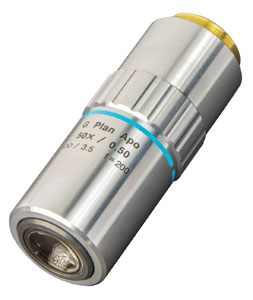 wide variety of life sciences applications.
Used in brightfield inspection microscopy
Mitutoyo Glass Thickness-Compensated Infinity Corrected Objectives are ideally suited for imaging objects through glass up to 3.5 mm thick. They are excellent when used in a broad range of brightfield inspection microscopy applications, including inspecting LCDs, semiconductor or flat screen TV monitors, or for imaging into a vacuum.
Outstanding color reproducibility
The infinity corrected, G Plan Apochromatic (Apo) objectives are also well suited for many different life sciences applications, including imaging through a coverslip or mediums like agar, water or nutrients. Available in 20X and 50X magnifications, Mitutoyo Glass Thickness-Compensated Infinity Corrected Objectives feature outstanding color reproducibility and a flat image surface over the entire field of view. The Objectives are in-stock and available for immediate delivery for fast turnaround and excellent value.
About EO
Edmund Optics® (EO) is a leading producer of optics, imaging, and photonics technology for R&D, electronics, semiconductor, pharmaceutical, biomedical, and military markets around the globe. EO is the world's largest supplier of off-the-shelf optical components. Customers can purchase items by contacting EO at 1-800-363-1992, via the catalog, or via the website
Company Contact:
Kirsten Bjork-Jones
Director Global Marketing Communications
1-800-363-1992
Editorial Contact:
James Liolin
Media Relations/Content Marketing
Lion Associates
1-914-670-0138
Barrington, N.J. - Edmund Optics® (EO), the premier provider of optical components, is now offering Mitutoyo Glass Thickness-Compensated Infinity Corrected Objectives. These precision objectives are designed for a
wide variety of life sciences applications. Used in brightfield inspection microscopy
Mitutoyo Glass Thickness-Compensated Infinity Corrected Objectives are ideally suited for imaging objects through glass up to 3.5 mm thick. They are excellent when used in a broad range of brightfield inspection microscopy applications, including inspecting LCDs, semiconductor or flat screen TV monitors, or for imaging into a vacuum.
Outstanding color reproducibility
The infinity corrected, G Plan Apochromatic (Apo) objectives are also well suited for many different life sciences applications, including imaging through a coverslip or mediums like agar, water or nutrients. Available in 20X and 50X magnifications, Mitutoyo Glass Thickness-Compensated Infinity Corrected Objectives feature outstanding color reproducibility and a flat image surface over the entire field of view. The Objectives are in-stock and available for immediate delivery for fast turnaround and excellent value.
About EO
Edmund Optics® (EO) is a leading producer of optics, imaging, and photonics technology for R&D, electronics, semiconductor, pharmaceutical, biomedical, and military markets around the globe. EO is the world's largest supplier of off-the-shelf optical components. Customers can purchase items by contacting EO at 1-800-363-1992, via the catalog, or via the website
Company Contact:
Kirsten Bjork-Jones
Director Global Marketing Communications
1-800-363-1992
Editorial Contact:
James Liolin
Media Relations/Content Marketing
Lion Associates
1-914-670-0138


MEET THE AUTHOR
Edmund Optics
Edmund Optics® (EO) is a leading producer of optics, imaging and photonics technology for R&D, electronics, semiconductor, pharmaceutical, biomedical and military markets around the globe.
Discover how Edmund Optics can support your automation journey with their complete range of solutions and expertise.
Visit Company Website
« Back To Robotics News

Edmund Optics® (EO) is a leading producer of optics, imaging and photonics technology for R&D, electronics, semiconductor, pharmaceutical, biomedical and military markets around the globe.
Vision in Life Sciences
This content is part of the Vision in Life Sciences curated collection. To learn more about Vision in Life Sciences, click here.