
News
High Contrast IR Wire Grid Polarizers
High Contrast IR Wire Grid Polarizers ideal for infrared applications that require high transmission
Designed using a lightweight, thin silicon substrate
Barrington, N.J. - Edmund Optics® (EO), the premier provider of optical components, introduces High Contrast IR Wire Grid Polarizers. These versatile polarizers are ideal for broadband infrared (IR) applications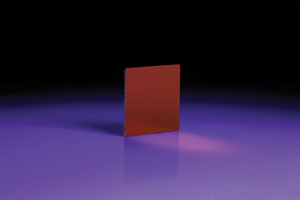 that require high transmission and contrast, including spectroscopy, thermal imaging and astronomy.
High Contrast IR Wire Grid Polarizers are constructed by applying a thin layer of aluminum MicroWires to a glass window. They are designed using a lightweight, thin silicon substrate, making them ideally suited for weight-sensitive systems, such as UAVs. High Contrast IR Wire Grid Polarizers feature wire grid technology, which allows the angle of incidence to vary +20° without exhibiting performance loss.
High heat resistance with low thermal expansion
Anti-reflective (AR) coated for superior transmission, High Contrast IR Wire Grid Polarizers are ideal for polarizing light from IR laser sources or for attenuating light from polarized IR lasers. They provide high heat resistance with low thermal expansion. Six models are available in 12.5 x 12.5 mm, 12 x 25 mm and 50 x 50 mm sizes for 3-5 μm or 7-15 μm wavelengths. High Contrast IR Wire Grid Polarizers are in-stock and available for immediate delivery for fast turnaround and excellent value.
About EO
Edmund Optics® (EO) is a leading producer of optics, imaging, and photonics technology for R&D, electronics, semiconductor, pharmaceutical, biomedical, and military markets around the globe. EO is the world's largest supplier of off-the-shelf optical components. Customers can purchase items by contacting EO at 1-800-363-1992, via the catalog, or via the website
Editorial Contact:
James Liolin
Lion Associates Inc.
Designed using a lightweight, thin silicon substrate
Barrington, N.J. - Edmund Optics® (EO), the premier provider of optical components, introduces High Contrast IR Wire Grid Polarizers. These versatile polarizers are ideal for broadband infrared (IR) applications
that require high transmission and contrast, including spectroscopy, thermal imaging and astronomy.High Contrast IR Wire Grid Polarizers are constructed by applying a thin layer of aluminum MicroWires to a glass window. They are designed using a lightweight, thin silicon substrate, making them ideally suited for weight-sensitive systems, such as UAVs. High Contrast IR Wire Grid Polarizers feature wire grid technology, which allows the angle of incidence to vary +20° without exhibiting performance loss.
High heat resistance with low thermal expansion
Anti-reflective (AR) coated for superior transmission, High Contrast IR Wire Grid Polarizers are ideal for polarizing light from IR laser sources or for attenuating light from polarized IR lasers. They provide high heat resistance with low thermal expansion. Six models are available in 12.5 x 12.5 mm, 12 x 25 mm and 50 x 50 mm sizes for 3-5 μm or 7-15 μm wavelengths. High Contrast IR Wire Grid Polarizers are in-stock and available for immediate delivery for fast turnaround and excellent value.
About EO
Edmund Optics® (EO) is a leading producer of optics, imaging, and photonics technology for R&D, electronics, semiconductor, pharmaceutical, biomedical, and military markets around the globe. EO is the world's largest supplier of off-the-shelf optical components. Customers can purchase items by contacting EO at 1-800-363-1992, via the catalog, or via the website
Editorial Contact:
James Liolin
Lion Associates Inc.

MEET THE AUTHOR
Edmund Optics
Edmund Optics® (EO) is a leading producer of optics, imaging and photonics technology for R&D, electronics, semiconductor, pharmaceutical, biomedical and military markets around the globe.
Discover how Edmund Optics can support your automation journey with their complete range of solutions and expertise.
Visit Company Website
« Back To Vision & Imaging News

Edmund Optics® (EO) is a leading producer of optics, imaging and photonics technology for R&D, electronics, semiconductor, pharmaceutical, biomedical and military markets around the globe.
Vision in Life Sciences
This content is part of the Vision in Life Sciences curated collection. To learn more about Vision in Life Sciences, click here.