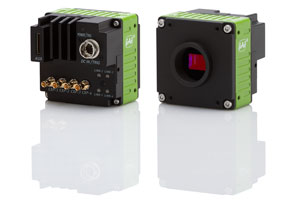
JAI’s has added a 4-channel CoaXPress interface to its 5-megapixel SP-5000 camera enabling the camera’s high performance CMOS imager to run at its maximum full frame rate of 253.8 frames per second for 8-bit, 10-bit, or 12-bit pixel formats. Two models are available – the SP-5000M-CXP4 (monochrome) and SP-5000C-CXP4 (color). Both models feature a 2560 x 2048 pixel CMOS imager available exclusively from JAI, with the color model offering raw Bayer output or 24-bit RGB output at a reduced frame rate.
Like the other models in the Spark Series SP-5000 line, the new cameras feature a combination of analog and digital gain controls to reduce the amount of quantized noise in low-light images compared to conventional CMOS cameras with digital gain functions alone. On the color model (SP-5000C-CXP4), an on-chip 4-channel analog gain control individually adjusts R, G, and B information for better white balancing with reduced noise.
The cameras are equipped with an auxiliary lens control circuit that supports P-iris control as well as programmable 3-axis control of motorized zoom lenses or other analog accessories.
The combination of speed and resolution makes the SP-5000-CXP4 cameras ideal for high-speed production line inspection, as well as process monitoring and event capture. Single and multi-ROI capabilities, available for both monochrome and color models, provide added flexibility for utilizing the high frame rate, pixel resolution, and bit depth of the cameras.
Outdoor applications benefit from the cameras’ automatic level control (ALC) capabilities, built-in high dynamic range mode (monochrome), and extended temperature rating, which enables the cameras to operate in conditions ranging from -45°C to +70°C.
The SP-5000-CXP4 accepts standard C-mount lenses. Power can be supplied through one of the CoaXPress channels, or can be provided via the separate 12-pin connector. Overall dimensions are 62 x 62 x 55.5 mm (HxWxL).
About JAI
JAI is a manufacturer of high quality, industrial-grade cameras for the machine vision, transportation, aerospace, homeland security, medical and scientific markets.
JAI’s broad product line features high performance progressive scan CCD cameras with spatial resolutions from VGA to 20 megapixels; traditional interlaced video cameras; intensified cameras with sensitivity to light levels as low as .00001 lux, and a range of innovative multi-imager prism-block cameras including both area scan and line scan models.
Physical interfaces include the Camera Link®, GigE Vision®, CoaXPress, and USB3 Vision high performance digital standards, as well as both TV-standard and analog progressive scan output.
JAI cameras help improve customer businesses in a variety of ways, whether by improving quality and accuracy, lowering costs, increasing yields, or simply enabling better service. In addition to cameras, JAI’s traffic solutions group is one of the world’s leading manufacturers of specialized traffic systems. Solutions are based on JAI-developed hardware and software, which is often integrated with third-party products.
Certified System Integrator Program
Set Yourself at the Forefront of the Global Vision Market
.jpg) Vision system integrators certified by A3 are acknowledged globally throughout the industry as an elite group of accomplished, highly skilled and trusted professionals. You’ll be able to leverage your certification to enhance your competitiveness and expand your opportunities.
Vision system integrators certified by A3 are acknowledged globally throughout the industry as an elite group of accomplished, highly skilled and trusted professionals. You’ll be able to leverage your certification to enhance your competitiveness and expand your opportunities.
GET CERTIFIED