
Industry Insights
Vertical Integration: Kewazo's Journey From Construction to Industrial
Construction is high on the list of things I don’t miss about city living. For the better part of a decade, I could see and hear a seemingly endless project roughly 200 feet from my window. More often than not, the streets of Manhattan are lined with scaffolding, and for years, LaGuardia was the airport to be avoided at all costs, due to on-going repairs. Now that those are done, New York has transformed JFK into a similarly post-apocalyptic nightmare.
That’s life in the big city. It’s ever-changing, always under construction, and the rodents are always looking for a new place to live – sometimes in your kitchen pantry. Construction has always been – and will almost certainly always be – a massive business. The global market was reportedly valued at $16.45 trillion last year, and is set to hit $17.26 trillion for 2026. Projections put that figure at $21.73 trillion for 2030.
These sorts of unfathomable numbers are precisely what caused me to do a doubletake when Kewazo CEO Artem Kuchukov told me the startup had shifted from its construction focus since the last time we had spoken, and had begun, “really honing down on industrial because we learned that industrial space is much more ready to pay because they have more capital.” The German company had continued to occupy a construction robotics role in my brain – and why not? There’s plenty of money to be made, as countless founders and investors have pointed out to me over the years.
A quick visit to Kewazo’s site surfaces the names of some massive industrial customers for its Liftbot System, including Chevron, Intel, and Dow. Kuchukov concedes that, while construction holds massive potential for the company, industrial plants currently make more sense for its immediate roadmap.
“There are multiple components to this,” he explains. “One of the biggest ones we saw is this connection of different actors, stakeholders in the value chain. In the construction industry, owners of the building don't care how their buildings are being built. They only care about the cost, and the cost is dictated by what general contractors are going to tell them. But in general, building owners are not going to tell their general contractors how to build. The same goes with general contractors and sub-contractors. General contractors are not going to mess with specific trades and dictate them how things should be done. It becomes a lot of disconnect.”
Also, while construction is massive as a whole, projects tend to be disparate/decentralized, and managers less willing to invest in massive upfront costs.
“In the construction world, there are super thin margins and effectively people don't have so much capital available. So, what we are seeing is that in commercial construction world, people think about today. It's really hard for them to think six months in front. It is job to job, and there's not much capital available and most of the companies are mid-size. You have some large corporations, but then they're being split into different branches, like a small company.”
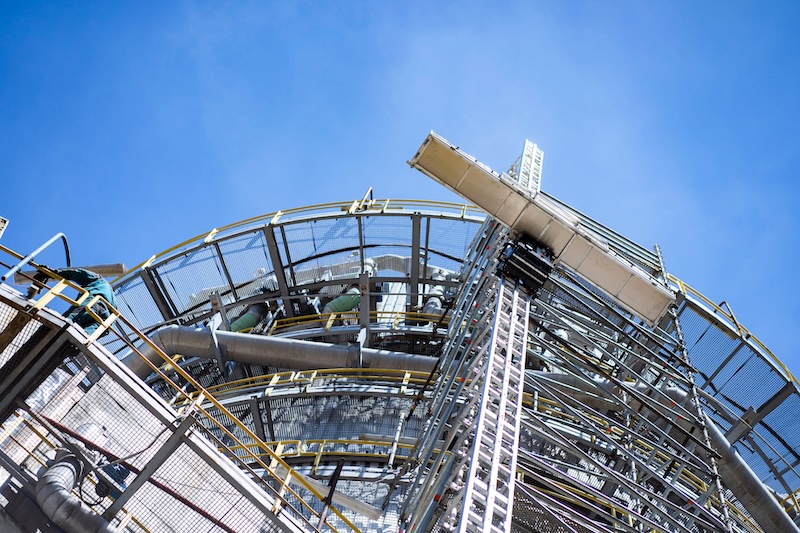
Oil/energy and chemical plants have been particularly successful Liftbot. The system, which was initially designed to lift materials vertically via construction site scaffolding, has adjusted well to its new vertical. A big piece of that is Kewazo’s data play, which keeps a tally of material flow, as it’s transported via the system.
“It's high information and so you can reach a lot of information without spending a lot of resources,” says Kuchukov. “In a similar way, when somebody feels unwell, they go to a doctor and the first thing the doctor does is they take in a blood test. By knowing the state of your blood, which is your transportation system, you know whether you need to do an MRI or not. So, the same way, if you can understand what the state of your material flow on your site, it gives you a lot of information about the state of your project.”
Despite the shift in focus, Kewazo retains existing construction clients. Kuchakov adds that the company’s recent $16 million raise gives it flexibility to explore and expand its verticals.
“We never abandoned construction,” he says. “We decided to channel our go-to-market resources more towards the industrial space because it's a really big market and we realized that you just cannot do it with approaching it not fully. We do have existing clients in commercial construction space. Clients still approach us and we work with them. It's just not something that they're actively pursuing.”
Kuchakov adds, “Short term, midterm, the industrial space is the big opportunity. But we never say ‘no’ to construction, it's just we are focused on being the go-to robotics player for heavy industry. Whenever big clients, need a solution in the robotics space, they can reach out to us, and we don't always have to provide the solution by ourselves. We can partner with others, we can white label solutions, we can acquire companies. But essentially [our goal is] to be their go-to provider in the robotics space.”
Association for Advancing Automation
Discover how Association for Advancing Automation can support your automation journey with their complete range of solutions and expertise.
Visit Company Website


