
Industry Insights
Hexagon Robotics Looks Beyond Grasping
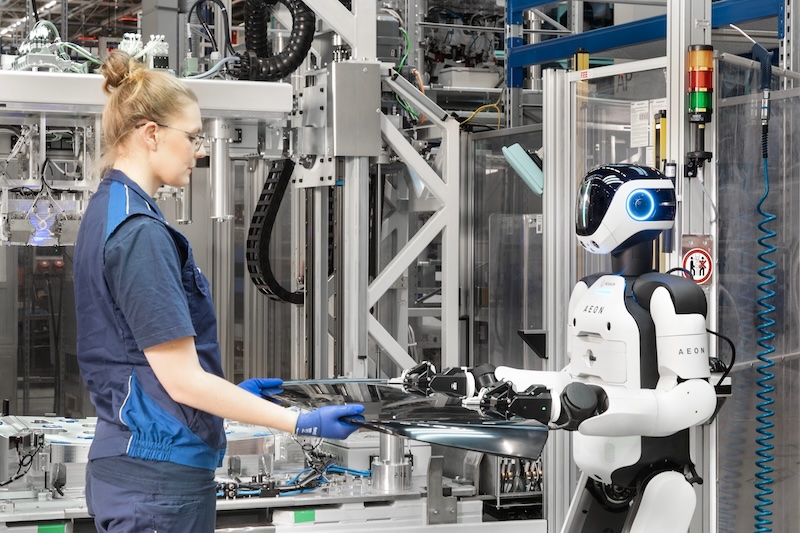
Hands are — at once — humanoid robots’ greatest asset and biggest challenge. They form the foundation of much of what we imagine these systems accomplishing, both at work and in the home. Mobile manipulation, however, is incredibly hard. For this reason, pilots have largely taken the form of baby steps — training and deploying systems to master one highly repeatable task with near-perfect accuracy.
“Most of our competitors are very, very focused on manipulation,” says Arnaud Robert. “It has different flavors. It can move boxes around, triage objects, etc. We felt it was a natural entry, but the humanoid only did that, it would be quite limiting over the long run.”
Boiled down to a single word, Hexagon’s approach to the form factor can be described as: “sensors.” In three, it would be: “lots of sensors.” Humanoid manufacturers have largely prided themselves on their speedy hardware iterations — a description that certainly applies to the swift launch of Aeon — but Hexagon is hoping to stuff its robot with some added future proofing.
“When you look at a more complicated task, as I mentioned, for scanning a door that might be 10 meters to 30 feet away for you, you need a lot of spatial intelligence,” says Robert. “But if a human actually crosses the path, what do you do? If there's a change in the position of the door, what do you do? And so on and so on. So when we look at all this, and again with the spirit of it has to be multi-purpose, we very quickly landed on, we need a pretty sophisticated suite of sensors if we want to be future proof from that perspective.”
There is tremendous opportunity in automating various manual labor jobs, from tote moving, on up. For Hexagon, however, “future proofing” means thinking about roles beyond material movement. Inspection is an immediate possibility for systems with sufficiently powerful sensors.
“When you look at what other things [a humanoid] could be doing, one of them is asset or part inspection,” says Robert. “The humanoid could do this because it can roam around a factory, find the part to inspect, and inspect it. It can do space inspection if you have, whether for safety, for security, or for other purposes. You can do reality capture, and you can do more sophisticated things where the humanoid effectively is doing a task that requires taking an object, going to a door, scanning the door in high resolution.”
It’s features like parts inspection that made Hexagon stand apart from its humanoid brethren when BMW went searching for some next-generation automation assistance. There is, certainly, something appealing in a robot that doesn’t simply transport parts, but rather inspects each for potential issues in the process.
“Following evaluation by our Centre of Competence for Physical AI in Production, tests were conducted in the laboratory and at Plant Leipzig at the end of last year,” the automaker’s head of process management and digitalization in production, Michael Ströbel, noted when the partnership was announced late last month. “This year, our focus is on step-by-step integration into our production system in order to explore a wide range of applications. The emphasis is on researching multifunctional use of the robot in various production areas such as battery manufacturing for energy modules and component production for exterior parts. With Hexagon's Robotics division, we have found a proven long-standing partner with a highly innovative approach to humanoid robotics for this project.”
The “a proven long-standing partner” refers, in part, to Hexagon AB’s long, deep history as an industrial tech conglomerate. The firm was founded just over half a century ago in Stockholm, making a name for itself with measuring and geospatial technologies. Its robotics history, meanwhile, is much more recent, stretching back just about a decade. Prior to the launch of the Hexagon Robotics sub-brand, the company developed inspection, space, and reality capture sensors for Boston Dynamics’ Spot systems.
“Our chairman had kind of the vision of, if we're providing all the sensors and intelligence to capture the environment and have some spatial intelligence around us, we should have our own carrier, which effectively meant a robot,” says Robert. “If you look at the last three years, we did a few iterations. I would say not all of them were pure humanoid shapes. It was more on the more traditional robotic side and evolved into humanoids. The very clear foresight that that form factor will play a critical role as a lot of industries, mostly traditional industries, automotive, aerospace, transportation, logistics, warehousing, we're moving more and more from automation to autonomy.”
Hexagon Robotics became its own division in 2025. Three months later, it announced Aeon, the wheel-legged humanoid that would form the foundation of its BMW and NVIDIA partnerships.
Association for Advancing Automation
Discover how Association for Advancing Automation can support your automation journey with their complete range of solutions and expertise.
Visit Company Website


Apptronik Plans to Debut Next Humanoid This Year
The new Apollo robot is set to break cover in 2025.
Humanoid Robots Are Evolving
Humanoid robots are still in their early stages, yet evolving fast.
DOBOT Showcases Multi-Form Embodied Intelligence at APEC PPSTI
DOBOT showcased humanoid robots, robot dogs, and collaborative robots at the APEC PPSTI exhibition in Guangzhou, highlighting real-world embodied intelligence