
Industry Insights
Docks of the Bay: With $110M in Fresh Funding, Skydio Eyes First Responder Growth
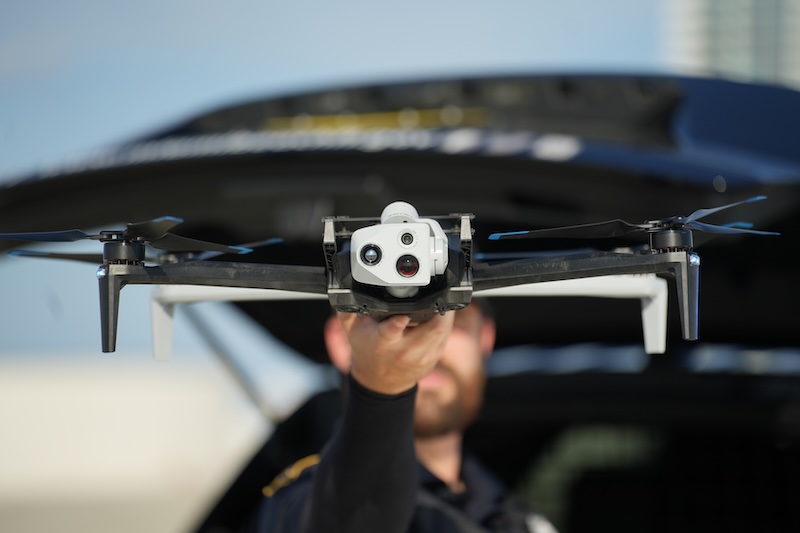
“A drone is really the ability to put a sensor anywhere you need it, anytime you need it, with no friction,” Alden Jones explains. The “no friction” bit is a tall order, certainly — such are the limitations of the physical world. Skydio’s head of product acknowledges as much, while pointing at on-going efforts to alleviate such pain points.
“Docks are remotely connected charging base station,” the VP adds. “Before docks, drones were still somewhat limited by the staff and the people that you had to drive them around. You essentially had little Uber drivers for robots, which was kind of crazy. Now that you can put them wherever you need them and then operate them remotely. We’ve seen an explosion in our ability to deliver value for customers.”
Value has disproportionately arrived by way of DFR — drone as first responder. The “force multiplier” is more or less what it sounds like, utilizing quadcopters as the first line of defense for emergency dispatches. An army of drones sit on these docks, charging 24/7. You dial 911, and the drone dispatches to your location within seconds, piloted by a remote operator — well before fire, EMTs, or police can make their way to the scene.
Skydio puts drone launch times at under 20 seconds and arrival times at less than 90 seconds in urban environments. Remote operators are capable of managing several drones simultaneously, as applications like Pathfinder and NightSense help the systems navigate to their destination without incident. Jones says around 16 million Americans currently live within two miles of a Skydio dock, “And by the end of that this year, we think that that number is going to substantially grow.”
The Bay Area-based drone maker is firmly in growth mode. Last week it announced a $110 million Series F, a figure CEO Adam Bry called notable for, “how little we are raising.” How’s that for a humble brag on a $4.4 billion valuation? Point being, the mere nine-figure funding round was a reflection of a company already in a revenue generating position.
A good chunk of funding will go toward increasing manufacturing capacity. Domestic manufacturing is as big a piece of Skydio’s story, as the company has syphoned off substantial business from American public and private bodies forced to part ways with DJI. Concurrent to its latest funding round, the company announced a $3.5 billion commitment to expand U.S. manufacturing over the next five years. Jones notes, however, that the decision to build here is more than strictly geopolitical.
“We take pride in the fact that we control and we build the entire stack, from the hardware design all the way up and into the software that people are using, to experience or fly the products,” he says. “When we want to make an adjustment to something to get a better outcome for our customers, it's very helpful to be able to make a tweak across the entire chain. We feel very strongly that it's important to have the ability to very quickly respond to our customers' needs.”
Skydio’s figures have suggested the company will create 3,000 additional in the U.S. supply chain. Jones adds that automation will also, no doubt, play a role in bringing that manufacturing up to speed. The company is currently targeting an assembly time of under one-hour for its R10 quadcopter drone — a goal Jones says the company is “within a couple minutes” of reaching.
Association for Advancing Automation
Discover how Association for Advancing Automation can support your automation journey with their complete range of solutions and expertise.
Visit Company Website


