
Industry Insights
A Guide to the Light Spectrum in Machine Vision
 Have you ever pointed a TV remote at your phone's camera and seen a little purple light flash on the screen as you press a button?
Try it. That flash, invisible to your eye but visible to the camera, is your first hint that a hidden world of light exists all around us. Our eyes are incredible, but they're tuned to only a tiny fraction of what's out there. In automation, being limited to human vision is akin to trying to listen to an orchestra while only being able to hear the violins.
This guide is your ticket to hearing the whole orchestra. We're embarking on a journey across the entire light spectrum and the full range of light that machine vision can utilize. Whether you're a student just starting or an industry veteran seeking a new solution, my goal is to provide you with a practical and intuitive understanding of these powerful technologies.
The truth is, this topic is complex. Both industry experts and end-users often struggle to comprehend the vast array of imaging solutions available. However, understanding this spectrum is key to solving the most complex automation challenges. Let's pull back the curtain and learn to see the invisible.
The Electromagnetic Spectrum
Think of the light spectrum like a massive piano keyboard. The small section of white keys in the middle is the visible light we see every day. But stretching out in both directions are countless other keys and other frequencies of light that produce a different "note." Machine vision enables us to play these keys.
We measure these wavelengths in nanometers (nm) and micrometers (µm). The specific wavelength we use determines what we can see, as some materials reflect one type of light while absorbing another.
However, before you can even think about special wavelengths, you must master the fundamentals. As Steve Kinney, director of training, compliance and technical solutions at Smart Vision Lights, emphasizes, lighting is fundamentally about geometry, placement, and type first. "The same object can be viewed six different ways depending on the lighting," Kinney explains. A common mistake he sees is engineers coming to a lighting expert with "locked parameters", like camera position or lens choice, which severely limits the possible solutions.
Once the fundamentals of geometry and placement are set, then wavelength comes into play. Kinney frames this along two axes: color theory (utilizing color to create contrast) and special properties (such as fluorescence or penetration).
A machine vision system is simply a camera and a light source tuned to the right "note" to make a feature of interest stand out.
Here's a quick cheat sheet for our journey:
| Abbreviation | Full Name | Wavelength Range (nm) |
|---|---|---|
| UV | Ultra Violet | 190-380 nm |
| VIS | Visible Spectrum | 380-780 nm |
| VNIR | Very Near Infrared | 780-1000 nm |
| NIR / SWIR | Short-wave Infrared | 950-2500 nm |
| MWIR | Mid-wave Infrared | 2000-5000 nm |
| LWIR | Long-wave Infrared | 8000-15000 nm |
Visible Light (VIS) & The Rules of 2D
This is the world we know, and it is the workhorse of machine vision, used in over 90% of applications. It's versatile, affordable, and ideal for inspecting aspects such as color, print quality, and fundamental surface flaws.
However, this is also where the most common and critical pitfalls occur. As a "vision doctor," Lars Fermum notes that 2D vision is entirely based on creating contrast by inspecting the reflectance of light off a surface. This process is complex, as it depends on the object's surface properties, the distribution of light, and the angles between the light, object, and camera. To even register a feature, Fermum explains, you typically need a minimum contrast difference of 15-20% and a minimum size of two to four pixels to overcome system noise and blur.
The biggest mistake is failing to control the light. Kinney points out that many users rely on ambient factory lighting, which is a recipe for failure. Why? Because those lights often "blink at 60 hertz," causing the image intensity to vary from shot to shot and making reliable inspection impossible. The solution is to use bandpass filters, which block all ambient light and allow only the specific wavelength from your controlled light source to reach the sensor.
An even more critical error, Fermum warns, is oversaturation. It may seem tempting to blast a part with light to get a bright image, but this "destroys analog curves and gray tones." When you oversaturate, all your data points reach maximum white, and the mathematical models that rely on subtle gray-level changes (derivatives) to detect scratches, dents, or edges fail to function correctly. This can also lead to "blooming," where the signal from oversaturated pixels drains into neighboring pixels, corrupting the image.
Light direction and area are just as crucial. Fermum uses the example of inspecting "hex nuts on a tray". A small ring light might illuminate the nuts in the center perfectly, but the nuts at the edges will reflect the light away from the camera, appearing dark. The solution is often a significant, diffuse light source, such as a dome light, which provides uniform illumination from all angles.
This is also where 2D hits its limit. When measuring 3D objects, Fermum explains, a standard 2D lens creates changing magnifications at different working distances; an object farther away looks smaller. While a telecentric lens can mitigate this for X and Y measurements, it still can't tell you the height. For tilted objects or parts with significant height variations, 2D fails. This is precisely why 3D sensing was developed: to capture all six degrees of freedom (X, Y, Z, plus rotation and tilt), which is impossible with 2D alone.
Ultraviolet (UV) Imaging
Just past the violet edge of our vision lies UV light. Its superpower is fluorescence. Certain materials absorb UV energy and instantly re-emit it as visible light, causing them to glow, much like a blacklight poster.
In automation, we employ this technique to uncover hidden clues. Kinney points to typical applications, such as detecting materials like grease or epoxies. A tiny, invisible drop of UV-fluorescent glue can confirm a part is sealed, invisible ink on a pharmaceutical label can verify its authenticity, or a faint crack on a metal part, filled with a fluorescent penetrant, can be made to shine brilliantly. UV vision reveals things that are designed to be hidden or are simply too subtle to see otherwise.
This technology, however, isn't a simple plug-and-play solution. Fermum explains that UV presents a unique hardware challenge: "standard glass is a block." This means systems require special lenses and sensor protection glass made from fused silica or quartz glass. These materials are difficult to polish and are produced in low volumes, making a single UV lens easily cost $2,000 or more. The good news is that sensor manufacturers, such as Sony, are now developing UV sensors that are "pin compatible" with their standard CMOS sensors, making it easier for camera manufacturers to integrate this technology.

Short-Wave Infrared (SWIR) Imaging
If UV is a detective, SWIR is a material whisperer. It's crucial to understand that SWIR does not see heat; it sees reflected light, just like our eyes do. The result is a surprisingly intuitive, high-contrast image that resembles a high-quality black-and-white photograph.
But what it reveals is astonishing. SWIR's secret lies in its interaction with molecules, particularly water. Water absorbs SWIR light, making it appear very dark. This simple property unlocks a vast range of applications:
- Agriculture: A SWIR camera can instantly spot a bruise on an apple (which is mostly water) long before it's visible.
- Packaging: It can penetrate through opaque plastic packaging to check the fill level inside.
- Electronics: It can even see through solid silicon wafers to find defects deep inside a microchip.
- Sorting: It can tell the difference between sugar, salt, and sand based on their unique molecular signatures. Fermum adds that it can even identify pure black carbon pigment, distinguishing it from black pigments made of color mixtures.
This technology, once exotic, is becoming more accessible. Fermum notes that new InGaAs sensors from companies now offer high resolution (up to 5 megapixels) and high quantum efficiency up to 1,700 nm. Notably, these new sensors can operate without the active Peltier (PT) cooling that older systems required, thereby lowering costs and complexity.
MWIR & LWIR Thermal Imaging
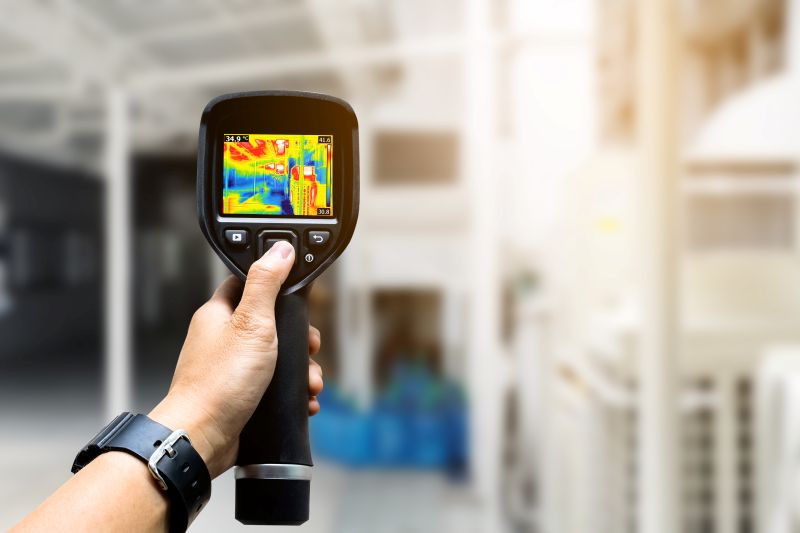
Here, we take a completely different turn. With thermal imaging, we stop looking at reflected light and start looking at emitted energy. Every object above absolute zero radiates heat, and thermal cameras create a picture of that heat, called a thermogram.
Long-Wave Infrared (LWIR)
LWIR is the most common thermal band, perfectly tuned to see temperatures in our everyday world. It's used for everything from detecting a fever in a crowd to locating an overloaded circuit breaker that's becoming dangerously warm.
Most of these cameras use microbolometer sensors that work like tiny resistors. According to Fermum, that "clicking" sound you hear from older thermal cameras is the mechanical shutter intermittently closing to cool and refresh the sensor, preventing it from "drifting".
However, there's a significant challenge: these cameras employ passive thermography, which means they measure reflected heat rather than absolute temperature. The detected temperature is entirely dependent on the material's heat reflectance constant. To obtain an accurate, calibrated measurement, Fermum recommends using a simple trick: "Use a special scotch tape" with a known reflectance value, place it on the object, and measure the temperature of the tape.\
Mid-Wave Infrared (MWIR)
MWIR is sensitive to a much hotter range of temperatures, making it the tool of choice for monitoring industrial furnaces or spotting gas leaks (where the gas itself creates a cool spot against a warmer background).
This is a highly specialized and expensive field of study. Fermum describes these cameras as "military stuff," often costing upwards of $100,000. The challenge lies in the exotic sensor materials, like indium antimonide or mercury cadmium telluride. These sensors require extreme deep temperature cooling (down to 150 Kelvin) for the Focal Plane Array (FPA) to operate. These cooling engines, such as Sterling motors, have a poor Mean Time Between Failures (MTBF) of only 20,000 hours, making them very expensive to operate and maintain.
A more advanced application for thermal imaging is Active Thermography. As Fermum explains, instead of just observing heat, you "stimulate an object with energy," like a heat flash, and watch the heat move. If there's a crack or flaw, it stops the heat transfer, making the area behind it cooler. This is incredibly effective, but for materials that transfer heat quickly, like metal, you need very high-speed cameras (up to 1,000 fps) to capture the event. This high-speed capability is also why these cameras are often subject to "dual-use" export controls; a 1,000 Hz camera can track a missile, while a standard 8 Hz camera cannot.
AI and the Multispectral Future
Multispectral and hyperspectral systems are emerging that capture images across multiple wavelengths simultaneously, creating a rich, layered dataset for every pixel. Fermum defines the difference: RGB has three channels, multispectral might have 12, but hyperspectral has 100+ channels.
This technology essentially performs spectroscopy on every pixel. As Fermum explains, a hyperspectral system utilizes a 2D imager where the X-direction provides spatial resolution (similar to a line-scan camera). At the same time, the Y-direction of the sensor captures the full spectrum of absorbance for each pixel.
This unlocks applications that are pure science fiction. As Kinney explains, you could use NIR to spot a bruise on a peach, but a hyperspectral system using multiple narrow bands could determine its sugar or moisture content. Fermum echoes this, noting it can be used for waste recycling (distinguishing polypropylene from polyethylene) or measuring the sugar concentration in a single potato or cherry.
Imagine inspecting a sterile medical device. A single system could utilize visible light to verify the label, UV to confirm a sterile seal, and SWIR to ensure the plastic has the correct chemical composition. This is no longer just an image; it's a complete digital fingerprint.
Of course, this creates a "tidal wave of data". The key to making sense of it all is artificial intelligence. AI algorithms can learn the subtle patterns and correlations across this "symphony of data" with a slight temperature change here or a tiny moisture anomaly there, making predictions that were impossible just a few years ago.
The journey across the light spectrum is just beginning. As these amazing technologies become more powerful and less expensive, they will continue to transform what's possible in automation. The next time you face an impossible inspection challenge, remember the TV remote and ask yourself a simple question: "What if I could see the problem instead of just looking for it?"
The answer might be waiting just beyond the visible light spectrum.
See the Future of Machine Vision in Action
Join industry leaders and tech innovators to explore the latest in machine vision, computer vision, and AI-driven automation at A3's Advanced Vision & AI Conference in Santa Clara, California from September 23-24, 2026. Learn more.

Association for Advancing Automation
Discover how Association for Advancing Automation can support your automation journey with their complete range of solutions and expertise.
Visit Company Website


Bin picking of casting discs
The automation of the production process of brake discs helped increase productivity and reduce the challenging nature of manually picking the brake discs
IoT Solution Enables Thermal Imaging for Early Fire Detection Applications
The new cloud application provides real-time situational awareness to facility operators, employees, and first responders. The IoT solution alerts users
Automated inspection of large objects in motion
This virtual case study looks at how colorful & high-quality 3D point clouds of large objects in motion can be used for the advanced inspection of large object