
News
What Manufacturers Need to Know Before Investing in Custom Automation
A Machine Buyer's Guide
By Steven Douglas Corp. | Exhibiting at Automate 2026 — Booth 26011
Custom automation machines are increasingly the foundation of modern manufacturing operations — particularly in electrical, automotive, medical device, and consumer manufacturing. But before approving a capital budget or requesting a quote, manufacturers need to understand what custom automation really involves: financially, technically, and strategically.
Check out the Full Buyer's Guide on Steven Douglas Corp.'s website.
What Is a Custom Automation Machine?
A custom automation machine is a purpose-built industrial system engineered around a specific process, product geometry, and production target — not a generalized application.
Unlike standard off-the-shelf equipment, custom automation systems are designed from the ground up to meet exact cycle times, tolerance requirements, quality standards, and integration constraints. They're built for real-world manufacturing conditions: part inconsistencies, high-volume output, robotic integration, AI-powered inspection, and future scalability.
When Does It Make Financial Sense?
The most common drivers behind custom automation investment include:
- Labor shortages or high turnover
- Inconsistent manual quality
- Safety risk exposure
- Cycle time bottlenecks
- High scrap or rework rates
A practical ROI framework considers labor exposure, throughput gains, and scrap reduction together. A process that runs at 20 seconds per unit manually and 12 seconds automated represents a 40% output increase — often enough to eliminate bottlenecks, defer capital spending elsewhere, or free capacity for growth. Defect rate reductions from 4–5% down to under 1% can compound quickly in precision-driven industries.
Typical payback timelines range from 16 weeks for semi-automated cells to 52+ weeks for fully integrated systems, but ROI is only part of the picture. For many manufacturers, the greater value is stability — knowing the most critical process will perform tomorrow exactly the way it performed today.
What Does It Cost?
Custom automation systems reflect the engineering required to make them reliable and scalable. Realistic investment ranges:
- Semi-automated station: $150,000 – $350,000+
- Single-station system: $200,000 – $600,000+
- Multi-station machine: $500,000 – $1.5 million+
- Fully integrated line: $1M – $5 million+
Two machines that look similar on paper can vary 2–3x in cost based on engineering depth, controls architecture, safety design, and long-term support structure. Choosing based on lowest upfront price is one of the most common — and costly — mistakes manufacturers make.
Why Projects Fail (And How to Avoid It)
Most custom automation projects don't fail because the technology doesn't work. They fail because fundamentals were missed early. The most common causes:
Poorly defined requirements. If throughput targets, quality metrics, and product variation aren't clearly established before engineering begins, the machine builder is forced to make assumptions — and those assumptions become change orders.
ROI Calculator

Discover the potential cost savings of robotic automation over a 20-year system life
This calculator compares your current manual labor costs against the total cost of owning and operating a robotic system over its 20-year lifespan.
Underestimating real-world variability. Parts vary. Materials fluctuate. Systems engineered only for ideal conditions degrade once production starts.
Selecting on price alone. The lowest proposal frequently becomes the most expensive over time through downtime, limited scalability, and expensive retrofits.
No internal ownership post-install. Even a well-built system underperforms without defined accountability for monitoring, maintenance, and continuous improvement.
Robotics Integration vs. Fixed Automation: The Right Question
The better question isn't "should we use robotics?" — it's "what architecture gives us the best combination of throughput, flexibility, reliability, and ROI?"
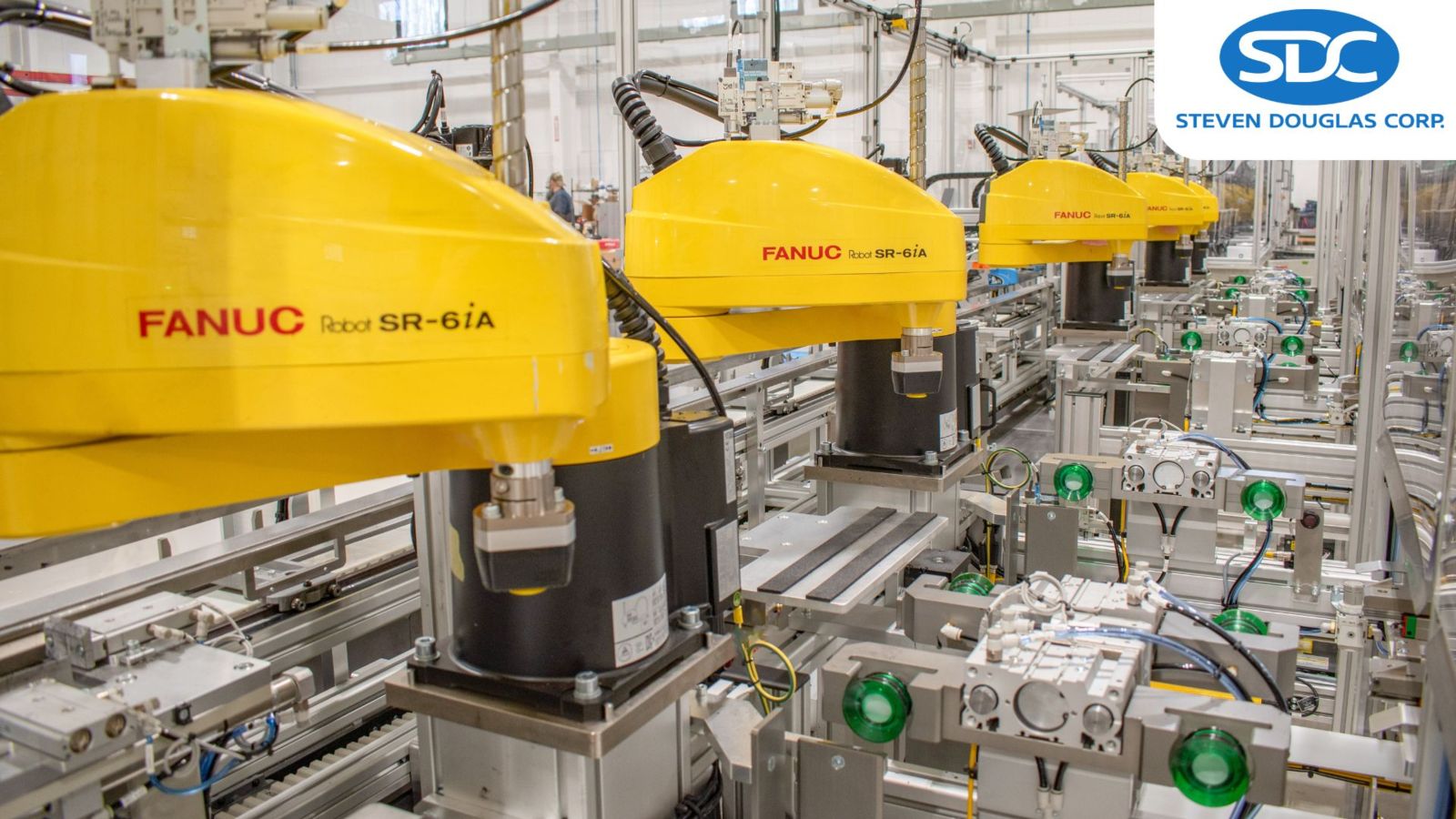
Robotics excel in high-mix, low-volume environments where changeovers are frequent and product geometry may evolve. Fixed automation delivers superior speed and cost efficiency in high-volume, stable processes. Most advanced systems combine both — robotics for material handling, fixed automation for precision assembly, AI-powered inspection for quality validation.
The right partner won't default to one approach because it's familiar. They'll challenge assumptions and recommend what actually fits your manufacturing environment.
Where AI Actually Adds Value
AI in manufacturing is real — but it's also overhyped in the wrong contexts.
In custom automation, AI delivers measurable value in three areas:
- Inspection — Machine learning models reduce false rejects and improve defect detection in high-mix or visually complex environments where rule-based vision systems struggle.
- Predictive maintenance — Analyzing vibration, motor loads, and cycle time anomalies before they become unplanned downtime.
- Process optimization — Identifying micro-stoppages and efficiency drift across high-volume production data.
AI should enhance automation — not complicate it. A competent machine builder should also be willing to tell you when AI is unnecessary.
The Bottom Line
Custom automation machines are long-term investments in production stability, quality consistency, and scalable growth. The technology — robotics, AI-powered inspection, smart factory integration — only delivers results when it's layered onto disciplined engineering, structured project management, and a partnership focused on long-term performance.
Manufacturing isn't theoretical. It's measurable, operational, and demanding. Your automation system should be built the same way.
Steven Douglas Corp. (SDC) is a custom automated machine builder serving electrical, automotive, medical device, consumer manufacturing industries, and more. Visit us at Automate 2026 in booth 26011 to discuss your automation challenges. Set up a discovery meeting by reaching out to [email protected]
Learn more at sdcautomation.com
Steven Douglas Corp.
Engineers. Builders. Problem-solvers. SDC has designed, engineered, and built custom automated machines since 1998 — concept through commissioning. We serve manufacturers in automotive, life sciences, electronics, consumer products, and more.
Discover how Steven Douglas Corp. can support your automation journey with their complete range of solutions and expertise.
Visit Company Website


Engineers. Builders. Problem-solvers. SDC has designed, engineered, and built custom automated machines since 1998 — concept through commissioning. We serve manufacturers in automotive, life sciences, electronics, consumer products, and more.
Switch Assembly Automation: A Hybrid Solution
Our long-time customer in global industrial technology needed a new semi-automated machine for their U.S. facility.
FANUC Awards ARC Specialties it's Innovative System of the Year Award
ARC Specialties was voted the winner at FANUC's annual Authorized System Integrator Conference held in Carlsbad, CA