
News
ABB Robotics and PSYONIC use human-generated data to advance robotic dexterity
- ABB Robotics and PSYONIC collaborate to revolutionize grasping and dexterity, a core capability for Autonomous Versatile Robotics (AVR™)
- ABB GoFa™ helps test PSYONIC’s Ability Hand for robotics, combining touch sensing, compliant design and human-derived training data
- Dexterity remains a major challenge for industry; improved handling can reduce engineering time by up to 30%¹
ABB Robotics is collaborating with California bionics company, PSYONIC, to advance robotic gripping and dexterity using a new approach that utilizes real-world manipulation data from human prosthetic use. By combining the PSYONIC Ability Hand with an ABB GoFa™ cobot, the collaboration will explore how touch and motion data generated by human prosthetic use can be used to train robots to perform delicate, variable tasks that have traditionally been difficult to automate.
“Human dexterity and the instinctive understanding of how to handle different objects is one of the most difficult things to replicate in industrial-grade robotics, but it’s a fundamental need for truly autonomous and versatile robots,” said Marc Segura, President, ABB Robotics. “As we develop the next generation physical AI, robots will learn and understand the world as we do. This collaboration with PSYONIC will help to close the long-standing gap between human and robot dexterity, opening up new possibilities for a wide range of industries.”
Grasping and dexterity are central to Autonomous Versatile Robotics (AVR™) – ABB Robotic’s vision for robots that can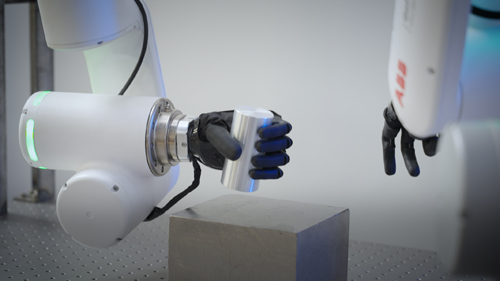 sense, reason, move and handle objects with precision in dynamic environments. They are also critical to advancing physical AI in industry: robotic systems that can learn from real-world interaction and apply that intelligence with industrial-grade reliability. The collaboration will explore new applications across numerous industries, including automotive, aerospace, packaging and logistics, and life sciences. By enabling robots to take on tasks that are repetitive, ergonomically challenging or difficult to perform consistently at scale, ABB Robotics and PSYONIC can help people and robots to work together more effectively, while improving productivity, flexibility and workplace safety.
PSYONIC is working closely with ABB Robotics’ R&D team on integration and development, exploring how touch-enabled manipulation can support next-generation autonomous robotics applications.
Revolutionizing robotic dexterity with human-generated data
Originally developed for prosthetic use, the PSYONIC Ability Hand combines myoelectric control, touch sensing and compliant mechanics in a lightweight, multi-articulating design. Its pressure sensors and vibration feedback system enable users to detect contact, grip force and release, while flexible fingers conform naturally to irregular and deformable objects.
ROI Calculator

Discover the potential cost savings of robotic automation over a 20-year system life
This calculator compares your current manual labor costs against the total cost of owning and operating a robotic system over its 20-year lifespan.
“Dexterous manipulation is ultimately a data challenge as much as a hardware challenge,” said Dr. Aadeel Akhtar, Founder and CEO of PSYONIC. “By using the same Ability Hand on people and on robots, we can capture high-fidelity real-world data on movement, contact and grip force, then use that to train robotic systems more effectively. Integrating with ABB Robotics’ robotics platform allows us to expand into more environments and unlock the level of dexterity needed to take on the hardest challenges in automation.”
To support this work, ABB Roboti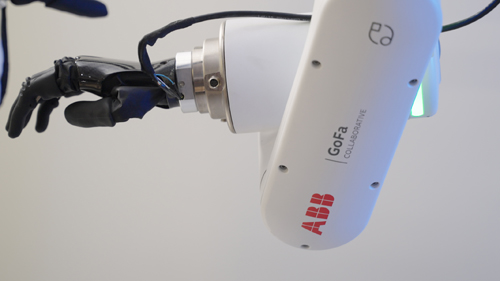 cs’ GoFa provides the accuracy and repeatability required for industrial-grade deployment, ensuring that subtle variations in grip force, finger positioning and movement can be consistently executed and evaluated. This level of precision is critical for translating human-derived manipulation data into reliable robotic performance across complex, variable tasks.
The collaboration will evaluate how this combined capability can be applied across industrial use cases where traditional gripping technologies struggle with variability, fragility or complexity – such as handling irregular or delicate objects. According to the International Federation of Robotics (IFR), advanced gripping and digital integration can reduce engineering time by up to 30%, underlining the importance of end-of-arm tooling in accelerating deployment and improving automation ROI.1
It also reflects ABB Robotics’ broader strategic approach of working with partners across its ecosystem to overcome long-standing barriers to automation. By combining robotics, AI and real-world manipulation data generated through human prosthetic use, ABB Robotics is advancing physical AI and enabling more capable, adaptable robots to operate reliably in real-world environments.
1International Federation of Robotics https://ifr.org/news/gripping-systems/

ABB Inc.
ABB Robotics & Discrete Automation is a pioneer in robotics, machine automation and digital services, providing innovative solutions for a diverse range of industries, from automotive to electronics to logistics.
Discover how ABB Inc. can support your automation journey with their complete range of solutions and expertise.
Visit Company Website
ABB Robotics & Discrete Automation is a pioneer in robotics, machine automation and digital services, providing innovative solutions for a diverse range of industries, from automotive to electronics to logistics.
Automated Adhesive Application Cell with ABB Robotics and Virtual Commissioning
A global automotive OEM implemented an automated adhesive application cell utilizing ABB robotics, Siemens controls, industrial vision systems, and virtual commissioning to improve process consistency and quality verification.
ABB to showcase next generation robotic technologies at Automate 2023
ABB Robotics will feature next generation robotic technologies that enable businesses to efficiently adapt production to variable market demands
ABB to highlight latest collaborative robotic metal fab technologies at FABTECH 2023
ABB Robotics will highlight next generation collaborative robotic technologies that enable metal fabricators to efficiently weld and cut parts