
Industry Insights
Why This Robotics Pioneer is Sticking With Academia
Budget at least an hour and a half to drive northwest from Boston to Lowell. Depending on time of day, it could take significantly longer. Beantown was recently named the fourth worst U.S. city for traffic, thanks in large part to I-93, the road that will take you halfway to your destination. Lowell has a long history as a manufacturing town, establishing itself as a textile hub in the 19th century. By 1940, it had become the nation’s chief producer of Jack Kerouac.
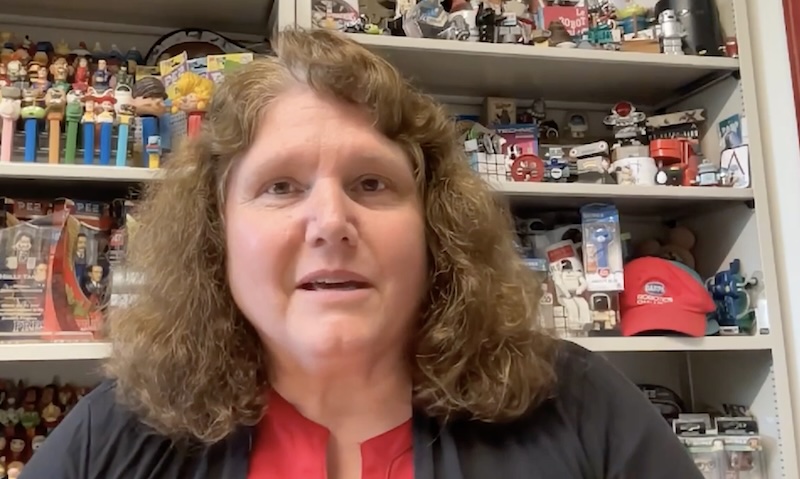
Holly Yanco resided in the city for the past quarter-century, as a particularly notable computer science professor at UMass Lowell. A leading researcher in human-robot interaction (HRI), she has also done important work in the fields of assistive and search and rescue technologies. For more than a decade, Yanco has led the New England Robotics Validation and Experimentation (NERVE) Center. She founded that university research lab, along with an enviable personal collection of Pez candy dispensers.
The latter formed the backdrop for our conversation, when we caught up with the professor earlier this year. Yanco was preparing to become Lowell’s latest export, another 90-minute road trip further west to Amherst. It’s a college town in its own right, as home to Amherst College, Hampshire College, and UMass Amherst, the “little Ivy” where Yanco now serves as Distinguished Professor, Mechanical and Industrial Engineering and Distinguished Professor, Manning College of Information & Computer Sciences.
“They asked if I would come out and help them grow their robotics program,” Yanco said during our conversation. “And so that was a pretty exciting opportunity to do something new.” Along with the move come plans to expand the NERVE center to a second location. With new scenery comes opportunity for new focus. The flagship school of the UMass system, Amherst was founded in the mid-19th century, as part of a federal government land grant focused on "agricultural, mechanical, and military arts” education.
ROI Calculator

Discover the potential cost savings of robotic automation over a 20-year system life
This calculator compares your current manual labor costs against the total cost of owning and operating a robotic system over its 20-year lifespan.
In keeping with the former, it was known as the Massachusetts Agricultural College for roughly 70 years. Along with technology, agriculture remains one of the school’s key focuses. The cross section presents opportunity for Yanco and the school’s growing robotics department to expand into a key vertical.
“In Lowell, we've been testing exoskeletons, search and rescue robots, a lot of robot manipulation and a few other things,” said Yanco. “But what I'm interested in picking up when we go to Amherst being a land grant school is thinking about agricultural robots, particularly kind of small family farms.”
Yanco envisions the department assisting in robotics adoption among smaller family farms — a contrast to the larger industrial versions that populate much of the American Midwest. She envisions the department further expanding into additional categories, including submersibles, taking full advantage of the Gloucester Marine Station that UMass Amherst maintains in the southern Gulf of Maine. She cites HRI as a throughline connecting these seemingly disparate facets of her research.
“I think that all the things that we do to make robots better also improve how [they] interact with people,” Yanco noted. “It may not be the primary interaction that we're thinking they'll work with it, but there'll be bystanders to it. Everything that we do to make a robot more understandable to work better is HRI.”
The ability to focus on myriad different modalities is a large piece of what keeps Yanco in academics, rather than adopting the startup route like countless high-profile professors before her.
“For me, the exciting part about academic is the ability to do lots of different things, as opposed to really putting everything down on one thing,” Yanco said. “I've certainly had students go and work in a lot of different companies. I think stuff in the lab does spin out -- at least the ideas do. But there hasn't been something where I've been like, ‘yes, I have to go and start a company with this.’ I haven't found it yet.”
Association for Advancing Automation
Discover how Association for Advancing Automation can support your automation journey with their complete range of solutions and expertise.
Visit Company Website


