
Industry Insights
Weave Robotics Eyes 2025 Delivery Date For Version One Of Its Home Humanoid, Isaac
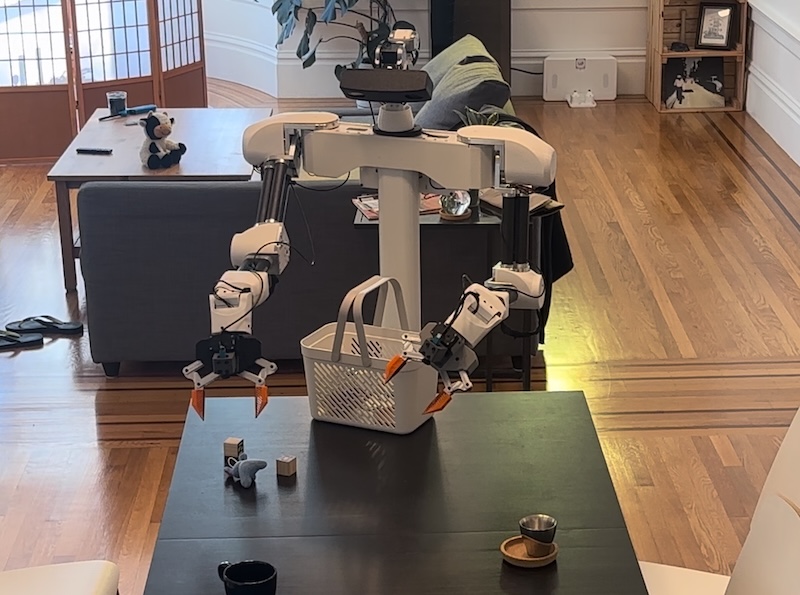
There’s an oft quoted (if questionably attributed) adage that goes, "The best time to plant a tree was 20 years ago. The second-best time is now.” The guy who sold me my house tweaked it to be about real estate, and I regularly hear something similar relayed about startup investments. It’s the sort of sentiment you can feel in your bones.
In technology, however, sometimes the inverse is true. Sometimes the best time to build a product is perpetually five to 10 years from now.
Few products illustrate this as well as the home robot. The category's bumpy history is lousy with well-funded corporations and well-intentioned startups who have struck out swinging for the fences. Still, everyone seems to agree that we’ll get there eventually – just give it five to 10 years.
“We’re making personal robots for the home,” Weave Robotics cofounder and CEO, Kaan Dogrusoz, wastes no time getting to the heart of the matter. “Not five to 10 years from now, but now. We’re focusing on robots that fold your laundry, tidy up around the house, and basically save you time.”

For decades now, consumer ROI has been the biggest question mark looming over the category. Again, most everyone seems to agree the public wants robots in the home, but no one has been able to figure out that golden ratio between features and cost. The robot vacuum is the perpetual counterexample, but 20 years on, even it has failed to kickstart a revolution.
What Roomba and its descendants have proven is that consumers are – largely speaking – ready for robots. Robots, on the other hand, haven’t been ready for consumers. Too many big swings have amounted to high priced and technically impressive devices that are little more than glorified Amazon Echoes.
Much of smart speakers’ success can be chalked up to big corporations like Amazon and Google treating the products as loss leaders. When, on the other hand, Amazon began selling Astro for the equivalent of 30 Echo Dots, consumers – understandably – demanded more of the product. Apple will face a similarly uphill battle if/when it announces its own robot.

For its part, Weave was founded the thesis that – after decades of being five to 10 years out – consumer robots are finally about to have their moment. Dogrusoz is a CMU grad, who worked on Apple’s iPhone team. From there, he made the jump to the company’s nascent AI division, where he worked alongside his future cofounder, Evan Wineland. Weave began life almost exactly one year ago, as a member of Y-Combinator’s Summer 2024 batch. The startup’s YC profile boldly sports the subhed, “Personal robots for the home -- that ship in 2025.”
The company’s first product is a wheeled humanoid named Isaac – a name it notably shares with NVIDIA’s near ubiquitous robotics platform. Dogrusoz tells me that around 30 people have ordered an Isaac unit, each of which Weave hopes to deliver before year’s end.

Given the company’s young age and a headcount of around one dozen, it’s unsurprising that 2025 Isaac is still in its early stages -- particularly given the fact that the company opted to build significant chunks of its robotics stack in house. Field data collected from early adopters’ homes will be used to continually improve the robot. Dogrusoz adds that the company expects to build hundreds of units in 2026.
“You want a robot in your home to be be able to manipulate household objects, while being able to navigate well” he explains. “That’s the main thing. We really wanted to focus on that portion, getting that done right, safely, and delightfully such that our first [commercial] product can really deliver on customers’ expectations.
Association for Advancing Automation
Discover how Association for Advancing Automation can support your automation journey with their complete range of solutions and expertise.
Visit Company Website


Boston Dynamics' Atlas Lead Talks Prototype to Product
Atlas General Manager Zack Jackowski discusses the company's latest commercial offering.
Humanoid Pioneer Aldebaran to Auction Off Assets Next Month
The Nao/Pepper maker is selling off assets as it enters liquidation.
DOBOT Showcases Multi-Form Embodied Intelligence at APEC PPSTI
DOBOT showcased humanoid robots, robot dogs, and collaborative robots at the APEC PPSTI exhibition in Guangzhou, highlighting real-world embodied intelligence