
Industry Insights
Walden Robotics Touts People Centric Physical AI
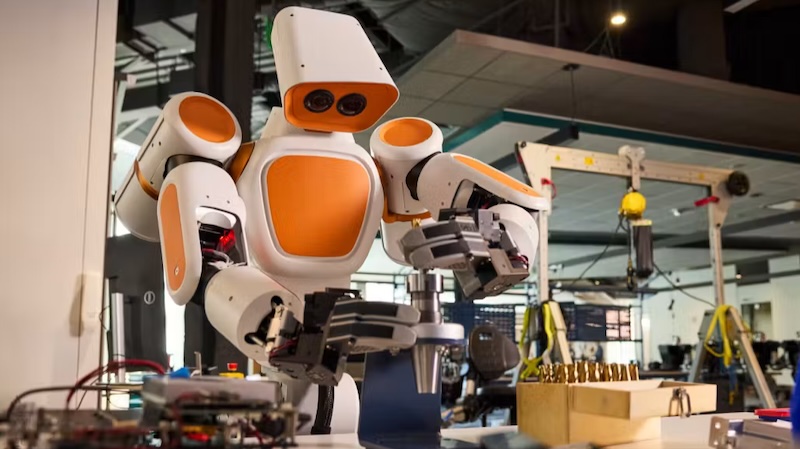
Midway through our discussion, Dave Johnson points me to apress quote from Gill Pratt.
I’m pretty sure this is the one he means, “Walden is where a groundbreaking set of inventions by the team at TRI will now be applied to address real-world needs. Walden stands out for both the groundbreaking technology they’re building and the team’s ability to translate pioneering research into real-world deployment.”
I don’t think I’m bursting anyone’s illusions here when I say that press quotes like these aren’t some last-minute, off-the-cuff addition. In fact, here’s a dirty little secret: the specifics of such quotes tend to be subject of the most intense scrutiny, and often the cause of delays in press release launches.
I’m not telling you this based on any particular quote or press release. If anything, Pratt is among the most forthcoming and on-point people I’ve spoken to in this industry. I say it because it’s a two-sentence quote that uses the phrase “real-world” twice. The first instance is “real-world needs,” the second “real-world deployment.”
This gets at the theme that reoccurred when Johnson and I spoke shortly after Walden emerged out of stealth with $300 million in funding at a $1.1 billion valuation.
“What we do in our office versus what we do at the customer site looks the same,” says Johnson. “We really think about that from the perspective of having built the company with this idea that we should be able to go to the customer site very quickly and easily. That there is a big difference between being in the lab and doing these demonstrations.”
Walden has had plenty of lab time, of course. The startup is a spinout of work researcher Russ Tedrake’s team pioneered with large behavior models (LBMs) at the Pratt-headed Toyota Research Institute.
Johnson adds that a driving piece of the company’s philosophy is limiting friction for both deployment and reskilling.
“Traditionally people have thought about robots very, very differently,” he says. “When we started Walden, our whole mission was: we must get this out in the world, and we must be able to make it easy to deploy to customers. And then to make it easy to retask and change things. That’s why we’ve taken the approach that we must make the autonomy perfect in the lab. Because that's not what the customer needs. The customer needs useful work. And if we need something from the remote assistant, that's okay. And then that will allow the system to improve.”

Get the Training You Need for a Safer Workplace!
Autonomous mobile robots are one of the fastest-growing segments of the robotics industry. During this live virtual training, you'll be introduced to safety protocols and best practices for working with mobile robots in industrial settings.
Learn more and register now for upcoming training dates.
Walden has joined the growing ranks of physical AI companies determined to take a full stack approach to robotics, building out as much of the end-to-end solution as possible.
“We are full stack because it enables us to really iterate rapidly with what the customer needs, because we own the full solution that the customer is buying,” he explains. “Ultimately the customer doesn't really care what robot they get, right? They want useful work done in their facility. And we need to take all that feedback from the customer and be able to make a robot that works for them. There are a lot of really important considerations when you put robots in facilities around people.”
Johnson joined TRI last August at Tedrake’s urging, after a long-stint running robotic food prep startup, Dexai. Walden launched quietly less than half a year later, in January 2026. By March, Tedrake was talking to Automated about the stealth startup in broad strokes, highlighting a human-focused approach.
“If we're successful, if the field is successful, then it's going to change the very nature of work for people,” Tedrake told me at the time. “What are the implications for the future of factory work? How do we help people age in place more gracefully? It has really shaped the way I think about this. I'm spending a lot of time these days talking to labor economists and spending time with people that I think could be potentially impacted and just trying to build my empathy muscles and build my understanding.”
In his announcement post last week, Tedrake explains that this approach is how the company settled on its unique name.
“This is why we called the company Walden Robotics,” Tedrake writes. “Not only is Walden Pond a local treasure just outside of Boston, but Henry David Thoreau’s book “Walden” famously articulated the importance of living deliberately and living with purpose. We must think now about how robots will help us find more purpose in our work and in our lives.”
As far as what makes Walden different from the growing army of physical AI forms, Johnson says that that, too, comes down to people.
“I think a big differentiator that we have is that the team is just incredible, and has been involved in this fundamental research and the creation of these approaches from the very beginning,” he says. “The team is also very focused on providing value at the customer site and taking an approach which is focused on what is necessary to put this in deployment in a way which provides real value. I think there's a lot of differences and choices that you make when you're building something which is fundamentally designed to be a product that sits in a customer site, and we take that very seriously.”
Association for Advancing Automation
Discover how Association for Advancing Automation can support your automation journey with their complete range of solutions and expertise.
Visit Company Website


