
Industry Insights
TRI's Humanoid Training Starts in the Factory
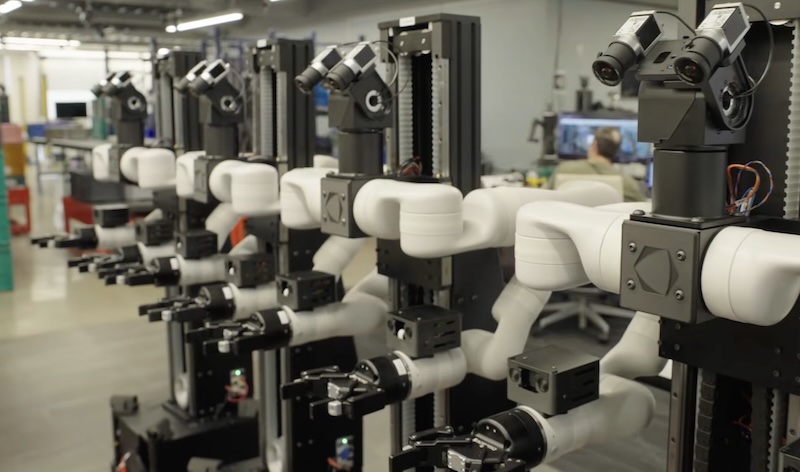
The robots that inhabit the halls of TRI’s Silicon Valley offices never appear too preoccupied with adhering to any humanoid standard of beauty. Wheels, legs, torso mounted upside-down to ceiling gantries — its all fair game. While Toyota’s research wing boasts high profile partnership with top humanoid manufacturers, including Atlas-maker, Boston Dynamics, many of the systems you’ll find on-site were developed in-house.
“We think that having a complete vertical integration, at least for us right now in terms of doing the research, is very powerful,” TRI’s senior vice president of robotics, Max Bajracharya, tells me on a call this week. “It means we can control every aspect of the robot. We can iterate very, very quickly based on the feedback that we're getting from our team members. We can change the hardware. We can change the compute. In robotics, it's always a highly, highly coupled system. We're optimizing different parts of the system all at the same time.”
For visitors, it means things can look considerably different every time you stop by. When the Automated Podcast popped to record the holiday episode late last year with robotics technology adoption senior manager, Erin McColl, I was struck by what had changed since my previous visit a few years prior. Earlier iterations of the lab sported a partial kitchen, lorded over by a gantry-based system, designed to offer in-house help.
Since then, much of the work — and the robots that perform it — have evolved to a more industrial setting. The move represents both a shift in primary focus for the division and a reprioritization of the possible.
“Our long-term goal is still helping everyone in society, including people in their homes,” says Bajracharya. “But I think one of our key realizations is that we can actually make a lot more progress starting with manufacturing, specifically in helping people in manufacturing, not trying to replace them, but actually giving them a tool that they can use in order to make either their lives better or other people's lives better. And then that's going to directly translate into helping people in society.”
The “helping everyone in society” bit was an especially powerful motivator early on. Japan’s aging population has been a major driver for the country’s adoption of home and healthcare automation, as it faces increased concerns around labor shortages. The mission statement has been a central piece of TRI’s DNA that dovetailed nicely with WovenCity, Toyota’s futuristic planned community. Announced at CES 2020, the project opened last year in Susono, Shizuoka Prefecture, Japan. The teams continue to work together, though Toyota’s robust manufacturing operation currently has a far stronger influence on TRI’s humanoid research.

Get the Training You Need for a Safer Workplace!
Autonomous mobile robots are one of the fastest-growing segments of the robotics industry. During this live virtual training, you'll be introduced to safety protocols and best practices for working with mobile robots in industrial settings.
Learn more and register now for upcoming training dates.
“We have such an in with Toyota manufacturing,” says Bajracharya. “We really are partnering with them. They're helping us understand what the needs are, how they would use our robots as tools. They really help us iterate very quickly on developing the technology.”
Non-industrial settings continue to play a real role in TRI’s research. You can, for instance, still spot a wheeled humanoid shopping for groceries amid some pop-up store aisles. But the group believes that even this work will help the team achieve its industrial goals.
“We sort of stumbled on the grocery shopping challenge project,” says Bajracharya, “but it turns out that it is really it's a set of very diverse items that are designed for humans to manipulate and if you think about everything in logistics or even really manufacturing it's very similar it's a very similar situation if you think about whether it's warehouses or parts distribution centers. It really is people picking items and moving them around. Everything that you learn from being able to pick human items in grocery stores, you can almost directly apply to logistics. But I think we're going, we're learning even more than that, which is the technology that we develop for grocery shopping can be applied even more broadly. So whether it's computer vision techniques, learning methods for manipulation, these all apply pretty directly to manufacturing.”
Safety remains a major focus, as well. What most humanoid manufacturers won’t tell you out of the gate is that their systems are still a ways from operating in closer proximity to people. TRI is looking into methods for making these systems safer from the outset. One way to accomplish this is to ensure the robot doesn’t fall over. A wheeled base is a good start, eschewing the constant demand for power required to keep bipeds upright.
TRI is also exploring methods to ensure a cut to power doesn’t mean the robot suddenly drops the product its tasked with transporting.
“Our robots are designed such that if you ever cut power, they immediately stop and they clamp and they hold onto anything that they're holding onto,” says Bajracharya. “That's something we learned is part of the Toyota safety culture. And it's kind of a rule that eventually, I'm sure, as you start deploying humanoids, you're going to need standards that break those kinds of rules. But for now, it's actually much easier to stay within the bounds of how Toyota thinks about safety and to build our robots in such a way that they adhere to those safety standards.”
The A3 Humanoid Robot Forum is Happening at Automate 2026!
As humanoid robots transition from experimental labs to the factory floor, the Humanoid Robot Forum provides the blueprint for what comes next. This intensive two-day event, taking place from June 23-24 at Automate in Chicago, explores the cutting-edge insights into the performance constraints and measurable outcomes of today's most advanced bionic systems. Learn more and join us there!
Association for Advancing Automation
Discover how Association for Advancing Automation can support your automation journey with their complete range of solutions and expertise.
Visit Company Website


