
Industry Insights
This Year’s Model: Apptronik's Next Apollo is (Nearly) Ready for Its Closeup
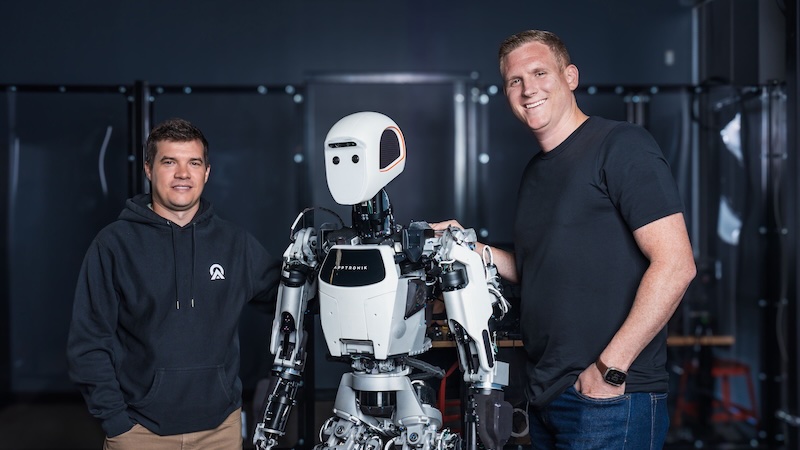
The latest version of Apollo has been kicking around Apptronik’s facilities for roughly a year now. The humanoid has been deployed for commercial pilots, and as part of a high-profile research partnership with Google’s Gemini Robotics. In fact, the Austin-based robotics startup has already produced more units of the new system than it had its predecessor, which was unveiled back in 2023. So why haven’t we actually seen it yet?
“We've always prided ourselves on substance,” cofounder and CEO, Jeff Cardenas, explains on a call following the company’s recent funding news. “One of the bars that I have is if I can show you something in a video, I should be able to show you the same thing in person live.”
It’s reasonable, as release standards go. As industrial robotics — humanoid in particular — have captured the public imagination. However, not everyone is adhering to the same rule book. Many “demos” have become increasingly indistinguishable from slick car ads, as the wrong lessons have been gleaned from viral robot videos of years past. If humanoids are going to work in any meaningful way, however, they’re going to have to do much better than executing a task successfully for a camera one time out of 20.
They’re going to have to do something useful correctly, repeatedly, at scale, and with minimal downtime. Cardenas notes that the latest Apollo has been shown off extensively to investors — forming the founding of an extension round that increased Apptronik’s Series A to just shy of $1 billion, valuing the company at $5+ billion in the process. The model has continually participated in testing and data collection, all while the company has been holding off for “something really interesting to show” when it makes its public debut.
As far as where the bar for “really interesting” sits these days in the world of highly advanced humanoid robots, Cardenas says, “new behaviors, new sort of work, just showing the integration of the hardware and the software.” He adds that the debut will “show what the models are capable of and how we're integrating those models on the robot. There's been a lot of work to get the data collection engine built up and harden the hardware.”
Cardenas had initially expected to show off the new Apollo for the public in 2025, and noted as much on stage at our Humanoid Robot Forum back in September. Refinements have pushed the timing back, but the executive assures us that we’ll see the fruits of the Apptronik team’s labor soon — and that it’s just the beginning.
“I would call the version that will show more of a refinement, but we are working on a significant jump up,” Cardenas says. “The product teams been working in parallel. There are multiple next versions of Apollo that you'll see that will look to be in pretty quick sequence. But a lot of this has just been happening under, you know, there's been a lot of man-hours, hundreds of folks, that have been working together to sort of showcase what we'll show off this year. Expect to see new versions of Apollo as we look ahead. There's a lot of work that the team's doing to make it the best robot in the world.”
Pragmatism is relative, of course, in a category like humanoids, but Apptronik’s approach to the space has been more measured than some. Along with a more cautious take on product reveals, it was one of the first firms to embrace both a wheeled and legged approach to humanoids.
The move was prescient, as several wheeled-based humanoid companies have since emerged, along with a small handful of hybrid firms, such as London’s Humanoid. Much like the former, Apptronik anticipates wheeled bases seeing earlier adoptions, due to cost, (relative) ease of deployment and fewer safety concerns around systems that don’t require a constant power supply to remain upright. Legs have their advantages, including narrower profiles, different ranges of motion, and the ability to traverse more uneven terrain, but it’s commonly held that wheels will be able to accomplish much — or even most — of what customers need on factory and warehouse floors.
“A lot of the early pool is for wheeled systems,” says Cardenas. “The thing I always say about the legged robots is the ceiling is much higher for a legged system and we will get to the point where you don't even think about the fact that these robots can fall over. There's huge potential for the legged systems, but there's also complexity. There are plenty of applications that you can do on wheels and so there's a big pull for those overall, but I think you'll see it depends on the industry and the environment. I think in the early industrial applications, you're going to see a lot of demand for the wheeled variants of humanoids early on. But as you start to look at the other markets, as you look beyond, you're going to see more full humanoids overall.”
Early industrial applications will be familiar to anyone who has followed the category with any regularity: tote moving, bin picking, and the like. Mobile manipulation remains a major hurdle for the category that will unlock a lot of future applications. Of course, for companies like Apptronik, the appeal of the humanoid form is the sort of generalization it potentially unlocks across all manner of categories and tasks.
In addition to the usual suspects of logistics and manufacturing, one new investor jumps out. John Deere, which has made a number of big robotics deals over the past decade, participated in the latest Series A extension. It’s hard not to read the investment as — at very least — interest in exploring the form factor in an ag-tech setting.
“We're excited to have them as a partner,” says Cardenas. ”We'll make the announcements when it's time for what we're doing with it, but you can take it for what you want. yeah, I think they're a bellwether of the American economy, and we're excited to have them as a partner and investor in this round.”
The A3 Humanoid Robot Forum is Happening at Automate 2026!
As humanoid robots transition from experimental labs to the factory floor, the Humanoid Robot Forum provides the blueprint for what comes next. This intensive two-day event, taking place from June 23-24 at Automate in Chicago, explores the cutting-edge insights into the performance constraints and measurable outcomes of today's most advanced bionic systems. Learn more and join us there!
Association for Advancing Automation
Discover how Association for Advancing Automation can support your automation journey with their complete range of solutions and expertise.
Visit Company Website


Hexagon rolls out a wheel-footed bipedal humanoid for manufacturing
Swiss tech conglomerate Hexagon showcased Aeon, a new humanoid robot with both legs and wheels.
Apptronik Plans to Debut Next Humanoid This Year
The new Apollo robot is set to break cover in 2025.