
Industry Insights
These Student Robotics Programs Spark Passion for Tomorrow’s Manufacturing Jobs
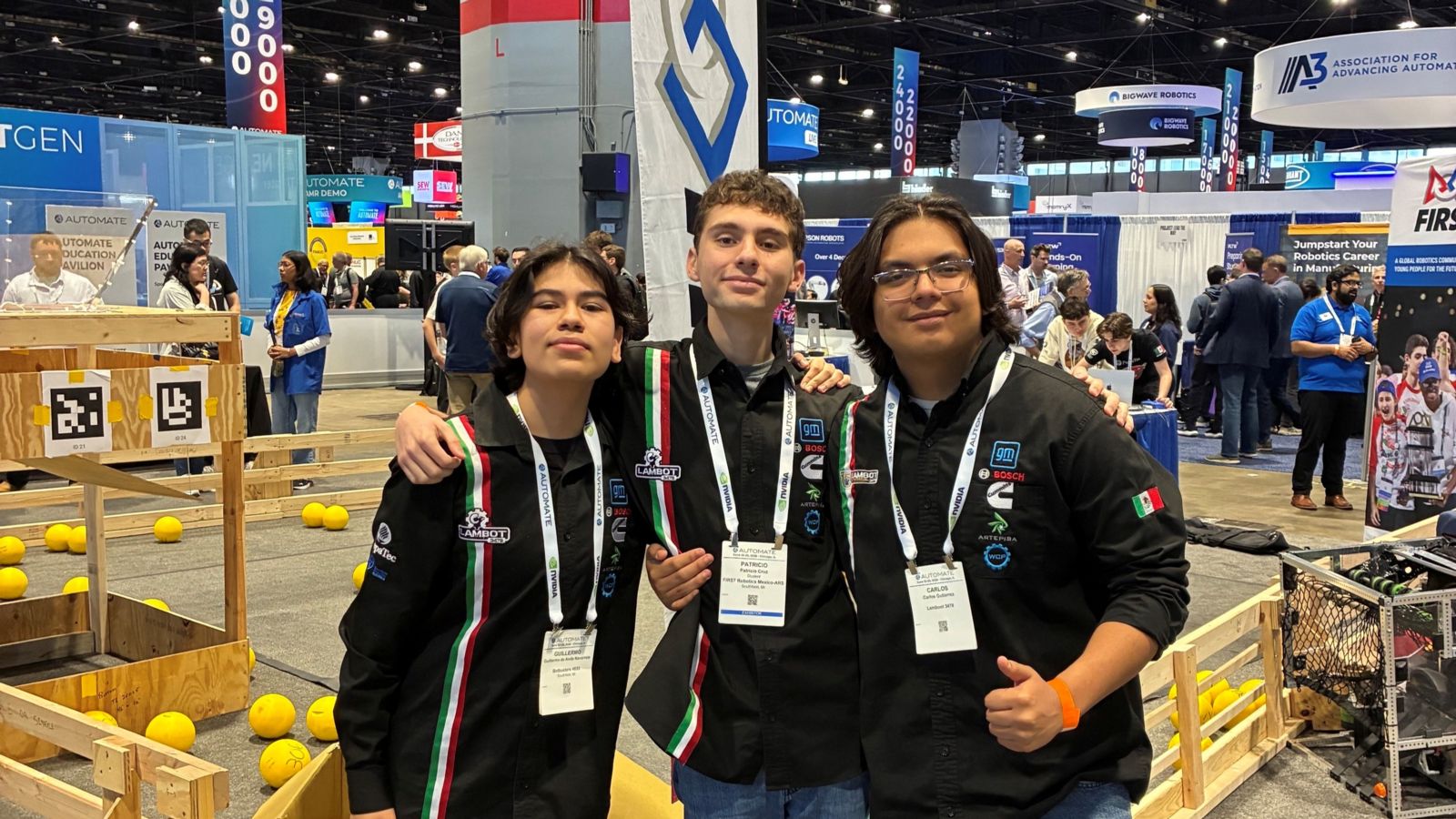 The Automate Student Challenge offers robotics teams from around the world a chance to compete and connect their education to innovations on the show floor from the best companies in the automation industry.
A lot of kids grow up knowing what certain dreams look like.
They can picture the soccer player, the musician, or the performer. They can see the field, the stage, or the crowd. For students on robotics teams, the dream can look a little different.
It’s the workshop after school, a competition field, or a robot that did not work yesterday but finally moves the way it is supposed to.
For Carlos Gutierrez, a member of LamBot, a FIRST Robotics team from San Luis Potosí, Mexico, robotics became a way to see a future he had not pictured before.
“When I got into high school, I didn’t think there was a competition this big in the world,” Gutierrez said. “To tell my mom to give me permission to go to Texas, to go to California, to go to Chicago, and all of that to pursue a dream in engineering, it has been really fantastic.”
Student robotics has brought them to competitions in different cities, introduced them to friends they might never have met, and given them a place they describe as a second home. At Automate 2026, they were also brought inside one of the largest automation events in North America, where students who spend much of the year building competition robots saw the companies and technologies shaping the industry's future.
For the students, the robot matters, but it is not the whole story. It is about the afternoons in the workshop, the problems that do not get solved the first time, and the feeling that comes when a team finally makes something work. It is also about what that experience can lead to when it’s time to enter the workforce.
A Different Kind of Dream
For Guillermo de Anda, a member of LamBot, that feeling started early.
He first became interested in robotics when he was about five years old. Later, his brothers were on a robotics team, and he followed them into the program. It began with small Lego robots. Over time it became something much bigger.
“I think it’s a really cool experience to build something and then see it work,” de Anda said. “That feeling of seeing it work, seeing it in action is pretty cool for me.”
That is part of what robotics competitions can do. It gives kids a team, a problem to solve, and a reason to keep coming back. It also offers an early look at a future that might not have seemed obvious before.
For LamBot students, the team has become one of the most important parts of that process.
“Many of my teammates and many of my friends today, I didn’t meet them and wouldn’t have met them if it wasn’t for robotics,” said Patricio Cruz, a member of LamBot.
That connection is built in the team’s workshop, where students spend much of their time preparing, building, and learning from one another. It is not only where they work on the robot. It is where much of the team’s identity takes shape.
“We share a space that we call our second home, our workshop, where we spend most of our afternoon right there, and it’s because we like it,” Cruz said. “We’re not obligated to be there. We do it because of love.”
Members of LamBot, a FIRST Robotics team from San Luis Potosí, Mexico, share how robotics has shaped their friendships, education, and future career goals.
Learning by Building
FIRST is one of the largest youth robotics organizations in the world, reaching students from kindergarten through high school. Sravan Suryadevara, FIRST Illinois regional director, shared that the organization serves about 100 countries and 800,000 students worldwide. The goal, he said, is not only to get students building robots. It is to expose them to the technologies shaping the workforce around them.
“We’re trying to make sure these students get exposed to the automation industry, get exposed to CAD, CNC manufacturing, programming, computer vision; all of the things that are critical for our workforce for the future,” Suryadevara said.
Suryadevara was a FIRST student himself about 20 years ago before studying computer science and spending about a decade as a web developer. He stayed involved as a volunteer and mentor before making FIRST his full-time work.
“Building robots and doing cool tech is one of the greatest things in the world, but being able to teach a young person to be able to do that is even more rewarding,” Suryadevara said.
He has also seen how much student robotics has grown. When he was a student, Suryadevara said FIRST had roughly 500 to 1,000 teams worldwide. Today, he said, that number is about 3,800.
The robots have changed, too. They are faster and more capable, and students are working with tools that continue to evolve. But for Suryadevara, the bigger point is what the work does for students.
“They go from not knowing what a computer is, not knowing what a soldering iron is, to being able to teach 10-year-olds how to solder, how to program,” Suryadevara said.
For him, programs like FIRST are also part of a larger change in education. Students still need to learn math. They still need to learn programming, design, and problem-solving. Robotics gives them a reason to use those skills together.
“We realize that education needs to adapt to the future where we are already,” Suryadevara said. “It no longer can be, ‘This is how you solve a triangle, here’s a triangle, solve it, okay, let me grade it.’ We need to adapt to, ‘This is how you solve a triangle, build a robot that can shoot balls.’”
That is the kind of connection this experience can make. It takes ideas that can feel distant in a classroom and gives students a reason to apply them.
A Pathway to Work
That same idea is showing up in different ways across schools. A group from DeKalb High School in Waterloo, Indiana, came to Automate from another direction. Their story was not only about a robotics team. It was about a high school program built around advanced manufacturing, automation, and the needs of local industry.
Jonathan Clingan, director of Baron Advanced Manufacturing at DeKalb came to education after 25 years in industry. He worked in semiconductors, automotive, and systems integration before helping start the high school program.
The reason, he said, was simple. “When I was a controls manager, I could never find qualified technicians, engineers, you name it,” Clingan said. “I gave up on looking for experienced people.”
At DeKalb, students learn the skills they would need in a real manufacturing environment, from safety and quality to automation, industrial electrical work, and CNC machining. They also take part in internships. Juniors rotate through different experiences, while seniors are placed at local facilities in hopes of earning a full-time job offer, continuing their education, or entering an apprenticeship.
For Clingan, the goal is not to bring back the old version of shop class. It is to bring technical education back in a way that matches what industry now needs.
“The school got together with our local community, and we basically decided to put this program together to bring the trades back into the school, except to the next level,” Clingan said.
Keegan Naragon, a DeKalb student entering his senior year, did not enter high school with a clear plan to go into manufacturing or robotics. In some ways, that is the point. “I had no idea what I really wanted to do going into high school,” Naragon said. “And I think there’s a lot of kids that don’t.”
Naragon knew he wanted to do something hands-on. He also knew he did not want a traditional four-year college path. Then he saw the program before his freshman year, and the technology caught his attention.
“(Clingan) ended up getting me really interested in something that I never thought I would be interested in, which is the manufacturing industry,” Naragon said.
The robots helped, too.
“Who doesn’t love robots, right?” Naragon said. “Robots are awesome.”
At DeKalb, students are not only learning about technology in theory. They are using equipment, visiting factories, competing, earning certifications, and building toward internships before they graduate.
Naragon said the program is still young, but he believes more students will see the value as they learn what it offers.
“I think it’s extremely underrated right now,” Naragon said. “It’s not the majority of our high school, but it should be.”
For him, the difference is that the classes lead somewhere. “It sets you up so well for an internship and going into the workforce out of high school, which is what so many kids nowadays want, whether they know it or not,” Naragon said.
Keegan Naragon entered high school without a clear career plan. After joining DeKalb High School’s advanced manufacturing program, he gained hands-on experience with industrial robotics, electrical systems, CNC machining and controls engineering.
Starting Earlier
Clingan wants students exposed to technology earlier. DeKalb is working with its middle and elementary schools to help students understand what robotics, manufacturing, and automation look like before they have to make decisions about high school pathways or future careers.
“We should be pushing this stuff down further and further into the school system,” Clingan said. “Not forcing them to choose a path in first or second grade, but just to expose them to what’s out there.”
Suryadevara sees the same need from the FIRST side. He said the goal is to make robotics more accessible not only for students who already know they want to work in automation, but also for students who may not yet know what they are interested in.
“Every single student needs to touch it, whether or not they go into the automation industry,” Suryadevara said. “This is the new language.”
That is where the workforce connection becomes clear. Robotics and advanced manufacturing programs are not asking every student to become an engineer. Instead, they expose students to a wide range of careers such as technicians, programmers, electricians, machinists, systems integrators, designers, and engineers. It gives more students the chance to see what these careers look like before they are asked to choose a path.
For Naragon, that chance changed the way he thinks about his future. During his senior year, he is set to intern at a local machine shop. After graduation, he hopes to move into full-time work as soon as possible.
“I would still, to this very moment, probably have no clue what I’m going to do realistically when I get out of high school,” Naragon said. “I know that I want a job and I want one as soon as possible, and I know that this program is going to help me accomplish that.”
That kind of path matters in a region where industry is already close by, and employers need people who can work with modern manufacturing technology.
“There’s no shortage of work,” Naragon said. “It’s just a shortage of people that can do it.”
Seeing the Industry Up Close
That exposure is part of what brought DeKalb to Automate. Clingan said FANUC America saw the program’s work and invited the team to the show to demonstrate what high school programs can accomplish. The answer was easy.
“As soon as I got that invite, I’m like, absolutely, I want to give these kids an experience of a lifetime,” Clingan said.
For the students, the size and scope of Automate were hard to explain until they saw it. Clingan had spent months trying to describe the show to them, but the scale did not really land until they walked in.
“For the last couple of months, I’ve been trying to explain what Automate is, and I cannot undersell this thing,” Clingan said. “When they walk in, they’re just looking around. You just see the awe in their face.”
Naragon felt that himself. “It’s like the stuff you see in the sci-fi movies, and you never think it’s real until you see it in person in real life,” Naragon said.
The scale stood out too. “My mind is blown at the fact that this does not fit in a whole,” Cruz said. “There are two whole places to go. I really can’t believe that I get to be here, showing a little bit of what I do.”
The automation workforce does not begin when someone graduates college or starts a first job. For many students, it begins earlier, when a robot does not work, a teammate stays late, a mentor helps solve the problem, and the student realizes they want to keep going.
For LamBot, DeKalb, and the students competing at Automate 2026, robotics became much more than a competition. It was a first look at a future they could build for themselves.
Association for Advancing Automation
Discover how Association for Advancing Automation can support your automation journey with their complete range of solutions and expertise.
Visit Company Website


Machine Vision Harvests Opportunities in Food Inspection
Like taste buds of the human tongue, machine vision’s use in food inspection can detect and process complexities on multiple...

Spot Welding Robots Can Eliminate These Common Defects
Welding tasks are a great candidate for robotic automation.
RND Automation Wins FANUC Robotics' 2017 System of the Year Award
RND Automation bestowed the annual honor at FANUC's Authorized System Integrator conference.