
Industry Insights
The Wave Energy Revolution is Coming, But it Needs Autonomy
In May of 2026 the Portland, Oregon based start-up Panthalassa raised $140 million in funding at a valuation reported near $1 billion. It hopes to build unmoored, buoy-like AI data centers in the open Pacific, powered by wave energy and connected to the internet by satellites. The first pilot nodes are planned for deployment later this year.
Panthalassa is geographically well-positioned to pursue its idea, as the Pacific Northwest is a hotspot for marine research. Less than a hundred miles away, off the coast of Newport, Oregon, sits PacWave, the only grid-connected wave energy site in the continental United States. Geoff Hollinger, who leads the Robotic Decision Making Laboratory at Oregon State University, says that by some estimates up to 60% of the West Coast's energy needs could be met with marine energy.
But wave energy is not a solved problem. Even Europe, the leader in this field, has only a handful of operational wave energy generation projects.
One obstacle is the cost of the deployment and maintenance large wave energy generation arrays will require. "Doing things in the ocean is incredibly expensive, and hopefully these start-ups are thinking about how expensive it’s going to be," says Hollinger. Ships must move to the site, and the people who operate those ships need specialized knowledge. "If you scale up marine energy to the point where you have energy arrays along the whole coast, you would not have enough ships to service them. There's just no way."
Hollinger's lab has spent four years on a Department of Energy-funded project researching how autonomous underwater vehicles (AUVs) can be adapted to solve this problem. A portion of the research has focused on something that seems deceptively simple: teaching AUVs to dock with their charger.
Underwater Autonomy is a Tough Problem
An autonomous underwater vehicle, or AUV, is a robot submarine that operates without input from an operator. The definition of an AUV, much like the definition of a self-driving car, is somewhat fluid. One way they can be categorized is by their job. Some AUVs are survey vehicles that have sensors but no means of manipulation, and others are intervention vehicles that have some means of interacting with infrastructure (like a robotic arm).
AUVs have existed since the late 1950s, and survey vehicles are now common. They were used to find the wreck of the Endurance, which sank in Antarctica over 100 years ago, and they’re frequently deployed for deepwater surveys.
AUV intervention vehicles, however, are not mature, and one leading reason is energy. An AUV of course requires a battery that must be swapped or charged for continuous operation. This is true for any AUV, no matter its job. However, swapping a battery is often easier to accomplish when deploying survey vehicles, as surveys tend to have a limited scope and duration, and the survey AUVs are often deployed from a ship. Intervention AUVs — particularly those meant to maintain infrastructure such as wave energy sites — will need to operate for longer durations alongside the infrastructure they maintain.
The solution is residency. An AUV can be deployed with a wireless charger that, in principle, works much the same way as wireless charging your phone (one manufacturer of such devices, Blue Logic, even calls its charger “Subsea USB,” though there’s no relation besides the name).
In 2019, Saab Seaeye's Sabertooth autonomously docked with Equinor's open-standard subsea docking station and recharged across an inductive connector. Today, resident drones built by Saipem are deployed in the Njord offshore oil field, though many are not fully autonomous.
As you might expect, wireless charging in the ocean isn’t simple. "Underwater wireless power transfer is still a developing technology," says Narayanamoorthi Rajamanickam, associate professor at the SRM Institute of Science and Technology in Chennai, India. “It has not yet reached the level of widespread commercial adoption seen in consumer wireless charging.”
Rajamanickam explains that because seawater is electrically conductive, wireless charging can create eddy currents that reduce efficiency. The charger is also sensitive to corrosion and biofouling (the accumulation of marine life), and performance is reduced if a connection is not well aligned.
Saab and Saipem have shown that residency is possible, if not easy, but there’s a catch. These examples involve undersea docks in a static location. A wave energy converter (WEC) is a different problem. A machine built to turn wave motion into electricity is a machine built to move, and that movement makes autonomous docking more difficult.
ROI Calculator
Discover the potential cost savings of robotic automation over a 20-year system life
This calculator compares your current manual labor costs against the total cost of owning and operating a robotic system over its 20-year lifespan.
Learning to Thread a Moving Needle
This tension between residency and wave power is what researchers at the Marine Autonomy Center set out to resolve. The work grew out of OSU's role in the Pacific Marine Energy Center and PacWave, the wave energy test site off Newport, Oregon.
A floating WEC extends 30 to 50 meters down, Hollinger explains. “A natural place to put the dock for a vehicle that's servicing that infrastructure would be at the bottom of the heave plate.” That’s in the “energetic” environment where surface waves and currents remain in play. In theory, a WEC might extend a cable to a static dock on the sea floor, but that adds more cables to maintain, and it could be a challenge when WECs are deployed in deeper waters. "What we were interested in was, could you dock with a dock that is connected to that heave plate?”
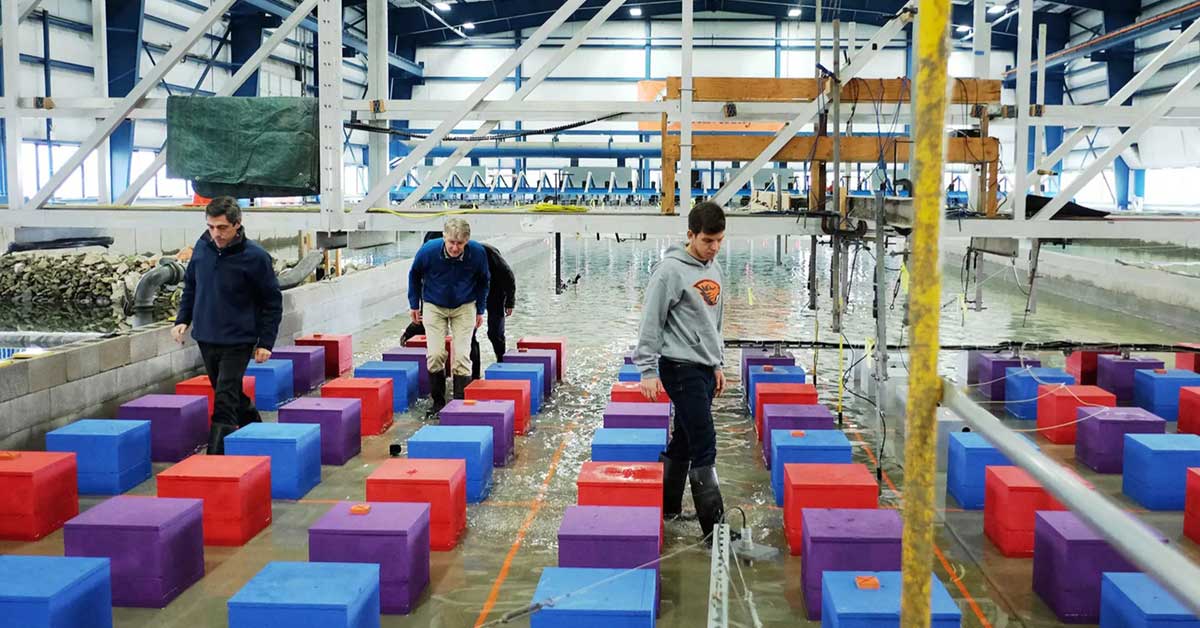
To find out, the researchers went to the university's O.H. Hinsdale Wave Research Laboratory and built a stand-in. "The dock is basically plugged into the wall," Hollinger says, "and we have a setup where we're emulating the kinds of motions that would happen if it were connected to a real WEC." After several years of effort, the lab now has a test vehicle that can dock with a success rate over 70%.
Pulling that off starts with sensing, which is the first big roadblock. Radio signals don’t propagate through seawater. That means no cellular, no Wi-Fi, no Bluetooth, and no GPS.
"[Researchers] must rely on other sensing technologies to track an AUV's position and trajectory," explains Brendan Englot, a professor at Stevens Institute of Technology who studies underwater robot perception. "Cameras are invaluable, but they don’t always work in turbid water, and may only be capable of seeing objects that are very close. For this reason, we usually rely on sonars to see at long distances in any type of water conditions."
No single sensor suffices, and Hollinger says success requires "a cocktail approach.” In the case of his group’s research, this includes a camera, imaging sonar, acoustic beacons, Doppler velocity logs, and inertial measurement units, all working together.
Acting on Imperfect Information
Solving sensing is important, but only half the battle. The vehicle still has to fight its way to the dock through the same waves that are throwing the dock around. To accomplish this, it must make decisions about how to maneuver.
Hollinger sees the problem as deeply entangled with sensing. "One way of describing a lot of what my lab does is active perception," Hollinger says. "You're getting better information so you can dock." The autonomous vehicle infers the flow of water from information on how the water is shoving it off course and creates an estimate for how it should respond.
That information is acted on with a model predictive control (MPC) technique similar to self-driving cars. It continuously simulates a short horizon into the future, picks the best commands, takes action, and repeats. MPC runs at roughly 10 hertz and is paired with another, faster controller (which operates the motor) and, sometimes, a longer-horizon motion planner for mission-level tasks.
All of this must happen onboard the underwater drone. The AUV’s brain is typically a Nvidia Jetson or a Raspberry Pi. Both have modest capabilities compared to even a single server GPU, so the models are trained onshore and designed to fit in tight memory and compute constraints.
While running a model on limited compute is a challenge, Hollinger says a lack of training data is the most persistent problem. "That's something that underwater robotics researchers complain about a lot.” Self-driving cars have the benefit of enormous datasets built from hundreds of thousands of hours of driving data. Underwater, however, "it's way, way, way less."
His lab compensates by transferring data from other uses. In one instance, the researchers adapted a manipulation model trained on data from the Amazon Picking Challenge to work underwater. Simulated data also holds promise. "If I'm able to create a digital twin of the underwater environment, and I run simulations in that digital twin, in theory I can generate as much data as I have time for."
From the Lab to Deployment
The wave lab results established viability under controlled conditions. A newly funded three-year project will couple the dock to lab-scale WECs at Hinsdale. The critical step after that, which is open-water demonstrations at PacWave, is not yet paid for. Hollinger says it will take both money and an industry partner willing to bolt OSU's dock onto its WEC.
That could prove a challenge, as funding has become more difficult. "In the last couple of years there have been significant challenges," Hollinger says. In response, his group has reframed how it pitches wave energy, with an emphasis on dependability and cost.
The U.S. Navy is one source of interest that could remain resilient. Hollinger says the Navy is "very interested in resident vehicle outposts that can help secure the ocean battle space.” The concept is a remote base, powered by wave energy and maintained autonomously, which can be used for recon or resupply.
As for Panthalassa? "They have not reached out to me," Hollinger says. "I'd be very happy to talk to them." They may want to. The wave energy revolution only pencils out if the offshore infrastructure can take care of itself.
Association for Advancing Automation
Discover how Association for Advancing Automation can support your automation journey with their complete range of solutions and expertise.
Visit Company Website


See OTTO 100 in Action!
OTTO 100 is a small, powerful autonomous mobile robot designed to move boxes, carts, bins, and other human-scale payloads through dynamic environments.