
Industry Insights
The Robots of 'Avatar: Fire and Ash'
I can’t recall how much I paid for admission to “The Way of Water,” only that it was likely the most I’ve ever plunked down on a single showing. Keep in mind, this was lower Manhattan. Also, I requested the works. The glasses, the vibrating seats — there may be a part of me that didn’t want to let down James Cameron and the dozen or so years of production the Disney team devoted to the Avatar sequel.
Having subsequently watched a pair of behind-the-scenes documentaries in preparation for this piece, I can tell you that the drive to not disappoint “Jim” is the driving force on set. The unprecedented lengths to which the Aliens/Terminator director will go to make CGI water sufficiently watery will one day likely be regarded as an overblown Hollywood myth.
It was, indeed, a wildly immersive experience. A small part of you can empathize with those stories of viewers getting — perhaps — a little too into the Pandora experience. But in the midst of witnessing a $400 million spectacle, thinking about work can still pull me back down to Earth for a few moments.
My first thought upon seeing a swarm of insectoid robots constructing military industrial complexes amid the virgin Pandora wilderness was immediate story potential. “The Way of Water” is set just under 150 years in the future, but it’s clear that whoever designed these little metal construction bugs has kept a close eye on contemporary industry trends. I filed that in the back of my mind for whenever the next movie comes out.
Three years and $400 million later, I’m happy to report that my goldfish brain held onto this one. It’s Thursday, December 18 — “Avatar: Fire and Ash” day. Just ahead of today’s release, production designer, Ben Procter sat down to discuss the finer points of the robots that populate the first three Avatar films, along with some peripheral media, like Ubisoft’s 2023 title, Frontiers of Pandora and Disney World’s Animal Kingdom: Pandora park. Here are some highlights.
Real World Inspiration
Jim [Cameron] wanted some kind of swarm assemblers that were moving around. I believe they existed previous to us doing design on them. There are times then we just come up with an idea and we pitch it to him and he's like great’ and then it goes in the movie. I think this was an idea he had already. The idea that they were insectoid in some form was already there. Jim is very familiar with technology and those of us who work on designs for movies are also big nerds and geeks for these kinds of things. The idea that didn't have to be humanoid in any way, that you can have a swarm that operates together in a known, algorithmically driven, intelligent way that's grander than any of the intellect that's on board with each of them — is an idea that, you know, that we're all familiar with. So we kind of went with that.
Tethering Sci-Fi to Reality
Everything we do, on the tech side or the hard surface side on “Avatar,” as anybody can tell, it's always like detuned from the most sci-fi, most futuristic version that could be. We all have computers in our pockets that look like slabs of abstract glass. This is where technology is really headed. But as a kid who grew up watching 1980s movies (some of them being Jim Cameron's), I became familiar with his aesthetic from the loader (“Aliens”) and other things like that, that leaning into kind of hardcore industrial stuff. It makes things feel much more real and timeless because there's a certain look to very functional things, whether it's stuff in a space program or stuff on an oil rig or stuff that's used for manufacturing anything that's not consumer facing, it has a kind of a vibe to it that's really cool and if you can lean into that, then you won't fall into kind of sci-fi tropes of trying to be trying to be too futuristic too hard.

Get the Training You Need for a Safer Workplace!
Autonomous mobile robots are one of the fastest-growing segments of the robotics industry. During this live virtual training, you'll be introduced to safety protocols and best practices for working with mobile robots in industrial settings.
Learn more and register now for upcoming training dates.
Getting Things Right (or At Least Right Enough)
We typically call up experts in certain categories. It tends to be medical graphics. When we needed to show how the Link system would work with coordinating two different brains to come into synchronicity in the first “Avatar,” we consulted with neurologists: What would the activity patterns look like? What is the correlation? What's the jargon we could put into our motion graphics?
We do go the extra mile in terms of research on things that I think we are least familiar with. I try to be scientifically aware but I'm no neurologist. So that stuff is very helpful. But for the mechanical stuff, I think it's a lot of research. There are so many incredible YouTube videos out there. All these companies that make robotics are doing a great job of promoting themselves.
Turns Out There are Guide Books
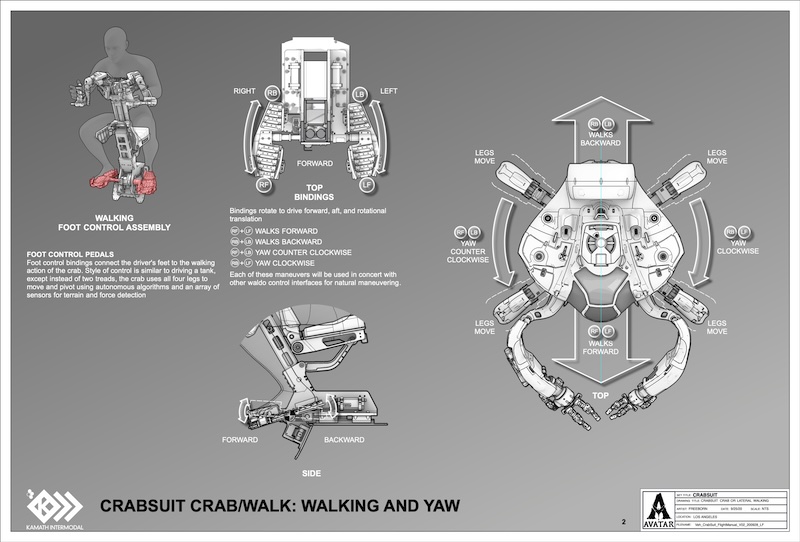
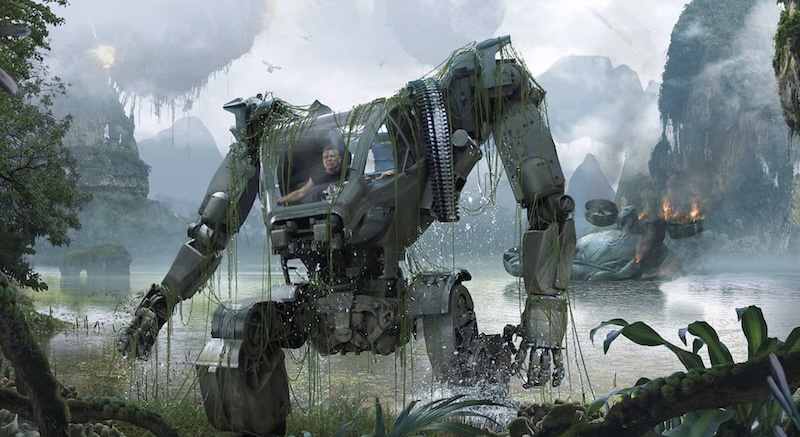
We have a pilot's manual for the crab suit because that was a less intuitive setup than the Amp and the Skel, which are much more humanoid in the way that you're relating to the mech. The Skel is very lightweight and very free and doesn't bind you. I don't think you need to give the actors a whole lot of input on how to use that system.
As far as the crab suit, we made the manual knowing that we wouldn't always be there. The people that use crab suits are not the lead actors. We don't have dialogue scenes around the apparatus the way we did with Slang [Stephen Lang] on the first movie. we did that knowing that we wouldn't be there to kind of encapsulate the knowledge. We give that to the assistant director and her department. We give it to our art directors who might be on set, just hoping that the knowledge kind of flows through.
Working with Iconic Directors
[Cameron’s] level of involvement is always there in super laser detail in the sense of looking at the designs carefully and perceiving whether they feel legitimate and feel real or not. Whfull-boreoesn't go right, he has to get more involved. There were certainly moments on Avatar 1 where people would get the full bore scrutiny into, ‘Okay, tell me what this detail on this helicopter does. What is that? What is that?’ I think he did that to shock the art department into, ‘All right, look, we gotta take this seriously. We're working for a frustrated engineer who knows how to fly a helicopter.’ You better know what cyclic means and all this kind of stuff. He established a standard. Does he go into the nitty gritty of every little detail anymore? If we are doing our job, he shouldn't have to do that.
Association for Advancing Automation
Discover how Association for Advancing Automation can support your automation journey with their complete range of solutions and expertise.
Visit Company Website


Ex-Disney Imagineer Makes Big Bet on Home Humanoids
Cartwheel Robotics is taking a unique approach to home humanoids
Letting it Go: Disney Research's Lab Director on Free Range Robots
Moritz Baecher discusses how Disney Research deploys robot snowmen and droids in the real world.