
Industry Insights
The Loneliness of the Middle Distance Trucker
Like most memorable phrases of uncertain origin, “boil the ocean” has been variously attributed to Mark Twain, Will Rogers, and Lewis Carroll — three great minds that appear to have done some of their greatest work long after death. Regardless of who first suggested we curb our seafood consumption, it’s long been an idiomatic yield sign for ambitious founders.
Pragmatism has never really been Silicon Valley’s strong suit, of course. One thing about moonshots is you really only need one or two to pay off to be considered a kind of sage. The other thing about moonshots, of course, is that even the ones that pay off tend to take a long time to do so, all while sacrificing a ton of hypothetical ROI along the way.
Somewhat in keeping with its name, Humble Robotics sits at an appealing cross-section of the pragmatic and wildly ambitious. A veteran of Mission Motors, Otto, and Spark AI, founder and CEO Eyal Cohen has spent much of his career on the latter side of the equation. Most recently, he worked as the head of hardware engineering, system engineering, operations at self-driving truck darling, Waabi.
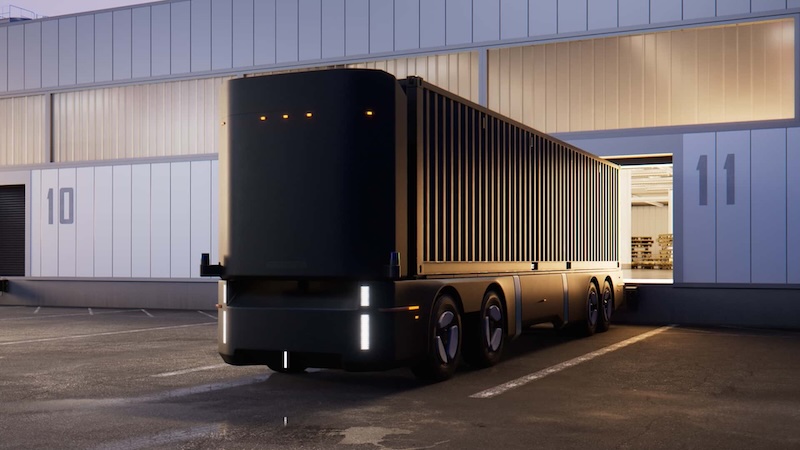
Humble’s offering doesn’t stray too far from his previous employer’s autonomous ambition, but the company’s initial aim is — quite literally — focused on a significantly shorter road.
“Over the years, I’ve seen how much freight moves relatively short distances,” Cohen recently told me. “All kinds of freight is moving one to five miles. It's very short links of warehouse to warehouse moves. Sometimes you'll see factories moving like parts from one the of building to another. But they're carried by trucks.”
Where most autonomous trucking companies have focused on the massive long haul market, Humble’s approach targets a smaller, but more grounded market. Trucks traveling these short distances often do so at 20 to 30 miles an hour, and manage to avoid highways altogether. Cohen adds that the short distances are more manageable for electric vehicles than long-haul trucking, requiring less power and never straying too far from a charger.
Humble hopes to help facilitate a fully automated warehouse material workflow. That includes the picking, the loading, the unloading, and, of course, the movement of freight.
“This platform that we're building is the start to that,” Cohen explains.” One of the major changes that we have here is that we have sensors on the back of the vehicle. When you automate just a tractor, you don't have sensors on the back of the trailer. So you cannot back a trailer in because you can't see behind you. One of the reasons we have this longer vehicle is so that we can put sensors all around the vehicle, which allows us to back up to a dock, which allows me to fulfill that vision of fully automated freight.”
Sensors on the rear of the device are just a piece of the company’s hardware rethink. Far more glaringly obvious is the decision to ditch the truck’s cab altogether. Dropping the front of the truck allows for more overall freight capacity, while managing to make the overall system lighter.
Cohen says the decision was part of an overall motivation to push the technology. “Hey, what if we remove the cab?” he rhetorically posits. “What does that look like? What if we rethought the vehicle? What does that look like? Can we make it electric? For a fully automated vehicle, electric is the right technology because you can charge hands-off. That vision of like fully automated freight is hard to do with diesel. I wanted to push the technology as far as it can go and then see if we can map it to a business case. What we found was that the business case was there and the tech was there. So, we launched a company around that.”
Association for Advancing Automation
Discover how Association for Advancing Automation can support your automation journey with their complete range of solutions and expertise.
Visit Company Website


