
Industry Insights
The Benefits of Decentralized and Distributed Manufacturing
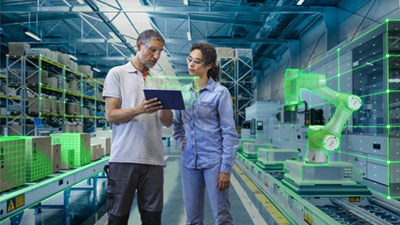 Large-scale factories offer many advantages, including volume economies of scale, high efficiency throughput, consolidated management, and a straightforward supply chain. However, there are many applications where smaller micro-factories offer enough flexibility and agility to complement large-scale production. A decentralized / distributed approach to manufacturing enables modern modular industrialization, reduces cost and risk, and improves the customer experience.
Big Factory Problems
The large-scale efficiency of big factories does not come without its challenges:
Labor: Large-scale factories tend to be in remote locations to save on land costs. This can make it difficult to find enough skilled workers, especially if other nearby factories are competing for the same limited workforce. A factory might have the capacity to fulfill more orders, but without enough workers, that capacity cannot be fully utilized.
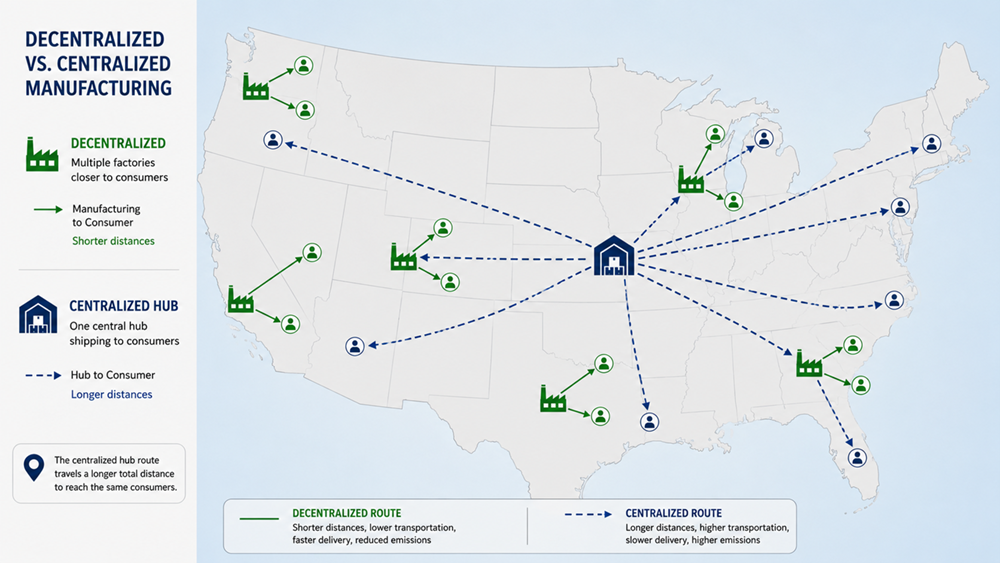
Shipping: When goods are manufactured in a single location, customers who are further away incur higher shipping costs and take longer to receive product (see Figure 1). This also applies to the supply side: manufacturing closer to where raw materials are sourced lowers costs.
Reconfiguration: Factories may produce multiple products, either using different materials or different packaging. For example, a nut factory may need to shut down the entire facility for 24 hours to change over product or packaging.
Storage: To reduce reconfiguration downtime, large-scale factories produce longer runs. This extra product, which may not be needed for months, needs to stored and managed.
Reliability: When all goods are produced in one factory, this presents the risk of vulnerability. For example, a power outage can completely shut all production down.
Investment: Large factories require large upfront costs and long stand-up time, and so present greater risk.
Distributed and Decentralized Manufacturing
To address the problems big factories face, many manufacturers are distributing and decentralizing their operations. Rather than have production done all in one place, manufacturers can stand up micro-factories in different locations, called distributed manufacturing. In addition, these micro-factories support more localized control, allowing them to be flexible and agile within their local markets, which is decentralized manufacturing.
“We work with our customers to assess the gives and gets for their application and evaluate whether it is worth the risk and investment to work on a smaller scale,” said Justin Garski, OEM segment manager, Rockwell Automation. “A smaller facility will likely be more expensive proportional to capacity. For example, a micro-factory may only produce 125 items / min compared to 200 items / min in a large-scale factory. The question is whether the benefits outweigh the difference.”
Benefits to Manufacturing With a Micro-Factory:
- Fewer workers are needed within an area, making it easier to scale labor and production.
- Goods can be manufactured closer to where they are needed. Consider the distributed bottling of soda. Rather than paying to ship water, smaller bottling facilities use local water and substantially reduce shipping costs. Product also gets to the customer faster, which can impact freshness, reduce shipping damage to product, and lower packaging costs.
- Micro-factories are easier and less expensive to reconfigure. Consider a large factory producing holiday packaging for a limited run. This comes at the cost of shutting the entire factory down twice for a small run. A micro-factory can accommodate limited runs more efficiently. This also applies to products that are packaged in many different sizes. With a lower cost to reconfigure, manufacturers can take advantages of more opportunities, markets, and use cases made possible by adjusting product or packaging.
- The agility of micro-factories to switch configurations faster and with less downtime cost means product can be manufactured when it is needed, reducing storage, inventory, and management costs.
- When a micro-factory experiences a power outage, only a fraction of production is impacted. In fact, other sites could make up for downtime, minimizing the disruption to customers.
- A micro-factory costs less to stand up with less risk. Where a large factory might take 12 quarters to get up and running, a micro-factory for the same product might take as little as a quarter to stand up. The ability to stand up new capacity quickly also allows manufacturers to commit to new orders with more confidence.
The Global Advantage of Micro-factories
Many companies have chosen to outsource manufacturing for cost reasons such as less expensive land and labor. Micro-factories change the economic landscape (see Figure 1):
- Faster responsiveness / speed to market
- Reduced transportation cost, packaging cost, and damage losses
- Avoidance of global instability and cost of tariffs and duties
- Localized customer support
- Resilience in supply line / production overlap / mitigation of risk
- More customized production with lower CAPEX and OPEX
- Better customer experience
In many use cases, a micro-factory can be more efficient than a large-scale factory. This is because the large-scale factory is likely optimized for the most common use case. As a result, special use cases (i.e., holiday packaging, regional differences, low-volume variety, etc.) may run substantially less efficiently. For example, when allergens like peanuts are used on a line, cleaning the equipment will increase factory downtime during a reconfiguration. By moving all allergens to production in a micro-factory, efficiency in the large-scale factory is improved. In addition, the products with allergens potentially cost less to manufacture as well.
NEW ONLINE TRAINING COURSE
Designing Industrial AI Agents
Gain the skills to orchestrate advanced AI agents that learn, adapt, and collaborate like experts in real-world automation environments
Micro-factories with localized control make it possible to be more responsive to local trends, niche markets, and regional preferences. Each facility can manage its own customers and forecasts to operate and grow the local business in a more self-reliant way. This enables efficiency at both the local and global level while maximizing scalability and reach.
Modern Modular Industrialization
“Decentralization is core to how we approach modern industrialization,” said Gregory Magdanz, vice president of OEM and robotics at Schneider Electric. “Decentralization enables modular production, making it possible for manufacturers to reconfigure lines going forward without large-scale redesign.”
When manufacturers are tied to a single platform, redesign is more significant and costly. Control software typically operates a single piece of hardware, and each system can affect how downstream systems function. Even when only a single workstation is modified, the way the entire factory is managed and operated may need to be redesigned as well.
With a modular approach, hardware is decoupled from control software. Modern hardware can be operated using third-party control software, allowing manufacturers to choose best-in-class hardware and software without being tied to a single vendor. This also promotes software-defined automation, where more functionality is managed via software. Thus, as opposed to needing to stand up new equipment to reconfigure a line, more of the reconfiguration can be done through software. This has the added benefit of providing visibility into the production line. Managers can now view all operations on a single platform.
Modular design also lowers risk and cost. A smaller factory can be deployed to test, evaluate, and optimize a production line. After lessons learned have been implemented, this same modular design can be repeated with significantly less risk across different locations.
Micro-factories can also be more innovative and efficient than large-scale lines. Their modular design means they can replace key equipment and introduce innovation that increases efficiency while retaining existing equipment longer. Also, as artificial intelligence technology advances, new optimizations can be implemented via software without the need for new equipment or extensive downtime. Finally, with the rising demand – and cost – for electricity, smaller operations can be designed for energy efficiency to provide further cost savings compared to larger legacy facilities.
Designing and Deploying the Micro-Factory
Modern open automation tools can accelerate the design and deployment of new facilities. Consider digital twins, which are computer simulated duplicates of a production line. With a digital twin, the engineering team has the flexibility to experiment with different equipment to identify the best choices, as well as evaluate different configurations. They can explore a variety of factory floors with different layouts and quickly simulate their operation in the cloud to optimize and confirm the design meets their requirements. This all happens before any equipment is actually purchased or deployed. In other words, this reduces the risk of building a production line only to find it doesn’t work as planned and has to be redesigned (see Figure 2).
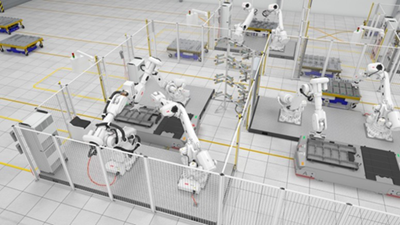 Once a plan is decided upon, the workforce can be trained using digital twins so they are ready when the equipment is ready. Digital twins are useful even after a production line is active. They can be used to verify the factory floor is producing as expected. A digital twin also allows manufacturers to improve, reconfigure, and update the line without disrupting or shutting down production. “With tools like these, we’ve seen up to a 70% improvement on engineering efficiency during design and a 60% improvement on commissioning time,” said Magdanz.
The availability of software-defined automation and open tools to design and operate equipment also enables manufacturers to bring more design in-house rather than rely on an outside vendor. Because the expertise around a production line is internal, the manufacturer is free to modify the design to modernize it at their own pace. The engineering team can continue to work in the virtual environment of the digital twin to identify areas of improvement, assess how they can be addressed, evaluate the new design, and then implement the changes seamlessly without having to shut the production line down for long periods of time. This also helps bring the IT/OT systems together to simplify operations and lower costs.
So how does a manufacturer evaluate the benefits of moving to a decentralized and distributed approach? “CAPEX equipment is only part of the equation when calculating business cases,” said Ben Perlson, director of consumer industries at ABB Robotics. “You’ve got to consider shipping costs, transportation time, and inventory management to get a wholistic view. How and where the equipment is produced and serviced from can have a significant impact on the customer experience."
Magdanz said, “For manufacturers with a limited budget or who want to start decentralization on a smaller scale, a modular approach allows you to isolate where you want to improve operations without a total rip out and replace. You get the ability to see what you have, determine what you need to do, and then do it faster and at a lower cost.”
Decentralization and distribution may not be for every business at this time. There is a barrier to entry to working with new manufacturing technology. But, with modular design and innovative technology, the micro-factory makes sense for more businesses every year.
To help make that evaluation, manufacturers can work directly with partners like ABB Robotics, Rockwell Automation, and Schneider Electric. While companies like these offer automation hardware, software, and services, they also understand that the modern factory is built on an ecosystem of companies. Their first step is to consult with manufacturers to understand their challenges and needs. Then they can help outline a plan that brings together technology from across the automation industry to make the micro-factory a profitable reality.
Association for Advancing Automation
Discover how Association for Advancing Automation can support your automation journey with their complete range of solutions and expertise.
Visit Company Website


QComp: Proud to Be One of the First ABB Value Providers in the World
QComp is honored to be among the first companies worldwide recognized as an ABB Value Provider, reinforcing our commitment to
Digital twinning and prototyping of car accessories
Facing the challenge of reducing R&D time for the design and production of high-precision car accessories

Güdel, Inc. Releases Technology Report on Advances in New TrackMotion Overhead (TMO) Modules
Slimmer machine profile has higher payload capacity, improved repeatability and easier access for maintenance with new linear motion technology.