
Industry Insights
Solving Robot Interoperability Issues in Industry 4.0 Manufacturing
Continued shortages of skilled employees licensed to operate powered industrial trucks including forklifts and other materials-handling equipment are driving the need for autonomous mobile robots (AMR) and automated guided vehicles (AGV). Since robot operating systems are proprietary to the manufacturer, adding another manufacturer’s robot to a facility with existing AMRs can create problems with logistics and communications. Enter robot interoperability, which allows robots from any manufacturer to share data and information and integrate into new spaces and platforms.
What is Robot Interoperability?
Interoperability from the AMR and AGV robot builder perspectives means primarily vehicles from different vendors coordinating and cooperating effectively. The ecosystem in robotics is already very complex. “Right now, engineers working at different manufacturers are spending years of their time rewriting code for the same thing. The gains come when major players collaborate and make key technologies more accessible across the industry. That’s when the innovation will take off," said Jason Okerman, staff product manager with OTTO by Rockwell Automation.
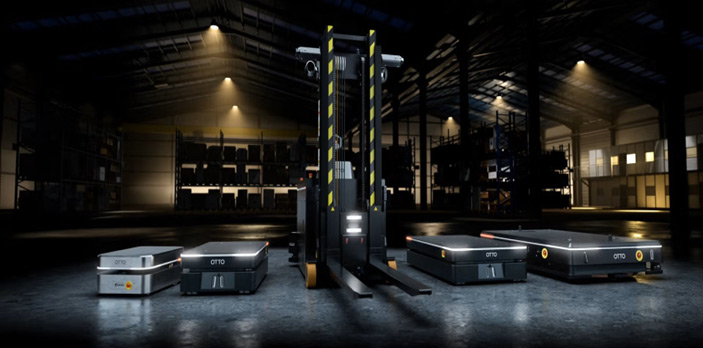
Whether a facility is adding an AMR that navigates using sensors and cameras, or a traditional AGV that follows a predefined path guided by wires or magnetic strips, the robot must be able to move within the facility around other machinery, robots, and human employees. “Human employees are problem-solvers. A human employee moving a pallet load that encounters an obstruction in an aisle will take an alternative route, whereas a mobile robot may deadlock, slowing or halting production,” said Daniel Theobold, co-founder, president, MassRobotics; founder, chairman, Vecna Robotics; and founder, CEO Mekable.
While custom-coded solutions unique to a facility's form factors are possible, scaling that solution to each location becomes prohibitively expensive for enterprise customers. Theobold equates it to “exception handling” that creates a “system of systems” and piecemeal solutions that works “until it doesn’t.”
“While many of the solutions are created to replace or replicate human intelligent problem-solving,” he explains, “they only address a part of the chain, and when it breaks it becomes a Rube Goldberg effect that can be difficult to detect and harder to fix.”
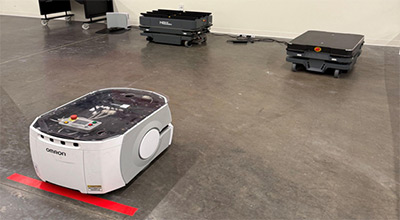 “Robot interoperability should be manufacturer agnostic, able to work with any existing robot without needing to go back to the engineer, integrator, or OEM any time an update is required. It should also allow for communication with other automation in the facility so any AMR can plug into any industrial robot without complex coding,” said Daniel Pereira, CEO and co-founder of FleetGlue.
Current Interoperability Challenges
Because the robot industry is highly competitive and technology is evolving rapidly, one of the pushbacks to interoperability is proprietary information that manufacturers are reluctant to share. “No one wants issues with safety or having an AMR go rogue and start driving into people. The main pushback we hear is not to touch the low-level controls or kinematics. It becomes a matter of coordination with the OEM to determine what level can be safely accessed and what rules and logic will apply,” continued Pereira.
One of the challenges with interoperability is the range of robots with different form factors that are already deployed. Robots that have been operating for several years may not have the same level of technology or responsiveness that a smart AMR/AGV robot may have. “You’ve got these elephant robots that are plodding along and they're not going to stop; they may be lower on the intelligence tier compared to a manual vehicle with a human driver. The AMR has to work in that environment,” said Okerman.
“When exceptions happen and there’s no good way to deal with them, factories stop and every minute of downtime can translate to millions of dollars in lost revenue. There needs to be a way to communicate machine-to-machine in simple, robust, and effective ways to allow for rapid troubleshooting and problem-solving,” added Theobold.
“People think interoperability only applies robot-to-robot. In reality, it also applies to robots-to-existing machinery, robots-to-software applications and robots-to-other devices. You need seamless interoperability of the whole facility, not just robot-to-robot,” said Pereira.
In addition, older or legacy robot platforms do not have the same levels of encryption or protection that smart robots have, and middleware and custom coding can introduce vulnerabilities. “There is a great deal of focus on human safety, but the cost of a ransomware attack, the cost of a cyber loophole being opened up is a driving force behind interoperability, and to provide really strong value in the software security of the total stack being delivered,” said Okerman.
Proposed Solutions
One solution to concerns about robot interoperability is a series of industry standards. Theobold founded MassRobotics with that goal in mind. Even simple robotic solutions are significant capital expenditures, and interoperability issues can delay those capital acquisitions, as customers delay the decision, waiting to see which players will remain in a highly competitive industry. No one wants to spend millions only to have the manufacturer go out of business and be left with obsolete automation. Robots from the same manufacturer can be coded to work together, whereas different manufacturers with proprietary operating code may not work together. “One of the challenges is to establish expected behaviors so that we know how to design our robots to work well regardless of the set of capabilities that a third-party AGV comes in with,” said Okerman.
Traditional standards can take years to develop and be accepted, and the robotics industry is evolving so rapidly that standards could be obsolete before they are adopted. Instead, MassRobotics is premised on a minimum viable product (MVP), the simplest interoperability standard that can provide the most value in an agile way. “Pre-competitive collaboration that builds the basis for superior, robust, resilient systems is the only way to compete against cheap labor in other companies. We need to create a clear ecosystem that will work with other suppliers’ robots. That signals a good investment, regardless of the manufacturer. That builds customer confidence,” said Theobold.
In 2021, a working group of vendors including Vecna Robotics, 6 River Systems, Waypoint Robotics, Locus Robotics, Seegrid, MiR, Autoguide Mobile Robots, Third Wave Automation, the Open-Source Robotics Foundation, and others produced the MassRobotics Interoperability Standard 1.0 for AMR. “The goal is to provide the framework and leave the creativity and innovation of the community to adapt it to their needs. Solutions can be implemented in a matter of hours, providing 80% of the value of more complicated standards. It has been so successful that ISO has formed a working committee to explore making it an international standard,” said Theobold.
FleetGlue is taking a similar approach. They are developing software that is manufacturer agnostic, based on proof of concept developed from conversations with integrators, plant managers, engineers and end-users to allow for optimization and continuous improvement through a software application that does not require complicated coding or an integrator’s involvement every time maintenance or a change is required. “We field tested it in the toughest location — my family’s factory. We added an AMR and needed it to communicate with existing automation so we developed the solution.”
Robotics-as-a-Service (RaaS) revenues are estimated to reach $6.42 billion by 2031, but those robots will have to play nicely together in the same space, regardless of manufacturer. “Interoperability in hardware and software will lead to an explosion of innovation. Interoperability allows for the easy exchange of data in a standard way that provides the tools for people to solve their own problems,” said Theobold.
Looking Ahead
One of the impediments to interoperability is the fear within the industry that competitive advantage will be lost. Okerman believes the opposite will happen. As the industry moves towards open source interoperability and industry standards, the companies with the strongest test case footprint, solid simulation capabilities, and the numbers to back it up will have the advantage. Secondly, companies that focus on cyber-security and quality software will quickly differentiate themselves from others who rush solutions to market. Thirdly, user experience, especially for implementing solutions and troubleshooting problems will become a crucial competitive advantage.
“The robotics industry is at a point in time similar to the personal computer industry was in the early 1980s. There was an Apple Macintosh, IBM, Commodore 64, TRS-80 and none of them could run other manufacturing software. When the industry moved to a standard operating system, the industry took off. Systems must be able to talk together to build resilient solutions. Information and data sharing that allows for real-time adjustments to whatever robotics are involved will ensure future success and that won’t be possible without industry interoperability standards,” said Theobold.
Association for Advancing Automation
Discover how Association for Advancing Automation can support your automation journey with their complete range of solutions and expertise.
Visit Company Website


Daniel Theobald Speaks with Kara Miller on Innovation Hub by WGBH
Innovation Hub’s Kara Miller sat down with Vecna Robotics co-founder and CIO, Daniel Theobald.
Introducing InOrbit Space Intelligence™, A Central Nervous System for Smarter Operations
InOrbit Space Intelligence™ is the central nervous system for your enterprise's smart operations.
Canimex: A Successful Transition to Industry 4.0 with AMR
See how Canimex improved safety, reduced forklift reliance and optimized internal material handling with Noovelia’s autonomous mobile robot.