
Industry Insights
Researchers Built a Tiny Robot to Inspect the Large Hadron Collider
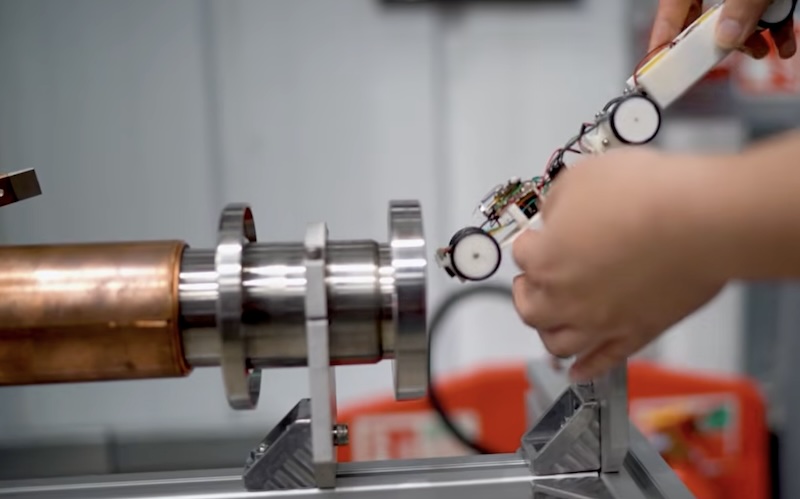
To solve a maintenance issue with the Large Hadron Collider (LHC), CERN — the European Organization for Nuclear Research — has enlisted the help of The Remote Applications in Challenging Environments (RACE) robotics center at UK Atomic Energy Authority (UKAEA). The solution comes in the form of a mouse-size robot that can travel several kilometers within beamline pipes to inspect for damage. Despite its miniture proportions, it could have big implications for CERN, earning the robot a “highly commended” nod for The Engineer’s Collaborate to Innovate (C2I) Award.
The Beamline Maintenance Challenge
The LHC contains beamlines that accelerate particles and help physicists unlock fundamental principles of subatomic matter. These beamlines are surrounded by superconducting magnets (magnets with no electrical resistance that can produce very high magnetic fields), which require cooling to -271 °C (-455.8 °F) and to be kept under an ultra-high vacuum. They are also located deep within the infrastructure of the facility, so if any issues arise, it makes manual access and inspection by humans very difficult.
This is why CERN is turning to robots, as the conventional approach uses a manual endoscope to identify any issues, like the degradation of small components. “At this stage, the robot is only tasked with identifying the defects and informing the human operators to take necessary actions rather than fixing them,” explains Lushan Weerasooriya, principal control systems engineer and group leader at UKAEA.
The LHC contains around 2000 PlugIn Modules (PIMs) that help the beamline handle the expansion and contraction of the pipes as the temperature changes. Radio frequency (RF) fingers in PIMs are designed to maintain electrical contact but can bend as the temperature changes. These are often the components that need to be replaced because even the slightest deformation inside the beamline pipe will disrupt the operation of the LHC.
Weerasooriya told A3 that “pushing a single endoscope for 3 km is almost impossible due to friction build up. CERN is currently using a 50-meter-long endoscope and does the inspection in sections, but opening the LHC in many places has a significant cost and time impact as these openings then need to be closed and sealed to hold the ultra-vacuum conditions.” Instead of 50 meter sections, the robot only requires a pair of openings 3 km apart, so it will solve a lot of these manual issues.

Get the Training You Need for a Safer Workplace!
Autonomous mobile robots are one of the fastest-growing segments of the robotics industry. During this live virtual training, you'll be introduced to safety protocols and best practices for working with mobile robots in industrial settings.
Learn more and register now for upcoming training dates.
A Big Challenge for a Small Robot
The small internal diameter (as small as 3.7 x 3.7 cm) of the LHC beamlines means that a small robot is required. The robot has been called PipeINEER, playing on the words “pipe” and “pioneer”, and is only 20 cm long and 3.7 cm wide. It has been designed to travel for 6 km on battery power alone and has been built to be reliable for long range inspection. Weerasooriya told A3 that “the robot’s materials were selected for vacuum compatibility and is controlled by a microcontroller and other custom-made electronic circuit boards”.
When the robot moves, it captures detailed images of the PIM and uses AI trained on LHC images to detect abnormalities. “Images are captured by an on-board camera and saved in an SD card for operators to access. In addition to the camera, it has multiple sensors which include LiDAR, IMU, and various temperature sensors,” says Weerasooriya. “AI edge impulse technology is used to assess the internal images of the LHC and identify defects. Upon exit, the robot will inform the operators of the locations of the defects it has identified”.
Given the operational constraints, reliability is a big characteristic of the robot. “We have made it reliable by creating a design that is suitable for the size constraints and adding safety features in electronics layer and software layer to continuously monitor its health and detect if it gets stuck,” explains Weerasooriya. When asked about what happens if it did get stuck, Weerasooriya told A3 “the operators are informed of the checkpoints it passes along the way, and they will be able to open the necessary short section and remove it without affecting the whole LHC”.
The PipeINEER robots are currently in the development stage with plans to test them over 60 km of operation in early 2026, followed by manufacturing later in 2026, and deployment in 2027. Weerasooriya confirmed to A3 that “CERN will start to deploy these robots for routine inspections, and once this stage is successfully completed, further use cases, such as repairs of certain defects, can be looked into as well.”

Association for Advancing Automation
Discover how Association for Advancing Automation can support your automation journey with their complete range of solutions and expertise.
Visit Company Website


What are Edge Servers and How are They Used?
Edge servers are powerful computers put at the network edge where data computation needs to happen.