
Industry Insights
Scientists Utilize Underwater Drones to Monitor Life in Coral Reefs
Coral reefs are one of the most biodiverse places in the world. A quarter of all marine species can be found among them, though they only occupy 0.01% of the ocean. They are, however, under immense threat. There is also an urgent need to monitor familiar reefs, and to learn more about unexplored areas.
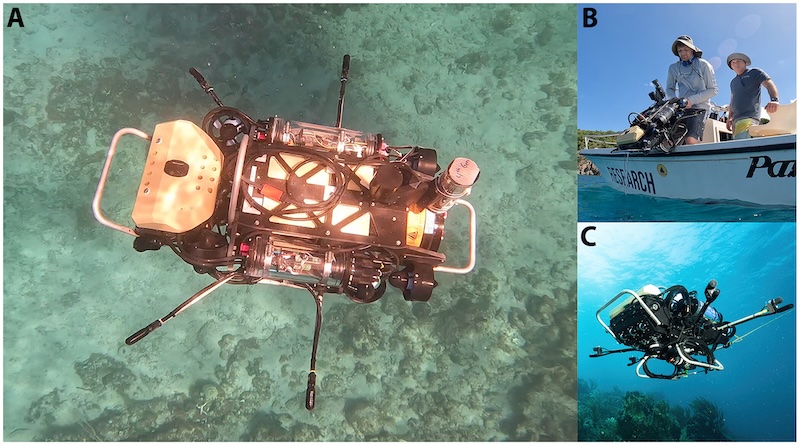
Researchers from Woods Hole Oceanographic Institution (WHOI) have developed an autonomous underwater vehicle (AUV) called Curious Underwater Robot for Ecosystem Exploration (CUREE) that uses audio and visual data to map hotspots of biodiversity with high precision. The robotic system can identify where marine life concentrates to better understand and protect these critical ecosystems.
WHOI's Yogesh Girdhar, who serves as one of the team's lead researchers, told A3 ,“Coral reefs are in decline worldwide and there are various ongoing monitoring, conservation, and restoration efforts happening around the world. We were originally motivated to find scalable solutions to monitor the biodiversity on a reef to monitor changes in reef ecology. However, the problem is intractable using current technology. This motivated us to work on the simpler problem of finding regions of high bioactivity that are correlated with biodiversity hotspots and hence makes the biodiversity monitoring problem tractable by enabling practitioners to focus on most relevant regions."
The CUREE AUV Robot
CUREE contains a range of cameras, hydrophones, and on-board computers to analyze both audio and visual signals in real-time. This dual sensing approach enabled the researchers to identify regions with high biological activity. This directly captured information was used alongside indirect information, which was inferred from the known environment, to identify and map the reef biodiversity, offering insight into reef health and resilience.
“Reefs are generally species rich, but they are also not homogeneous places. There are pockets of biological activity, such as cleaning stations and huge pillar coral, which act as ‘community’ centers and play important roles in the ecosystem, and we wanted to find them,” says Girdhar. "We leveraged not only what we see in terms of biodiversity and bioactivity, but also what we can hear. Lots of aquatic fish and invertebrates make sounds and finding these spots may be the first pairing of this bio-acoustic-visual-diversity on a reef."
Reef surveys are usually performed by trained divers, but this is expensive, limits coverage across the reef and is often hazardous. The CUREE has been designed to operate autonomously for hours at a time and can precisely locate itself on the reef to capture data over large coverage areas. The approach provided a high resolution that enabled the mapping of coral reefs at the centimeter scale―and not only mapped where biodiversity was concentrated, but the AUV could also be used to find new hotspots in unexplored areas.
The use of visual and audio information is the cornerstone of the robot’s success because while acoustic sensing can detect animals from tens of meters away, coral reefs are very busy places with lots of camouflaged and hidden animals. The cameras, however, provide detailed, species-level information over short ranges, so combining the two provides a much clearer picture than when either are used on their own―the sum becomes greater than its parts.
Field Test in the Caribbean
The researchers tested the AUV in field tests across three expeditions (2022-2024) in the U.S. Virgin Islands to a reef known as Joel’s Shoal. “Joel’s Shoal was first discovered by WHOI scientist Dr. Joel Lopiz, while he was being towed behind our research boat as we were looking for reefs to study [the old school way],” says Girdhar. "It is unique in that it has high fish and coral biodiversity, while being isolated from other nearby reef structures."
On the uniqueness of the reef, Girdhar told A3 that, “It is essentially a well-defined hotspot, surrounded by regions of low biodiversity on all sides. Even within this shoal, the north side has a large Dendrogyra (pillar coral), which acts as a habitat for a large number of fish, making it a hotspot within a hotspot. This well-defined spatial and biodiversity structure made it a great candidate for validating our work”.
During these field tests, the CUREE consistently identified the same hotspot, i.e. the pillar coral. The visual survey of the reef showed that the fish density was around 25 times higher around the pillar coral than it was the rest of the reef, and the acoustic sensing confirmed that there was a high biological activity across a wide area of the reef.
During these studies, the AUV also followed a barracuda as it moved through the reef and was able to identify a hotspot/area of ecological importance by observing where these ‘sentinel species’ regularly return to. These areas are critical for ensuring that reefs stay healthy as areas of intense biological activity facilitate feeding, shelter, and reproduction in the reef. Tracking these patterns and linking them to reef structures now gives scientists a better way to monitor reefs and understand what processes sustain healthy reef ecosystems.
What’s Next?
When asked what the plans are going forward to improve on the developments to date and ensure that reefs are better protected, Girdhar concluded to A3 that, "Our plan is to continue to make progress on the broader theme of ecosystem monitoring through progress in robotics and AI. We need improved capabilities in our robots for monitoring marine ecosystems. They need to be more agile, run longer, deeper, and faster, while not disturbing the wildlife and the ecosystem they are observing. We need to build larger and more comprehensive AI models of marine ecosystems, that go beyond reefs and include all life forms, from microbes to megafauna."

Association for Advancing Automation
Discover how Association for Advancing Automation can support your automation journey with their complete range of solutions and expertise.
Visit Company Website


