
Industry Insights
Sanctuary, Psyonic, and Kinisi Founders Discuss Humanoid Hands
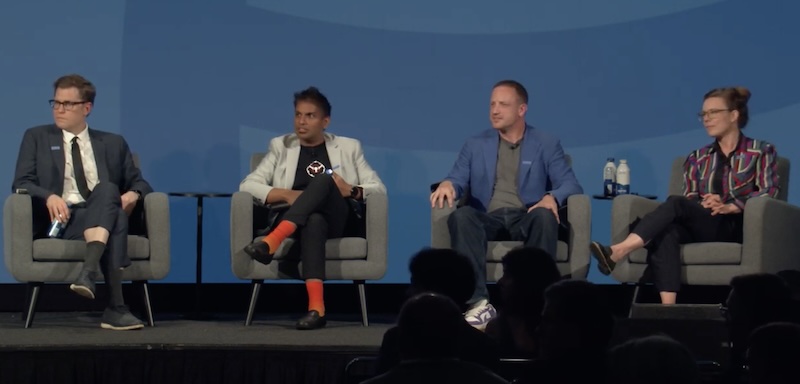
We closed both days of this year’s Humanoid Robot Forum with three-person panels, designed to offer a bigger picture of the industry halfway through 2026. It’s a nice way to balance a series of one-person presentations, engaging in conversation, while taking a pragmatic look at the challenges the form factor currently faces.
The day two panel (which we’ll explore in an upcoming piece) featured Ani Kelkar (McKinsey), Erin McColl (Toyota Research Institute), Elizabeth Samara Rubio (Noble Machines), and Rebecca Yeung (Silicon Foundry, Dexterity) discussing questions of scaling and deployment.
On day one, I spoke with Aadeel Akhtar (PSYONIC), Olivia Norton (Sanctuary AI), and Bren Pierce (KINISI) about humanoids’ other biggest problems: namely dexterity and data collection/training. But before all of that, we had to address the bear in the room. Kinisi, which made its Automate debut by winning 2025’s Startup Challenge, just revealed it had been acquired.
“I sold the company yesterday. To my other company. It's very similar to Elon Musk,” Pierce winked, “you take one company, sell it to your other one.” The CEO cofounded restaurant automation firm Bear Robotics in 2017, before serving as chief robotics officer for the next four years.
In 2023, he founded Kinisi with chief of staff Shannon Needham. Among the U.K. company’s guiding philosophies is a drive to “build robots that actually get work done.” That entails utilizing available technologies, rather than the full-stack from-scratch approach currently driving many of the company's bipedal competitors.
Perhaps the biggest shortcut to deployment was the design to build a bidexterous humanoid torso on top of Bear’s wheeled base and navigation stack.
“For the last six months, I found myself repeating what I was trying to do before at Bear,” he adds. “ ‘Okay, now I need to mass-produce this, I need fleet management, over-the-air updates, navigation, a sales team. And at the same time, I know a company with 300 employees that's already doing all of this.’ ”
That philosophy highlighted another factor separating Kinisi from competitors. One key factor driving massive funding rounds is the aforementioned push to create a full-stack approach. Even so, some of the biggest firms are still relying on third parties for certain production elements, including manipulators. That, in turn, has opened a huge new revenue stream for Psyonic, which was founded as a prosthesis startup.

Get the Training You Need for a Safer Workplace!
Autonomous mobile robots are one of the fastest-growing segments of the robotics industry. During this live virtual training, you'll be introduced to safety protocols and best practices for working with mobile robots in industrial settings.
Learn more and register now for upcoming training dates.
Akhtar said the potential was clear when a massive tech firm first reached out about using its five-finger hands for robotics.
“When we first went nationwide with the Ability Hand, it was mostly prosthetics,” he explained. “But Meta was an early buyer, about four years ago. It's really because of advances in physical AI that we've seen an explosion on the robotics side, to the point where it's overtaken the prosthetics side.”
Apptronik and Hexagon have both signed on to use a version of the Ability Hand in their robots. ABB, meanwhile, recently announced it will be employing Pysonic’s technology for data collection purposes. Kinisi’s use of off-the-shelf graspers is focused on removing as many barriers to market as possible, while Pysonic’s highly sophisticated (and pricey) hands point to a longer-tail, general-purpose approach to market that will almost certainly require a longer runway.
“There are plenty of tasks that have already been automated on factory floors with parallel jaw grippers and suction grippers,” said Akhtar. “But a lot of the tasks where those fall short involve deformable objects — like, if you have a Twinkie, and you grip it too hard, you crush it, and if you don't grip it hard enough, it slips out. Or an eyedropper task, like the one in the video, which requires a certain amount of precision. If you're handling a lot of differently-shaped objects, requiring different tools, doing a tool change becomes another failure point for the robot.”
Sanctuary, meanwhile, has shifted its focus over the past few years. The B.C.-based company was among the earliest members of this humanoid cohort. Much of their work, however, has become hyper-focused on the challenges surrounding mobile manipulation.
“There's a lot of interest, as Aadeel mentioned, in bringing dexterity to existing industrial hardware and arms, because it provides a level of capability that's not currently present in the off-the-shelf market,” noted Norton, Sanctuary’s cofounder and CTO, and that's true across the board, in terms of the outreach and interest we're hearing. They understand there's a future for dexterity in this broader sense, and while they may be working through the lower-hanging fruit right now — tasks automatable with a simple gripper — they know that future is coming.”
Association for Advancing Automation
Discover how Association for Advancing Automation can support your automation journey with their complete range of solutions and expertise.
Visit Company Website


The Rise of Mobile Manipulators: AI-Enabled Robots Find Place in More Applications
Mobile manipulators combine automated mobile robots with robot manipulators and AI for an intelligent mobile solution
CES 2026: Qualcomm Targets NVIDIA Jetson with New Robotics Developer Platform
Following its Arduino acquisition, the mobile giant is promising big partnerships with a platform aimed at scaling systems.