
Industry Insights
Rovex is Speeding Up Patient Transport With Robots
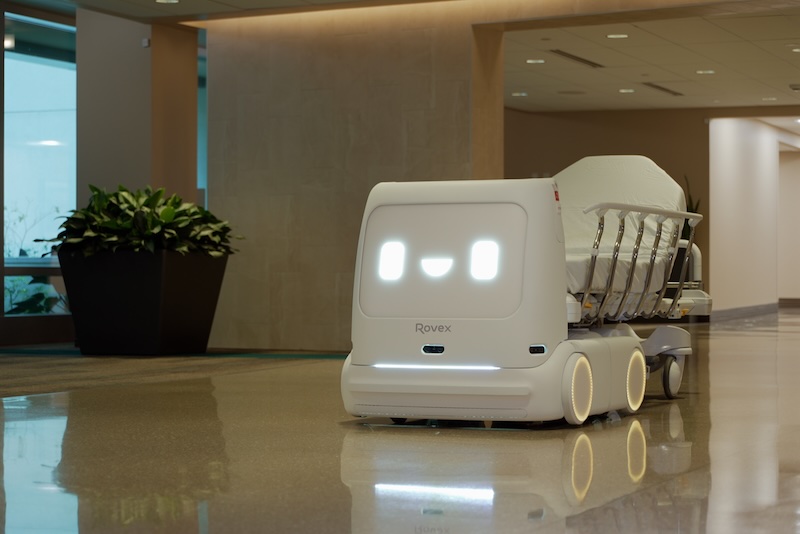
David Crabb witnessed healthcare bottlenecks firsthand, as an E.R. doctor. Patient transport remains a major issue, as it still requires people physically pushing beds and stretchers around potentially sizable hospitals and healthcare facilities. It was an issue that, Crabb believed, could be solved by robotics.
The result was Rovi, a patient transport robot that attaches to stretchers, autonomously moving them around healthcare facilities. The systems include a screen that keeps patients informed of where they are going and why. In the future, Rovi will bring similar functionality to hospital beds and wheelchairs.
Rovi is produced by Rovex, where Crabb currently serves as CEO. He told A3 he initially considered redesigning hospital beds so that they’d be able to move themselves. He instead opted for the Rovi approach, believing it could improve adoption.
“I've implemented a lot of technology in hospitals in my role,” Crabb said. “New tech, that's exciting, but when people have to change around the new tech, that can really decrease your adoption rates, even if you have really exciting tech. The actual implementation is almost just as important as the solution itself.”
Crabb had no robotics experience to speak of when he launched Rovex, he did, however, have a background building tech for the healthcare sector. He taught himself to code in high school and built software that would automate DNA string sequencing for a colleague while working in a microbiology lab at age 18. This software saved his colleaguse days of work and was the first of many software programs he designed.
Crabb started thinking about this patient transportation problem as early as 2021 and started tinkering with potential solutions shortly after. He launched and self-funded Rovex in 2024 and hired a team of engineers to start working on developing the bot. Once they had a promising prototype, he left his job at the hospital to work on Rovex full time.

Get the Training You Need for a Safer Workplace!
Autonomous mobile robots are one of the fastest-growing segments of the robotics industry. During this live virtual training, you'll be introduced to safety protocols and best practices for working with mobile robots in industrial settings.
Learn more and register now for upcoming training dates.
Rovis aare integrated into healthcare systems in a manner similar to how Roombas go to work in the home, Crabb said. When Rovex begins to work with a new healthcare system, their software maps the entire building and builds a digital twin. After that, Rovi begins training in Nvidia’s Omniverse simulation
Crabb understands that people may be wary about interacting with robots especially in a stressful environment like a hospital. He said Rovi’s sensors and systems can’t record human faces for privacy reasons and that they designed the bot to look nonthreatening.
“That's why we focus so much on the look of the robot to make sure that people feel comfortable, disarmed, because people are vulnerable. They're not having a good day when they're in the hospital,” Crabb said. “If people can at least crack a tiny smile when they see Rovi rolling around the corner to help them out, then we've won.”
Rovex launched its first pilot program with the BayCare Health System at its Morton Plant Hospital in April. Once Rovex maps the hospital for a pilor, Rovi goes to work retreiving empty stretchers, an important task on its own, to help it continue to train and improve before it starts to move any actual patients.
The company hopes to have two to three pilots going by the end of the year, which seems reasonable considering Rovex is seeing strong inbound demand from hospitals almost daily, Crabb said.
“I think that this is a really exciting opportunity to have a tangible benefit, a tangible win for all parties,” Crabb said. “My dream is that our healthcare workers are able to have longer, happier, healthier careers longterm, and be able to spend a little more time with patients. I think we're going to get there.”
Association for Advancing Automation
Discover how Association for Advancing Automation can support your automation journey with their complete range of solutions and expertise.
Visit Company Website


How Robotic Automation is Revolutionizing Medical Laboratories
Medical laboratories are essential for conducting scientific research, developing new drugs and diagnosing diseases. However, many of the tasks involved in
Automating Pharmaceutical Applications in an AI World
Midwest Engineered Systems has been leading the way by providing robotically automated solutions for the pharmaceutical and healthcare industries.
Vision Alleviates Pain Points in Life Sciences Market
With global healthcare spending expected to increase by 4.3% over today’s unprecedented levels, the life sciences market represents a massive...