
Industry Insights
Robot Fish Could Help Us Understand How Fish Evolved to Walk on Land
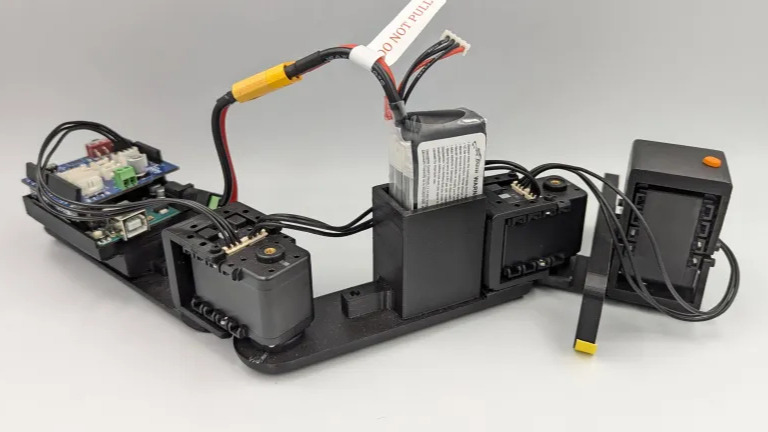
Science has long sought to understand how animals evolved and moved onto land millions of years ago. Researchers are now using robots to mimic how modern-day fish walk on land, in hopes of forming a better understanding of how their ancestors evolved similar abilities millions of years ago.
“This research is borne out of research questions about the history of life; more specifically, about how ancient aquatic species from hundreds of millions of years ago started to develop the ability to move on land,” says Michael Ishida, the leading researcher on the study. "This is one of the great transitions in evolutionary history that we’re very curious about – how and why did these animals that were well-equipped for aquatic environments start to first become terrestrial? What are the minimum requirements for a fish to be able to start walking on land?"
By studying computer models, along with modern fish behavior, the team determined that a wide range of unrelated fish species have all independently evolved the same walking style. Called the ‘undulating tripod gait,’ it mimics a swimming motion on land. It resembles a fish ‘flopping’ around on land and is a very simple locomotion ― fish propel themselves forward and at the same time use their heads or front fins as support. While the gait of individual fish has been well-documented, it’s the first time that a unified locomotive mechanism has been identified across multiple unrelated species.
“We’re very interested in fish locomotion because of this evolutionary question. We’re studying the early terrestrial vertebrates which were fish or fish-like animals, so it’s a natural place to begin this study of the basics of terrestrial locomotion,” Ishida told A3.
Computer models were based on the movements of Polypterus senegalus¸ which is a grey bichir native to Africa. The model found that several other fish species, including catfish, lungfish, snakehead, and sculpin, all shared similar modes of locomotion to the Polypterus senegalus, even though they were not directly related and were geographically separate.
It’s thought that convergent evolution is the reason for all these species showing the same locomotion gaits on land, meaning the different species evolved similar traits independently. However, understanding this in more detail helps to better understand how the first fish made that initial transition from water to land and set off the evolutionary motion that has led to our biodiverse world today (including us humans). The ability for some fish to walk on land, even in the modern-day, is an evolutionary benefit that helps fish to escape predators and move between shallow-water environments.
After realizing that multiple fish have this same gait, and that many of their ancestors might have used a similar gait to first walk on land, the researchers built a robot fish to test their results. The undulating tripod gait in the robot closely matched both the bichir’s movements, as well as the computer models. Other gaits were tried during this process, but the robots were much slower with other gaits, and changing how the body bent, or its bending sequence, took the robot fish further away from the bichir. The optimal walking pattern set out in the simulation and the robot directly matched the modern-day fish.

Get the Training You Need for a Safer Workplace!
Autonomous mobile robots are one of the fastest-growing segments of the robotics industry. During this live virtual training, you'll be introduced to safety protocols and best practices for working with mobile robots in industrial settings.
Learn more and register now for upcoming training dates.
“We’ve created a simple model of a very basic walking gait that is shared among a number of fish species that exist today. Because it’s a very basic motion that has very few morphological requirements, we think that it has evolved separately in the extant species that we studied and is a plausible gait for the first ancient fish that were capable of terrestrial walking. We obviously can’t directly observe the walking motion of extinct fish, but the simulated and physical robots that we’ve made give us some real data to support these idea,” says Ishida . "This work is an example of how robots can be used to study big basic science research questions that none of biologists, paleontologists, or engineers can answer on their own."
The model and robotic pairing can now be taken forward to looking at how fish might first have walked on land. One fossilized fish that is being targeted is Tiktaalik roseae, an important fossil link in the transition from water to land. This fish did have true stepping gaits, but did have girdles and fins that might be suitable for the undulating tripod gait. Going forward, a similar approach to using computer models and robot fish can be used to determine if this was indeed the way that the first fish made it onto land.
“We’re very interested in continuing to study walking fishes. Now that we’ve created very high-level robotic models that describe common gaits of many species, we could potentially narrow the scope to robotic models of specific species. For example, we can use scans of actual fossils to 3D print robot parts that reproduce the anatomy of extinct fishes that we actuate using robotic artificial muscles,” says Ishida. “These paleo-inspired robots could be used to directly study how features seen in the fossils affect what locomotory gaits are plausible or implausible from experiments on force production or energy usage of the robots. We’re just scratching the surface of how robots can help us learn more about the evolution of ancient life."
When asked about could these robots have any other applications beyond evolutionary understanding, Ishida concluded that, “besides the basic science questions, this is a step forward toward starting to understand multimodal locomotion in robots, which in this case is the ability for one robot to be able to both walk and swim. You can probably imagine a lot of the commercial robots you’ve seen – they’re well-equipped to either swim or walk but most likely can’t operate both on land and in water. It’s still a way away from a truly practical application, but by studying more about the basic requirements for terrestrial locomotion of a robot which has a body based on a swimming animal, we can use these findings to build multi-environmental robots”.

Association for Advancing Automation
Discover how Association for Advancing Automation can support your automation journey with their complete range of solutions and expertise.
Visit Company Website


