
Industry Insights
Researchers teach a robot dog how to throw
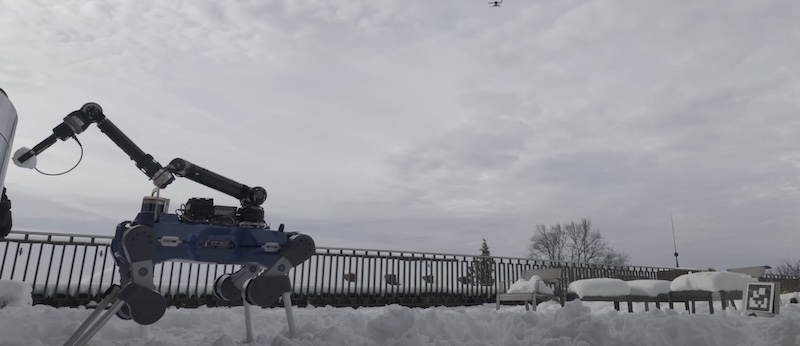
Learning to throw is a treasured memory for many. Baseballs, footballs, snowballs – each represent fundamental pieces of childhood. Like many things developing humans pick up quickly, however, throwing presents a unique challenge for robots.
Researchers at ETH Zürich tasked themselves with the challenge, utilizing an arm mounted to the back of a robot quadruped. As they note in a newly published paper, throwing represents more than a fun bit of diversion here. It could eventually serve as a valuable skill in its own right, “enabl[ing] robots to manipulate objects in ways that extend beyond the reach of their arms.”
The work took a “whole-body” approach to the task, utilizing momentum from the entire system to improve force and accuracy in much the same way people do. There are a number of challenges in creating accurate robot throws, including some that might not be immediately obvious to the non-roboticist.
Take the material of the object, for example. Different surfaces present different levels of friction, while some materials are more easily deformed than others. Each of these have an impact on when the gripper should release the object for maximum accuracy. There’s plenty of coordination involved, as well. Joints and motion all need to be taken into account – another one of those things we tend to take for granted when throwing.

Get the Training You Need for a Safer Workplace!
Autonomous mobile robots are one of the fastest-growing segments of the robotics industry. During this live virtual training, you'll be introduced to safety protocols and best practices for working with mobile robots in industrial settings.
Learn more and register now for upcoming training dates.
The framework enabled the system to throw objects more accurately than humans in a study conducting among university students. The robot achieved a 56.8% accuracy rate when tossing objects at small targets placed three to five meters away. That’s a significant advantage over the 15.2% the students were able to hit. One imagines the students polled weren't starting pitchers from the school's baseball team, but impressive results nonetheless.
“Our experiments confirm the framework’s ability to achieve fast and accurate throws, resulting in the average of 0.276 m landing error when throwing at targets located 6 m away, improving accuracy by 49.5% over the baseline and significantly outperforming humans in our comparative study,” the paper notes. “To our knowledge, this is the first reported instance of whole-body prehensile throwing with quantified accuracy on hardware.”
The results are promising, but there’s still work to be done. Improvements to tracking will be an essential part of improving throwing accuracy, going forward.
Association for Advancing Automation
Discover how Association for Advancing Automation can support your automation journey with their complete range of solutions and expertise.
Visit Company Website


RAMBO Helps Robot Dogs Balance on Hind Legs, While Carrying Objects
A new framework allows robot dogs to perform tasks with their front legs without following.
Cybathlon & Maxon: The Gold Partnership
Drive specialist maxon has been part of the Cybathlon right from the start. Without hesitation, maxon also joined the third editi
maxon Drives Help People Walk Again
Swiss motors are driving exoskeletons all over the world.