
Industry Insights
Researchers Inspired by Snails for Robotic Drug Delivery
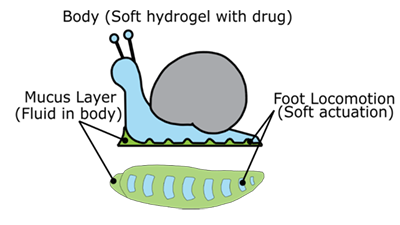 Researchers are continually finding new ways to deliver drugs to patients, and taking inspiration from nature is often one of the best ways to tackle a new challenge — because as they say, nature is the best scientist. The approach called biomimicry — mimicking natural systems when creating synthetic systems — is becoming increasingly popular, and researchers from the University of Manchester, U.K., have taken inspiration from snails and are developing new robotic drug delivery systems for colorectal cancer.
Mostafa Nabawy, one of the lead researchers told A3, “The idea originated after a successful spider-inspired robotics project. The project was initially shelved due to soft-robotics challenges, including a lack of adequate simulators, requirement for customizable high-strain materials, and a suitable use-case to justify the effort.”
However, despite previous challenges, Nabawy confirmed to A3 that “Five years later, it was suggested that modern GPU approaches could produce the necessary simulations, while customizable polypeptide techniques could provide the soft biomaterial components required for colonic drug delivery”.
Colorectal cancer is difficult to treat through precision medicine because targeted anti-cancer treatments struggle to target the colon, and this causes adverse side effects in other parts of the body. The snail-inspired robots hope to change this by delivering therapies to tumor locations in the colon with highly targeted, region-specific precision.
Mohamed Elsawy, another lead researcher in the project, told A3 that there are “currently no effective targeted or localized drug delivery formulations for bowel cancer, so our approach will be transformative”.
Snail locomotion and its biomechanics is an area that is underexplored. The researchers in the project (which has funding close to £1 million) plan to generate an experimental dataset on snail movement, mucus interactions, and foot actuation that will drive the development of advanced digital simulations and machine learning driven control systems.
These mechanistic insights will drive the design of new soft robots constructed from peptide-based bionanomaterials and will be designed to be unaffected by external magnetic fields but will be controllable remotely from outside of the body.
“Gastropod mollusks, such as snails, use slime-based locomotion and can survive in extreme environments, including as intestinal parasites” says Nawaby “their locomotor mechanism provides high precision, low speed, and substrate-independent body movement, which will enable regiospecific localized drug release, for enhanced bioavailability in malignant tumors”.
Inspired by the slow, controlled, and adaptable movement of snails, the soft robots will mimic the slime-based locomotion mechanisms to navigate the gastrointestinal tract with a high accuracy. The robots will then anchor themselves on to the target tumor tissue and release the therapeutic load held by the robot in a controlled manner. By controlling the release at the target site, it should not only increase the drug bioavailability, but it will also reduce the off-target toxicity to improve patient outcomes.
“Snail-inspired locomotion and selective bio-adhesion to cancer tissues will provide both flexibility of navigation and high-precision localized delivery,” says Elsawy. “It will also circumvent limitations associated with systemic targeting of nanocarriers, including nanotoxicity, immune clearance, short circulation time, and physical instability.”
On the delivery itself, Elsawy confirmed that “The localized robotic delivery will significantly improve drug bioavailability in tumor tissue, enhancing both clinical outcomes and patient quality of life when compared to the traditional systemic administration of highly toxic combination chemotherapy.”
The research project also plans to create a digital twin framework that integrates biomechanics, robotics, bionanomaterials and cancer biology to enable researchers to model different robot–tissue interactions before taking them to clinical trials and further clinical development.
The research is still ongoing with many avenues to explore and Nabawy concluded the discussions with A3 by stating, “We are still doing the research and our targets are to deliver detailed data on snail biomechanics that is new to science, to design biocompatible soft actuators with controlled mechanical and responsiveness properties, to discover novel actuation strategies and kinematic configurations in soft-robotics, and demonstrate a step-change in colorectal cancer treatment through regiospecific delivery of drug cargo to malignant tissues”.
While the initial plan is geared towards improving colorectal cancer treatment, it has been suggested that the soft robots could have further reaching applications in endoscopy procedures, environmental and industrial micro robotic operations, pipeline inspection, and agrifood systems.
Association for Advancing Automation
Discover how Association for Advancing Automation can support your automation journey with their complete range of solutions and expertise.
Visit Company Website


