
Industry Insights
Researchers are developing an open-source, modular robot exoskeleton
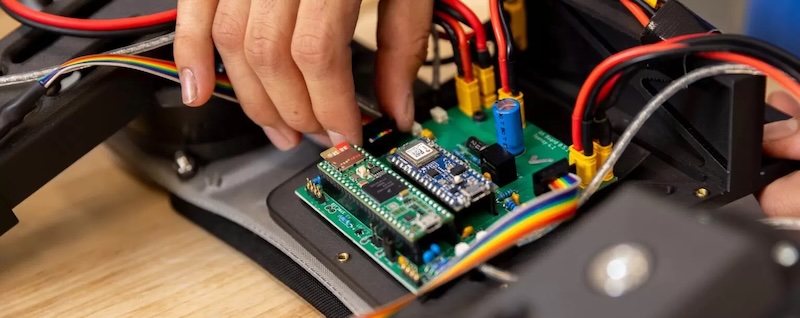
Over the past decade, exoskeletons have emerged as one of the most exciting categories for robotics research. They've also grown into a lucrative avenue for startups leveraging the technology to take some of the physical burden off of blue-collar workers and improve movement for people with mobility issues.
It’s one of those ideas that seems perpetually on the cusp of a mainstream breakthrough, but there remains a barrier of entry for those looking to embrace the technology. Researchers at the University of Michigan are hoping to make the world of wearable assistive robotics more accessible through OpenExo.
The project, which is highlighted in this month’s Science Robotics, is an open-source, modular approach to exoskeletons. Researchers are building the platform to decrease the cost and time currently required to develop a system.
“Our hope is that OpenExo will accelerate the development and testing of new exoskeleton designs and control schemes while simultaneously encouraging others,” the team notes, “including those who would have been turned away from entering the field, to explore new and unique research questions.”
ROI Calculator

Discover the potential cost savings of robotic automation over a 20-year system life
This calculator compares your current manual labor costs against the total cost of owning and operating a robotic system over its 20-year lifespan.
As such, all aspects of the software and hardware design are free for other researchers to access and use in their own work. That includes electrical schematics, code, a Github repository, and a wiki with a bill of materials and build guides.
Modularity is the other key factor here, allowing researchers to swap relevant components in, as needed.
Per the paper,
The modular hardware components include an untethered waist belt that houses the electronics and supports up to four motors at a time, with direct-drive and Bowden cable–based transmission options. The customizable software includes an open-source exoskeleton control package designed to have a high degree of modularity to accommodate new joints, motor types, sensors, and control approaches, including the ability to plot and store data, update controller parameters, and provide biofeedback. I2C, interintegrated circuit; SPI, serial peripheral interface.
The relevant information can be accessed over on the OpenExo site.

Association for Advancing Automation
Discover how Association for Advancing Automation can support your automation journey with their complete range of solutions and expertise.
Visit Company Website


How to design an exoskeleton
An exoskeleton must be lightweight, compact, powerful, reliable, and
Harmonic Drive launches new super-flat actuators
Harmonic Drive LLC, the leader in high precision motion control announces super-flat actuators.
“driven” explains the factory of the future
Digitization and automation will completely change the way we develop and produce products.