
Industry Insights
Research, Rockets, Raas: Generative Bionics' Journey to Industrial Humanoids
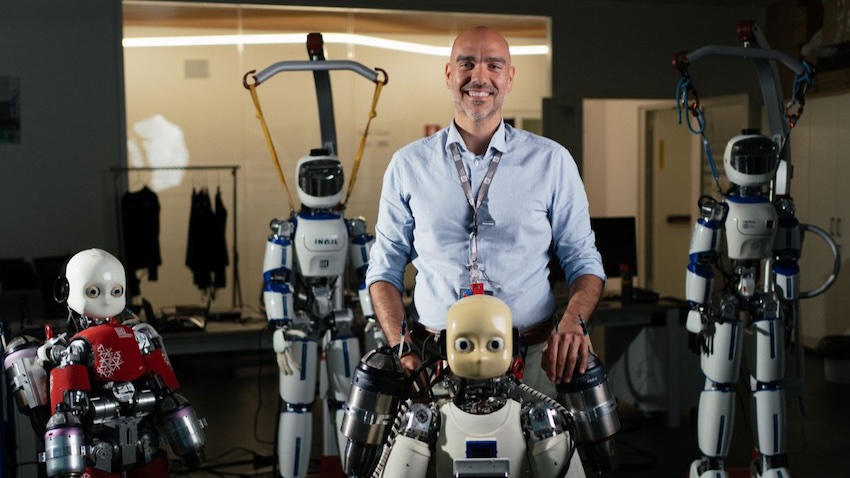
In 2020, the iCub project forked. Eleven years after the open-source robotics humanoid entered the world, it would be pulled in two distinct directions. Jetpack-sporting iRonCub made a splash last June, when its third official release achieved liftoff. iRonCub3 landed in Nature Communications Engineering and various international publications by hovering with stability at around 50 cm (~20 inches) off the ground.
The Istituto Italiano di Tecnologia’s (IIT) other successor to the doll-headed research robot has taken an arguably less glamourous road — it went to work.
“ergoCub is a project that develops technologies to catalyze the necessary digital transformation for reducing the number of musculoskeletal diseases related to biomechanical risk in future workers,” IIT writes of the project. “This objective is pursued by developing wearable technologies, humanoid robots, and artificial intelligence while monitoring the acceptability of these technologies. “
The project’s name derives from a focus on the role of ergonomics in reducing injury risk, specifically for workers in industrial and healthcare settings. Six years after launch, ergoCub would also serve as the foundation for a new robotics startup. At CES in January, Generative Bionics’ Daniele Pucci shared the stage with AMD CEO, Lisa Su, as the silicon giant made a full-throated pitch for entrance into physical AI.
AMD was an early backer, contributing to the Italian startup’s seed round. In a conversation this week, Pucci told me the partnership goes deeper than funding, including edge-based processing and future data center plans. For now, AMD is happy to keep sharing stage time, as Generative Bionics is showcasing its new platform, Gene.01, at the company’s Advancing AI developer conference this week in San Francisco.
Pucci, who spoke to me from the show floor, gestures behind him, noting that the bipedal humanoid was apparently wandering the Moscone Center halls somewhere.
After working on the iCub project for the past 15 years, it’s unsurprising that Pucci has taken a full-stack approach to his latest robot. For the research project, that was largely out of necessity, as the team was also assembling and maintaining the robots, which the professor says were produced “in the tens” of units.
“We were doing software, we were doing the AI, we were doing the control, we were doing the electronics, we were doing the production,” Pucci explained. “We really had the end-to-end integration.”
The full-stack approach to Gene.01, on the other hand, is a reflection of its unique bent on the humanoid space. Marketing materials refer to it as a “platform,” in reference to a kind of hardware and AI modularity at the heart of the system. Pucci compared the approach to the automotive industry, where different makes and models are built atop shared elements such as floorplans, wheelbases, and steering mechanisms. Fittingly, Pucci gleefully noted that the company poached chief production & industrialization officer, Federico Santini, from Ferrari.
“The key to success in our opinion is really modularity,” Pucci explained. “The platform is a humanoid robot, modular in terms of hardware and software. And from this platform, we will derive application-specific humanoid robots for the different verticals. That for us are three: inspection, logistics and manufacturing, and healthcare.”
Modularity from a hardware perspective, means the exterior design and the hands/end-effectors. Pucci offered the example of welding for the shipbuilding industry. The system would require a rugged, outdoor exterior, coupled with end-of-arm tooling designed specifically for that use case. Healthcare, on the other hand, offers fewer opportunities to use a welding torch day to day.
Healthcare does, on the other hand, present issues around safety, as these humanoids will likely be in close proximity to some of society’s most vulnerable. That’s where Generative Bionics’ other big value add comes into play. When I mentioned the “smart skin” the company touts in its recent release,” Pucci explained, “it's not a matter of sensing, it's a matter of safety.” Sensing is the core, of course, with both proximity and touch built in.
“These two kinds of sensing modalities give the robot the capabilities to understand the human presence around and optimize actions depending on the human,” said Pucci. “Imagine, for instance, if an elderly [person] has to grab the arm of the robot, the robot has to feel it, but feel it, and not only react to it, it has to feel it. It can then integrate the optimal interaction with the elderly [person]. So that's the direction that we are going. In order to get safety for human robot integration, you have to add another sensing modality.”
For now, Pucci believes the quickest way to the market is through industrial inspection applications that will require humanoids’ ability to both navigate unstructured environments and manipulate complex objects.
“Unstructured environments like stairs, like others, and then you have to have a degree of manipulation,” Pucci said. “That's where the quadrupeds really struggle. All the attempts of having an arm on top of quadrupeds really failed miserably, because that dexterity level is not enough.”
Association for Advancing Automation
Discover how Association for Advancing Automation can support your automation journey with their complete range of solutions and expertise.
Visit Company Website


