
Industry Insights
MIT CSAIL Director Daniela Rus on the Future of Robotics
Released in 1970, “Songs of the Humpback Whale” profoundly altered human perception of animal intelligence. The collection of bio-acoustic field recordings moved 100,000 copies, becoming the best-selling environmental album of all time and serving as a foundational text for the creation of the era’s Save the Whales movement.
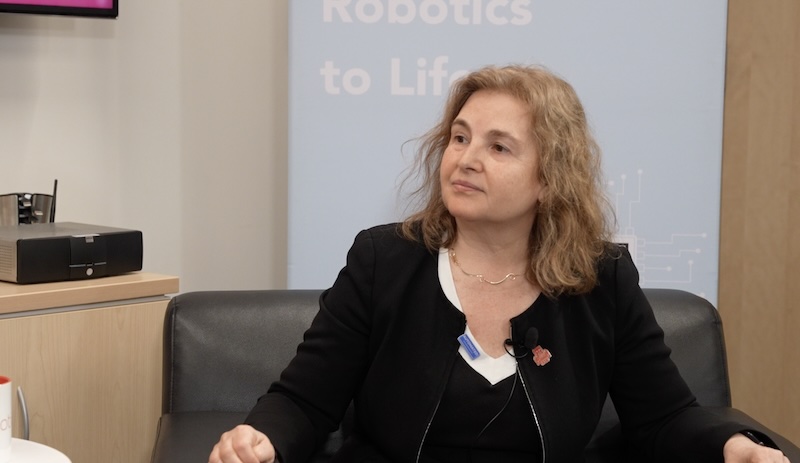
The album’s creator, Roger Payne, devoted the remainder of his life to cetaceans, prior to his 2023 death. During our live podcast kicking off National Robotics Week at MassRobotics’ Boston offices, Daniela Rus recalled the impact the marine biologist had on her own life and work. The MIT professor recounted a talk given by the marine biologist at a meeting of MacArthur Fellows nearly two decades back as sparking her own interest in the topic.
“I still remember going up to Roger to say, ‘hey, I love your whale songs,’” Rus explained, “
Can I make you some robots?” Drones soon replaced a paper, pencil, and a pair of binoculars in the daunting task of documenting whales off the coast of Argentina.
Rus and Payne would cross paths again over the years, including a Harvard workshop a few years after their first meeting. This time, the questions grew larger and more profound. “What if we could someday understand what whales are saying to each other?” Rus told the crowd. “What is part of the communication mechanism, the vocalization, and the song of whales?”
The collaboration between MIT CSAIL (Computer Science and Artificial Intelligence Laboratory) and Project CETI recently answered these questions in surprising ways. Machine learning revealed far more complex nuances of sperm whale language than previously understood by science. Researchers described the discovery of a “sperm whale phonetic alphabet” and were able to determine what they were going to “say” next, based on speech patterns i.e., predictive text for sperm whales.
Longstanding partnerships like these continue to bear fruit. Last month, Project SETI revealed that drones had captured something extraordinarily rare — to human eyes, at least. A group of sperm whales huddled around a massive cloud of blood. Concern soon gave way to wonder, when the researchers realized what they were witnessing: a birth. Non-kin whales had gathered to assist with the birth — a phenomenon they’d not previously witnessed.
Cross discipline work has been a throughline for much of Rus’ work as the director of CSAIL. Throughout our nearly hour-long conversation, we discuss breakthroughs in self-driving cars (ground penetrating radar to spot road landmarks under the snow) and liquid neural networks. We unfortunately didn’t get time to discuss the sea turtle robot, Crush, or the 3D printed bubble robots.
I’ve long considered curiosity one of the greatest assets in my own line of work, and believe the same can be said for Rus’ role. Learning about problems in different fields presents opportunities to connect with technological solutions.
“I see my role as thinking about the future and building programs and bringing ideas for my colleagues to help develop,” says Rus. “I'm very interested in topics that are bigger than an individual researcher's area of expertise. I've been looking at some of the challenges and problems that require expertise from multiple aspects of computing, maybe even reaching out to other disciplines. And how can we then create an opportunity for people to come together and address those challenges?”
ROI Calculator

Discover the potential cost savings of robotic automation over a 20-year system life
This calculator compares your current manual labor costs against the total cost of owning and operating a robotic system over its 20-year lifespan.
Curiosity isn’t just about expanding beyond one’s comfort zone. It can often take the form of adopting a beginner’s mind (to borrow a phrase from Zen Buddhism) approach to familiar territory. Rus alluded to two more projects during a roughly hour-long conversation that piqued my own interest in topics I’ve heard discussed plenty over the years.
The volume of coverage around physical/embodied AI, for instance, has been overwhelming of late. One related avenue that I’ve become increasingly interested in discussing with interview subjects is how a kind of decentralized nervous system functions in the context of embodied AI. Rus pointed to research at MIT that has asked a similar question, and as with the above work, has taken cues from marine animals.
In this case, it’s cephalopods like octopus, whose evolutionary branches split from ours much further back than our whale friends. These and other vertebrae offer a fascinating blueprint for distributed intelligence. Rus suggested that the systems could also allow for a highly flexible form of modularity.
“Most solutions that we have today for robots learn skill in context,” noted Rus. “Are there new ideas that enable the learning of skills that can be then applied to any kind of context through some form of adaptation? A machine that has the kind of sophisticated ability to adapt — how does that machine learn to do new things? Imagine you have a robot with one arm. All of a sudden, you add a second arm to the robot. What can the robot do? There are certain things you can do with one arm. But when you have two arms, then you can have extraordinary richness of things you could do that one arm is insufficient for.”
A final project takes a unique spin on generative AI. Several years ago, when I asked Rus how the technology could be leveraged in robotics, she offered a take I hadn’t heard at the time: design. Last summer, CSAIL highlighted work along these lines, when it showcased how it was using GenAI to dream up robots capable of jumping higher than their human designed versions.
Rus took things even further during our conversation, suggesting a scenario wherein a non-roboticist could describe a system in plain language, which it would then design and 3D print.
“For instance, let's say you want to create a custom robot that automates a lab and needs to operate the syringe,” Rus explained. That robot has to hold the syringe and then has to operate the plunger. These are the degrees of freedom that ultimately have to be mapped to mechanisms. Our system is able to reason through these degrees of freedom and create a mechanism that realizes that task under the specifications that we give. This is actually quite exceptional, because now you don't have to program a 3D printer to make a mechanism that you have to design bottom up with great detail. What you do is you tell your AI engineer, ‘Hey, I need a robot to operate the syringe.’ ”
Association for Advancing Automation
Discover how Association for Advancing Automation can support your automation journey with their complete range of solutions and expertise.
Visit Company Website


MIT’s New Hardware Tool Aims To Democratize On The Job Training For Robots
The new end effector allows for training via tele-op, demonstration, and manual movement.
Test-Time Training Could Help Robot Learning Adapt on the Fly
Researchers at MIT outline a novel AI architecture than can help robots solve hard problems.

Vecna Robotics Appoints AI Scientist Daniela Rus to Board of Directors
Waltham, MA — July 1, 2020 — Vecna Robotics, the autonomous mobile robot and workflow orchestration company, today announced the appointment