
Industry Insights
Humanoids Might Not Be Ready for the Warehouse, But Locus Array Is
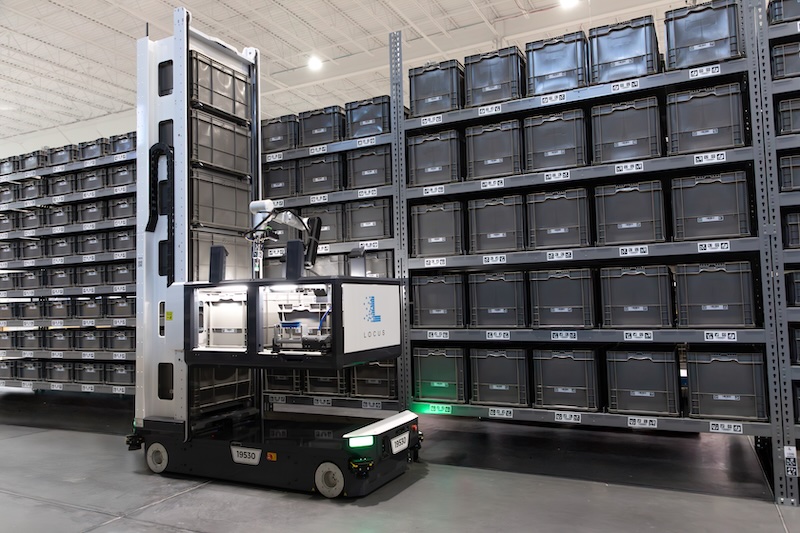
“We don't have our head in the sand,” Rick Faulk notes. “I think at some point, humanoids may play a role doing certain things.” It’s not a concession from the CEO of an AMR powerhouse, so much as an acknowledgement that the much-hyped form factor may, eventually, find its place on warehouse and factory floors alongside Locus’s growing robot army.
“The question,” he quickly adds, “is what and how you can they get an ROI for clients because that's what they're interested in. They're interested in, ‘does it work? Is it safe? And can I get an ROI with that product?’ Eventually, humanoids may get there. I think over the next five years, it's going to be a big challenge.”
Activity at Locus HQ has hit a fever pitch as we sit down for our podcast interview. In a few hours, the company is hosting Boston’s regular Women in Robotics meetup in the same room our film crew is currently occupying. The real all-hands flurry, however, is Modex. Locus always has a big showing, but this year’s event is different. After teasing the product out for the better part of a year, the company is set to officially unveil its latest robotic system.
Until now, Locus Array has been relegated to private meetings, press teasers, and the occasional news piece. Monday’s Modex kickoff represents the official coming out party for the system, which marks a radical departure for Locus’s lineup. Up to now, the line has largely represented iterations on the standard AMR form factor, each revolving around a model wherein the robot autonomously navigates to a human associate who then picks an item off the shelf.
Array is designed to automate significantly more of the process – “reducing manual labor by 90%,” according to the company.
“These jobs and warehouses right now are very hard to fill for clients,” says Faulk. “Turnovers in some accounts are double digits a week. Any worker that we replace with Array will probably find another job within that warehouse. It could be in the packing function, receiving function, that sort of thing. Although we will be reducing labor with Array, for the most part, most every single one of those workers will find another job within the building.”
What jumped out at me upon first seeing system is that it strikes a kind of middle ground between the present (AMRs) and a hypothetical future (humanoids). I’ve suggested for some time now that bipedal robots are a bid to leapfrog that next logical link in the chain – autonomous mobile robots with mobile manipulators.

Get the Training You Need for a Safer Workplace!
Autonomous mobile robots are one of the fastest-growing segments of the robotics industry. During this live virtual training, you'll be introduced to safety protocols and best practices for working with mobile robots in industrial settings.
Learn more and register now for upcoming training dates.
The closest we’ve come to widespread acknowledgement of this notion is the seemingly sudden proliferation of wheeled humanoids. I would suggest, however, that Array hits the nail more squarely on the head. Locus refers to the model as “robots-to-goods” or R2G. Of course, its other AMRs match that description to an extent, but lacked the vital ability to load and unload said goods without human intervention.
Per the press copy, the robot, “handles picking, putaway, induction, drop-off, slotting, and replenishment in one system.” The system looks as though it’s taken some cues from automated storage and retrieval systems (ARSR) like AutoStore, but Locus prides itself in continuing to offer a more brownfield solution.
“It's very hard to automate a building that was built 10, 15, 20, even 50 years ago,” says Faulk. “Really, really hard to do it. There's infrastructure there. There are things in the way. Warehouses are messy places, as you know. Objectively, there are only several companies in the world that can do it. I'm a little biased, but I think we're the best in the world at doing it. We've sort of proven that.”
As an interesting caveat, the CEO adds that Locus’s model has shifted somewhat over the years, with around one-quarter of its business now targeting greenfield warehouses.
Locus has already begun to deploy Array systems to select partners in North America, including – most notably – DHL. It has plans to roll out the system in in the Europe and APAC regions, as well, though it has yet to offer any specifics. The company has utilized safety fences for these early tests, out of an abundance of caution, according to Faulk.
“It felt like the right thing to do because we want to learn and not make mistakes,” he explains. “Array is designed with maximum safety involved. We have a number of safety sensors on it and a number of special braking units on it, because it’s a heavier robot. The safety zone around Array is larger than Origin. With Origins, can walk, literally can dance on Origin. The array won't be quite as nimble as origin. It was never designed to be. It doesn't have to be. But we have a very large safety zone around it.”

Association for Advancing Automation
Discover how Association for Advancing Automation can support your automation journey with their complete range of solutions and expertise.
Visit Company Website


The Opportunities for Autonomous Mobile Robots: Highlights from A3’s CEO Roundtable
Even before the COVID-19 crisis, autonomous mobile robots (AMRs) were changing the landscape across many environments – from factories to

Locus Robotics Announces Technology Collaboration Partnership with RightHand Robotics
Top robotics companies join forces to build automation solutions for high-volume order fulfillment warehouse operations