
Industry Insights
Humanoid’s Alpha Robot Gets Legs, Eyes Home Applications
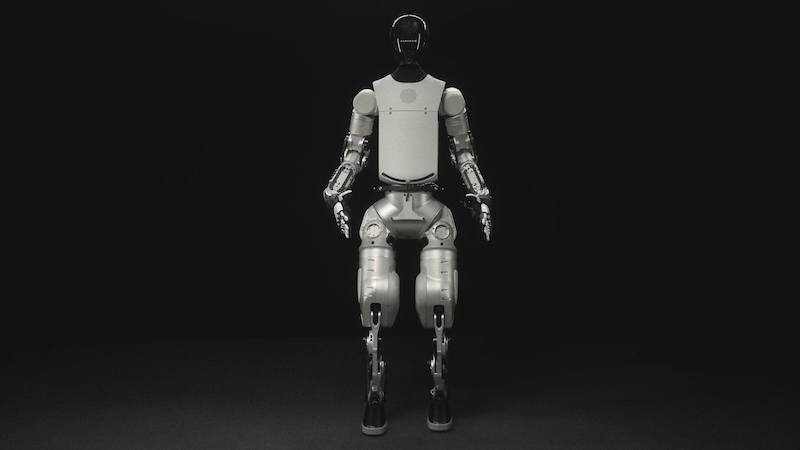
Much like the Little Mermaid before it, Humanoid’s 01 Alpha robot has spent the last couple of months wawnting nothing more than a pair of legs. The arrive this week, as the lower half of the HMND 01 Alpha Bipedal, which, as the name suggests, maintains the London-based company’s modular approach toward an eventual general purpose robot.
Unveiled in September, the HMND 01 Alpha mounted a torso to a large AMR-style wheeled base. It is, in essence, a bi-dexterous mobile manipulator – albeit one that looks a bit more like a centaur than previous ones we’ve seen in the field. The design keeps with the startup’s name, of course, but also the spirit of the broader humanoid form factor, which are designed to slot into existing human spaces.
Conversations around the category have shifted a good deal over the past six months to a year, toward a more Swiss Army Knife approach to robots in the field. That is to say that legs have their place, particularly when it comes to navigating stairs and other terrain and bending down to grab things off the lower shelf. Most of the time, however, wheels will mostly do the trick.
That certainly appears to be the case in the industrial setting, where AMRs have thrived over the past decade. Homes are a lot harder to pin down. As countless robot vacuums have proven out, there are those that can be reasonably covered by a wheeled robot. But again, stairs present a problem, as can rugs/carpets, dirty laundry, and any number of ever-changing obstacles. Looking at the original wheeled HMND 01, it’s also easy to image a big, industrial base having trouble maneuvering through significantly tighter spaces.
Incidentally, Humanoid lists “domestic applications” alongside industrial when talking about the Alpha Bipedal. I asked for some clarification on that front, and will update the piece if/when I receive it. Notably, however, companies including 1X and Figure have increasingly looked at the home as an alternative to a theoretically crowded industrial market.
Of late, factories and warehouses have been considered the low hanging fruit for the category, though there’s already a long line at that specific orchard. In particular, Humanoid appears interested in age-tech, which has been a longtime industry target. Likely that would involve care facilities, prior to deployment in private homes.

Get the Training You Need for a Safer Workplace!
Autonomous mobile robots are one of the fastest-growing segments of the robotics industry. During this live virtual training, you'll be introduced to safety protocols and best practices for working with mobile robots in industrial settings.
Learn more and register now for upcoming training dates.
“HMND 01 is designed to address real-world challenges across industrial and home environments,” CEO Artem Sokolov says in a release. “With manufacturing sectors facing labour shortages of up to 27%, leaving significant gaps in production, and millions of people performing physically demanding or repetitive tasks, robots can provide meaningful support. In domestic environments, they have the potential to assist elderly people or those with physical limitations, helping with object handling, coordination, and daily activities. Every day, over 16 billion hours are spent on unpaid domestic and care work worldwide — work that, if valued economically, would exceed 40% of GDP in some countries. By taking on these responsibilities, humanoid robots can free humans to focus on higher-value and safer work, improving their productivity and quality of life.”
Another trend that stands out in Humanoid’s announcement is the highlighting of development speed. Here’s the headline for the press release, “Humanoid Unveils Record Breaking Bipedal Robot Walking 48 Hours After Assembly.” And here are the opening sentences, “Humanoid, a UK-based robotics and AI company, today unveiled HMND 01 Alpha Bipedal, a humanoid robot that sets a new benchmark for development speed and operational readiness. Built from initial design to working prototype in just five months, compared with the industry average of 18 to 24 months, Alpha achieved stable walking only 48 hours after final assembly, a milestone that typically takes weeks or even months.”
It's been interesting to see more and more companies use development speed as a metric to distinguish themselves among the growing army of humanoid robot startups.
According to Humanoid, the robot stands 5’10 tall and is capable of carrying payloads up to 33 pounds. It ‘s powered by Nvidia Jetson Orin AGX and Intel i9, and was trained using Isaac Sim and Isaac Lab.

Association for Advancing Automation
Discover how Association for Advancing Automation can support your automation journey with their complete range of solutions and expertise.
Visit Company Website


How Embodied AI Fits into the Future of Manufacturing
Embodied AI implementations are becoming well-established, and the growth of embodied AI in industrial settings has only just begun.
Ubtech’s New Humanoid Robot Swaps Out Its Own Batteries
Ubtech's Walker S2 humanoid can replace its battery and get back to work.
This Open Source Legged Humanoid Robot is Available to Order at $8,000
K-Scale Labs announces an $8,000 open source humanoid for research.