
Industry Insights
How Physical AI Could Make Industrial Robots Easier to Deploy
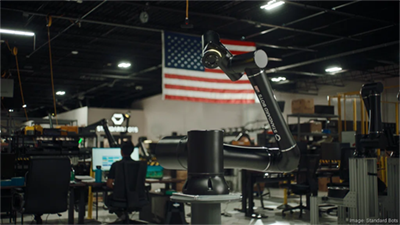 Most manufacturers have at least one job on the floor they would automate tomorrow if the right solution existed.
It might be a task that takes too long, a process that changes too often, or a job that seems simple until programming, integration, and cost make it much harder than it looks. For Evan Beard, that gap between what manufacturers want to automate and what they can actually automate is the problem Standard Bots has spent years trying to solve.
Beard, the co-founder and CEO of Standard Bots, is focused on making industrial robots easier to teach, deploy, and use for manufacturers when things change. Standard Bots, founded by Beard, James Cordle, and David Golden in 2017, has had its direction shaped by conversations with manufacturers about how they use robots and what keeps automation out of reach.
“We realized that the products are really hard to use, that they’re really complicated, they’re too expensive,” Beard said. “And we also realized that 99 percent of them are not made here in the U.S.”
That became a clear focus for Standard Bots. The company wanted to build robots in the U.S. while also removing some of the friction that keeps manufacturers from using more automation.
“We set out to change that, to build an American-made robotics company with products that are simple enough to use, you don’t even need a manual,” Beard said. “It’s like an iPhone. You don’t have a manual. We want our robot to be like that.”
Industrial robots must be safe, precise, durable, and productive in environments where downtime matters. But Beard said the question for many manufacturers is still simple.
Can my team actually use this?
Beard sees physical AI as one way to change that.
Instead of writing every instruction, a person can show the robot what to do. That can happen through a handheld device, a controller, or teleoperation. The robot records the movement, turns it into training data, and uses that information to learn the task.
“What’s changed in the last few years is all the advancements in something like ChatGPT are coming to the physical world,” Beard said. “You control the arm, and you show what to do, and that’s creating training data to train the AI model that can do the job autonomously.”
Beard points to clothes folding as one example of how difficult some physical tasks have been for robots. It is a task most people do without much thought, but one researchers have worked on for years.
“You would go to see a professor of robotics, and they would show you their clothes-folding robot,” Beard said. “And they’d been working on folding clothes with this robot for decades. And you’d see it fold the clothes, and you wouldn’t necessarily be that impressed.”
The issue is variation. People deal with it naturally, while robots have traditionally struggled when the world does not line up perfectly. A shirt moves, a part shifts, a surface changes, or a product variation shows up, and suddenly the system needs more work. Beard said newer models can help robots better handle those changes, allowing them to extrapolate and handle entirely new object sizes or shapes on their own.
The Two Buckets of Automation
Beard sees automation work in two groups.
The first includes the jobs robots already do well, such as machine tending, welding, palletizing, and painting. Those applications are understood, and Standard Bots wants to make them easier and less expensive to deploy.
The second group includes the jobs that manufacturers have often been told are not realistic candidates for automation. They might be too difficult, too expensive, too variable, or too hard to justify once integration costs are included.
“There’s this other bucket of tasks,” Beard said. “These are the tasks that if you call your integrator, you say, ‘Hey, can you do this?’ This is just not possible, or it’s going to be so dramatically cost-prohibitive that you wouldn’t even consider it.”
He calls them impossible jobs.
“We’re really excited to automate the impossible tasks as well, because those are the jobs that really move the needle,” Beard said. “We’re automating today so little of what we really need to bring back manufacturing and improve the efficiency of the country.”
One example came in automotive, where a task had to be completed within a one-minute station time. Traditionally, it took too long. With physical AI, Beard said, the robot could be shown the job, find the right area, and complete the task fast enough to meet the cycle time.
“You can meet the cycle time,” Beard said. “You can perform the task at a human level and do it a lot faster than you would have been able to do it without this plan.”
Bringing It Back Home
Standard Bots is also building in the United States, which Beard said matters to manufacturers here. For him, it is not only about where the robot is made, but what happens after it is installed.
“I think a lot of U.S. manufacturers take pride in the fact that they make things here in the United States,” Beard said. “For there not to be an option to have an American-made robot and to have an American support team that’s there to guide you and help when you need help, and to answer the phone, I think that matters to a lot of customers.”
That concern, making robotics more accessible to U.S. manufacturers, has also pushed Beard into the national policy conversation.
On April 21, Beard testified before the House Science, Space, and Technology Committee’s Subcommittee on Research and Technology during a hearing titled “Robots Made in America: Advancing U.S. Leadership in Manufacturing and Automation.” He appeared alongside A3 President Jeff Burnstein, with both emphasizing the need for a more coordinated national robotics strategy.
Beard’s message to lawmakers was that robotics is not only a factory issue. In his testimony, he said the United States has gone from nearly 20 million manufacturing workers in 1979 to about 13 million today, and that manufacturing’s larger footprint supports many more jobs across the economy. He argued that a strong manufacturing base is tied to wages, opportunity, and regional growth.
“The countries that dominate robotics today are the ones that had a national robotics policy in the past,” Beard said. “It’s incumbent upon us, if we want to go somewhere, to think about how we’re going to get there and make a plan.”
In the meantime, Beard is not trying to hide what Standard Bots wants to become.
“Our goal is to build the biggest robotics company in the world,” Beard said. “We think the way to do that is to make the best product at the lowest cost, made here in the United States, using the latest technology.”
For Beard, that ambition depends on whether robots can move from specialized equipment to tools that more manufacturers can actually use. If robots become easier to teach, more affordable to deploy, and better at handling change, he believes more manufacturers will be able to use them.
“When we look back on 2026, we’re going to say that we barely had automated anything,” Beard said. “The robots were so limited, they were so hard to deploy that you needed to spend days or weeks to get a robot installed. I think all that’s going to change over the coming years.”
Association for Advancing Automation
Discover how Association for Advancing Automation can support your automation journey with their complete range of solutions and expertise.
Visit Company Website



EPSON Robots Honors Flexible Automation, Inc. for 30 Years of Outstanding Partnership
Epson Robots recognizes Flexible Automation, Inc. for 30 years of partnership in designing and implementing top notch robotic automation solutions.
Robotic Industries Association Welcomes First China-Based Member, SIASUN Robot & Automation Co. Ltd.
Industrial Robot Supplier and Integrator Joins Global Association, Signifying Strategic Role of Automation in China.
Deploying VLAs with OORB runfp
A 7-minute demo showing how OORB runfp supports VLA deployment by capturing robot run state, comparing changes, and generating reliability evidence for robotics teams.