
Industry Insights
How Flexible Should Your Automation Be?
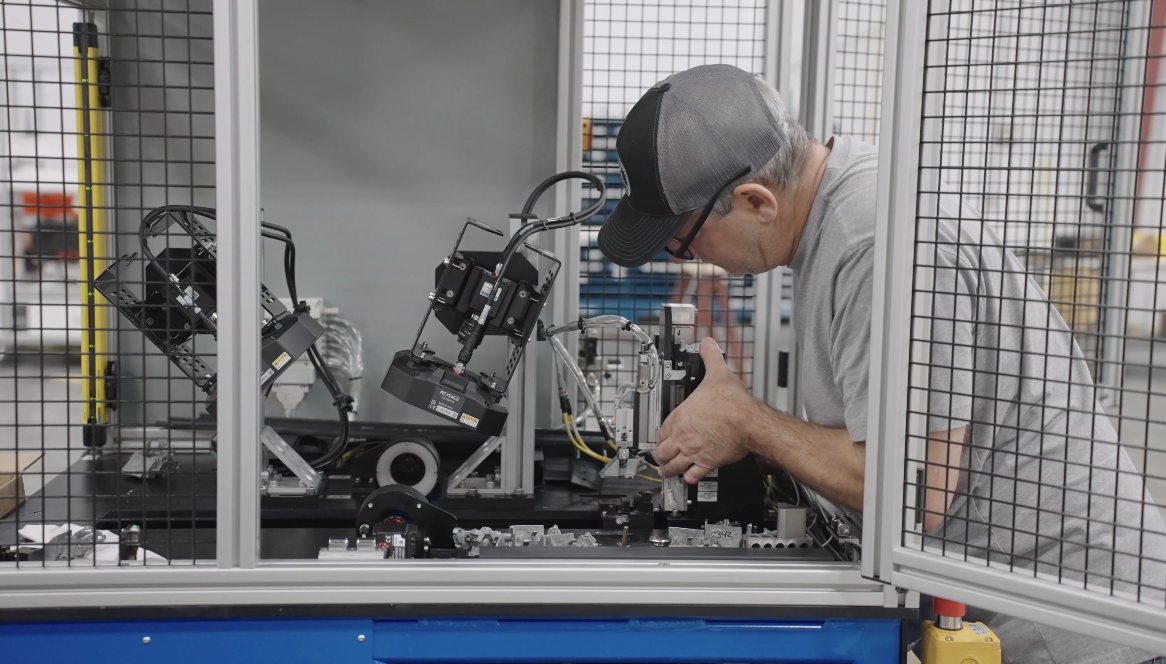 Automation spans a spectrum from fixed, static systems designed to perform a single, repeatable task all the way to general-purpose, flexible automation that is designed to perform many tasks and handle variations in product and environment.
Typically, fixed systems are optimized for one process or product, while general purpose automation is reprogrammable to suit changing production needs.
The key questions for end users are: which side of the spectrum delivers the best return — and does the distinction between “general-purpose” and “specific-process” automation really matter in practice?
Experts from 7robotics, Kawasaki Robotics (USA), and Addtronics Custom Automation (ACA) shared their insights on how flexibility, cost, and cycle time can shape automation strategy.
“If ‘general purpose’ truly means all purposes, all activities and all processes, then humanoid robots are probably the best example. Meanwhile, industrial robots, including cobots, tend to be tailored more to specific processes, but they are getting more adaptable over time,” says Camren May, automation developer at 7robotics.
May notes that even highly adaptable industrial robots rely on application-specific end-of-arm tooling (EOAT), placing them somewhere between fixed automation and fully general-purpose humanoids. EOATs define a robot’s actual task capability. A gripper designed for cartons, for instance, can’t lift flexible bags without redesigning contact geometry or suction parameters. The requirement for dedicated EOATs limits the “general-purpose” label sometimes applied to industrial robots.
Many fixed, specific process automation systems don’t involve robots at all, says Alexandre Boffi, manager, General Industries Sales, Kawasaki Robotics (USA), noting that traditional mechanical automation can outperform robots in certain repetitive, high-speed tasks.
“Fixed mechanical automation is often used in palletizing applications. A product comes down an elevated conveyor and drops into the square, the pallet drops, and then another layer comes in, and the pallet drops again. Such systems are very prevalent,” says Boffi.
Adding a robot to a fixed setup introduces reprogram ability — allowing the cell to adapt to new pallet patterns or product types, Boffi explains.
Adding a robot to fixed systems adds complexity, says David Hopkins, VP of Engineering at ACA.
“Pretty much anybody can order a conveyor, plug it into the wall, and have it going in ten minutes. It's not going to be that easy with a robot. A robot is going to require a specialized programmer. It's going to require some math to figure out payload and some expertise to ensure that the system is safe.”
Integrating a robot into an existing mechanical line also requires safety interlocks, emergency-stop circuits, and risk-rated guarding per ISO 10218-1/2. These add engineering hours and validation steps that don’t exist in simpler electromechanical automation.
Flexible automation tends to require more expertise to operate, although this challenge also runs on a spectrum, from easy-to-program cobots all the way to behemoth industrial robot arms programmed via expert-only code. Once up and running fixed systems tend to need very little intervention, save for standard maintenance.
For Hopkins, a more useful distinction can be made on the application level, with specialized automation focused on applications like welding or painting and general purpose robots taking on broader, more generic tasks, like pick and place.
The Speed vs. Flexibility Trade-Off
Wherever the technology falls on the spectrum that runs from simple systems to humanoids, there are trade-offs involved when choosing between different automation types. General purpose automation can be assigned to a wide range of tasks. However, this tends to come with slower overall cycle times and lower throughput.
For example, a fixed mechanical palletizer might process 20 boxes per minute, whereas a flexible robotic cell configured for multiple box sizes might run at 15 — a 25 % slower cycle time, but one that pays off when SKUs change weekly.
Specific process automation tends to excel in low mix/high volume environments, so if you’re making one widget over and over, then it makes sense to explore fixed solutions for maximum speed and throughput — but with the knowledge that adapting to product and process changes is likely to be more difficult and costly.
Upfront capital costs also tend to be higher with specialized, fixed solutions due to the amount of customization involved. However, that is offset to some extent once they are up and running due to the high speeds and massive throughput enabled by such systems.
Kawasaki Robotics’ Boffi, who has experience in plastics and bottle manufacturing, sees such applications as best suited to fixed automation systems.
“We had a machine that could blow mold one million bottles every day. It was kicking them out fast and the bottles would whizz past in a blur. Every single bottle that came off the machine was exactly the same. When you have that type of volume and speed with a low mix, fixed automation is likely to be the best choice,” says Boffi.
Fixed systems also dominate press operations, Boffi adds. Mechanical actuators, not robots, transfer sheets between presses in perfect synchronization.
“It's all mechanically keyed in with the up and down motion of the press itself, which is advantageous when you have super high speeds and there's no room for error,” explains Boffi.
Even if humanoid robots are considered the ultimate in general purpose robotics, it doesn't mean that a humanoid is necessarily going to be the right fit for your application, says ACA’s Hopkins, who warns that some companies invest in robots without clear use cases.
“This is how robots end up stuck in a back room. Without proper analysis of payload or cycle-time requirements, the result can be an expensive idle asset,” explains Hopkins.
Our experts also noted that given the inherent payload and speed limitations of today’s humanoid robots, even the most versatile and flexible ‘general purpose’ robots cannot handle every application – with the implication that traditional industrial robots will have an important role to play for the foreseeable future.
7robotics’ May adds that humanoid robots and fixed systems can operate well together.
“We’ve seen humanoids being used to pick buckets, carry product to shelves that are then paired with automated conveyor systems,” he says.
Futureproofing
“Imagine a fast-food company with thousands of outlets using a system that dispenses a cup, carries it on a conveyor, fills it with soda and then a human puts the lid on and hands it to the customer,” suggests Kawasaki Robotics’ Boffi.
Boffi explains that if the company makes a small design change — such as using biodegradable cups that are more sensitive to the forces exerted by the automation — could force a costly rebuild, replacement, or reprogramming of every fixed system.
Flexible automation, on the other hand, makes it easier to accommodate such changes.
“If this fast food company had flexible automation capabilities, all they'd have to do is change the gripper or modify the program so that the gripper doesn't grab the cup as hard. By contrast, it's very difficult to futureproof with fixed automation, precisely because it's fixed,” explains Boffi.
May distinguishes between futureproofing for products and futureproofing for processes.
“It’s usually a lot easier to futureproof tooling. You can design tooling to be bigger or have extra pickup spots to handle a wide variety of different products.
Futureproofing processes is a little trickier because you would need a crystal ball to estimate your future production requirements,” says May.
Flexibility is especially important for companies manufacturing products that change over time, says ACA’s Hopkins.
“If you're making a product that has constant updates, you know that you're building version one, but you also know that there's going to be a new model coming out next year. Flexible automation is a smart investment in these scenarios, because you can reteach that robot to run my part next year, whereas, if you have hard automation, you’re going to have to buy new automation next year, as opposed to just repurposing what you already have,” he explains.
In the end, whether fixed or flexible, the right automation system is the one that solves your specific problem as simply as possible.
Practicalities
When it comes to the practicalities of helping customers, remaining focused on what drives automation adoption and solving problems is more important than thinking in terms of fixed versus flexible automation, says Hopkins.
“There are three main drivers for automation adoption: labor cost savings, safety, and quality. Most of our customers are just looking for solutions and they don't care if you call it general automation or specialized automation,” says Hopkins.
At 7robotics, engineers think less about fixed vs flexible automation and focus more on the 80-20 rule, which states that roughly 80% of the benefits of automation come from 20% of the effort, investment, or system components.
“We look to maximize the uptime and minimize the complexity. We look for high labor processes, and for processes that marry well together. If a customer is relatively low production for the process, we try to find multiple processes that would pair well so that we can increase the production of the system.
As you move to the “general purpose” side of the spectrum, you can increase efficiencies, however, you eventually reach a point where you're trying to over automate. Automation can be too generalized, and then it can become very cumbersome in terms of your tooling, design, and overall programming structure,” observes May.
Association for Advancing Automation
Discover how Association for Advancing Automation can support your automation journey with their complete range of solutions and expertise.
Visit Company Website


DOBOT Nova Series Ultra-compact Industrial Robots
DOBOT Nova Series: Compact collaborative robots designed for industrial automation, featuring 2kg and 5kg payload options for high precision
ABB Robotics Receives the Global Powertrain Manufacturing Excellence Award from the Ford Motor Company
Award recognizes the Flexible Cylinder Head Assembly system for bringing superior technical innovation and global supply solutions to improve investment.
Sure Controls Micro Automation - No Part Too Small
Small part assembly by the Team at Sure Controls. Micro Automation - No Part Too Small