
Industry Insights
How Bee-Inspired Robots Can Improve Mining Operations
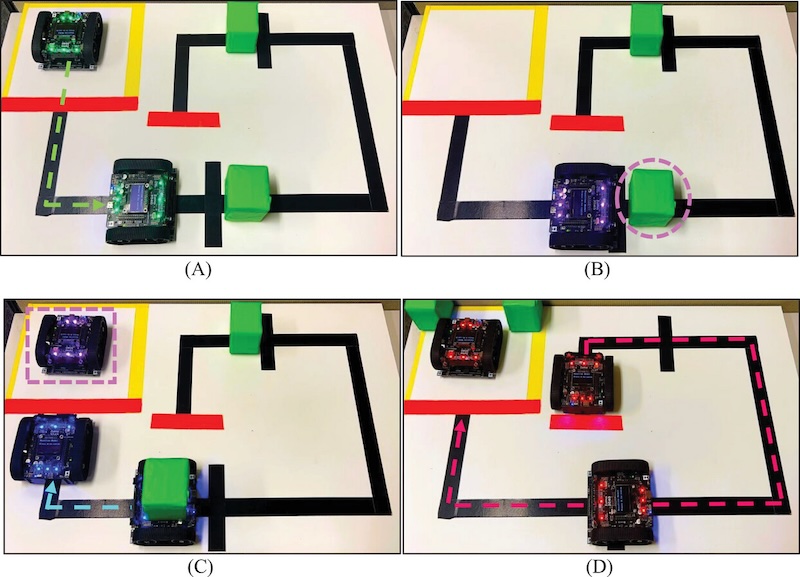
While it's one of the world's biggest industries, Mining faces ongoing challenges around operational efficiency, environmental footprint, and human safety. Companies have increasingly turned to automation, but risk remains, should the central control system fails.
Researchers at Adelaide University have drawn inspiration from nature and developed robotic swarms inspired by ants and bees to make operations safer, more efficient, and more sustainable.
This latest study took inspiration from the ways social transport food, applying it to small swarms of robots that don’t need a single control center―an approach that enabled the systems to respond quickly to changing environmental conditions. The researchers used Zumo 2040 robots in a test environment designed to mimic a mine setting. Because the robots operated as a swarm, each unit could make their own decision while working together. This meant that the combined system could keep operating when individual robots stopped.
Three different robot strategies were trailed in a scaled straight-line haul-route environment. One was a basic system where the robots collected an ore and immediately returned, another was a tandem partitioning leafcutter ant-inspired system that shared tasks, and the third was a memory-retrieval honeybee-inspired system where the robots explored and mapped an area before collecting resources. The three strategies were compared based on total travel distance, energy consumption and ore delivery. The honeybee method proved the most effective in all tests.
The ant-inspired approach was found to have a better performance than the basic model, because it could divide work between the robots, where some would gather resources and others would transport them. However, because the honeybee swarm first explored and mapped an area, it could remember where the resources were located, making them more efficient when it came to retrieving them. Because of this, the honeybee approach had lower travel distances of up to 80%, reduced energy usage of around 50% and completed ore delivery tasks up to 60% faster than the basic approach on a 16-m route test with eight ore blocks.
These results showed that the honeybee-inspired swarm was superior to the other two swarm robot models in both mid-and long-distance open-pit mining. Because the fundamental operation of the honeybee swarm was to scan for mineral deposits before commencing mineral ore collection, it will be more beneficial for mining sites with longer haul routes and fragmented ore deposits.
The honeybee swarm was also found to be effective under real-world conditions where sensor noise, battery drain, and mechanical misalignment can affect efficiency, whereas coordination problems would be exacerbated in the ant models in complex mining environments due to the repetitive search-and-return ‘looping’ in the logic algorithms.
Like any new developments, there are still challenges that need to be overcome before we see this type of swarm implemented in real mines . Current technology bottlenecks include the need for better sensors and longer-life batteries so that the robots can better adapt to unpredictable underground conditions.
Nevertheless, there is potential for these systems to simplify complex mining operations and reduce the risks to workers while improving productivity. This includes dangerous and/or difficult-to-reach mining areas and space mining missions where fully autonomous systems will be essential.
Future research will look to address the limitations of the test environment by extending it to multi-lane routing, dynamic ore placement, dust and extreme weather conditions. There are also plans to build test environments specially developed for space mining that account for the conditions on the moon, including abrasive regolith, lunar dust and low gravity. The team also stated that larger robotic systems could be trailed in the future with advanced sensing capabilities and real-time communication protocols to improve both the ant-inspired and bee-inspired swarms.

Association for Advancing Automation
Discover how Association for Advancing Automation can support your automation journey with their complete range of solutions and expertise.
Visit Company Website


