
Industry Insights
From Moonshots to Ship Docks
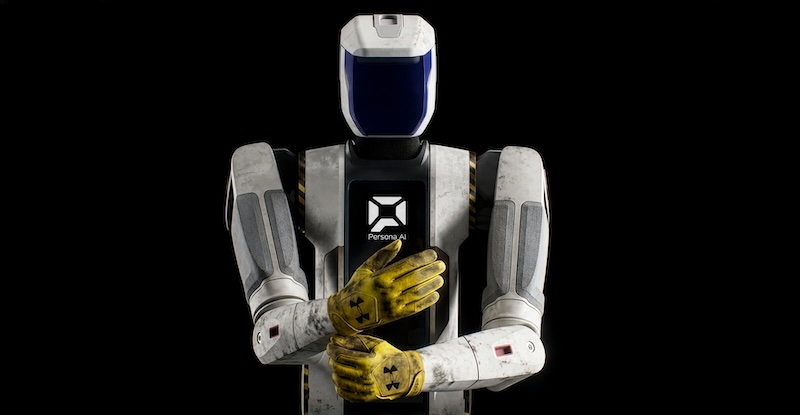
“What’s worse than a moonshot?” Nicolaus Radford rhetorically posits. “It was much more, it was much worse than that.” NASA’s Robonaut program turned 30 this year. Officially kicking off in 1996, engineering work began in earnest on the humanoid astronaut the following year.
By the turn of the millennium, the team had produced the first version of the robot torso. A more “portable” Robonaut R1B arrived in 2002. None managed to slip the surly bonds of Earth. Nor, for that matter, did Centaur, which mounted the half-humanoid atop a four-wheel mobile for some theoretical off-planet off-roading (though it did spend some time in Arizona).
Robonaut 2, famously, had a bit more luck when it arrived in 2011. The system marked enough of an advancement over its predecessor to earn it a place aboard the International Space Station (ISS). R5, “Valkyrie,” arrived two short years later, designed with more terrestrial ambitions.
The bipedal humanoid was developed by the Johnson Space Center (JSC) Engineering Directorate to compete in that year’s DARPA Robotics Challenge Trials. Ultimately, however, a networking issue bested the robot, which failed to meet its marks. If that’s not a relatable human challenge, I’m not sure what is.
Radford worked on these and other robotics projects during his 14 years at the home of the original moonshot. He parted ways with the space agency in 2014 to form ocean autonomy firm Nauticus Robotics. In 2018 he did the same with components manufacturer, Jacobi Motors. It would be another six years before he was ready to jump back into bipedal humanoids with both feet. It no doubt helped to have a 20-year Institute for Human and Machine Cognition vet and recent Figure CTO, Jerry, on board.
“There were a lot of pieces,” Radford says of Persona’s 2024 founding. “From Jerry and my point of view, we’ve known each other twenty years and we've always been kindred spirits when it came to the challenges of designing humanoid robotics. We've had a lot of mutual interests and actuation, and what are the best actuators for walking, and the torque speed envelopes, and the dynamics of locomotion.”

Get the Training You Need for a Safer Workplace!
Autonomous mobile robots are one of the fastest-growing segments of the robotics industry. During this live virtual training, you'll be introduced to safety protocols and best practices for working with mobile robots in industrial settings.
Learn more and register now for upcoming training dates.
Advances in AI, autonomy, navigation, and hardware meant – at very least – the prospect of a functioning humanoid was no longer relegated to the “worse than moonshot” bin. When discussing Persona’s origin, Radford is quick to contrast the company with decades he and Pratt spent developing research robots.
“What I learned through Jacoby and Nauticus and a couple other ventures that I started, was this, the commercial side, not to be overlooked,” he says. “Because backflips grab headlines. They grab the clicks in the YouTube views. But the places that are probably going to make money are far less sexy. And what we wanted to do was take a rather contrarian view of the market because we're not humanoid maximalists. We're actually rather skeptical that the early market traction is going to be in the popularized markets. And so when we came together, and we said, let's build Persona.”
Amid a growing army of humanoid robot firms, the startup is looking to set itself apart by touch grass. Persona bucks the trend of manufacturing and fulfillment humanoids with a ruggedized system designed specifically for outdoor tasks, beginning with welding.
“We're not gonna show the robot folding laundry, then maybe moving sheet metal, and maybe moving a box and doing a sorting activity, then coming back over here and showing the robot in some other config you know it's just all over the place,” says Radford. “Sure, it's got some usefulness to it, but in order for the titration time to get a general-purpose humanoid done and to market is gonna be lengthy. And maybe alternatively you could do that in a bit of a, in more of a piecewise approach. Take a page out of Peter Thiel's Zero to book.
Don't be so concerned about the size of your first market. Just go in and dominate it and then start moving adjacently and creeping adjacently. So we've picked welding and shipbuilding. That's our first market. We're partnered with HD Hyundai. We're delivering robots to them at the end of this year. Now we're on our third generation of our system. We've built a Gen 1 platform, a Gen 2 platform, and we're now kicking off the production on our Gen 3 platform.”
Association for Advancing Automation
Discover how Association for Advancing Automation can support your automation journey with their complete range of solutions and expertise.
Visit Company Website


