
Industry Insights
From Lab to Workplace: How Exoskeletons are Evolving
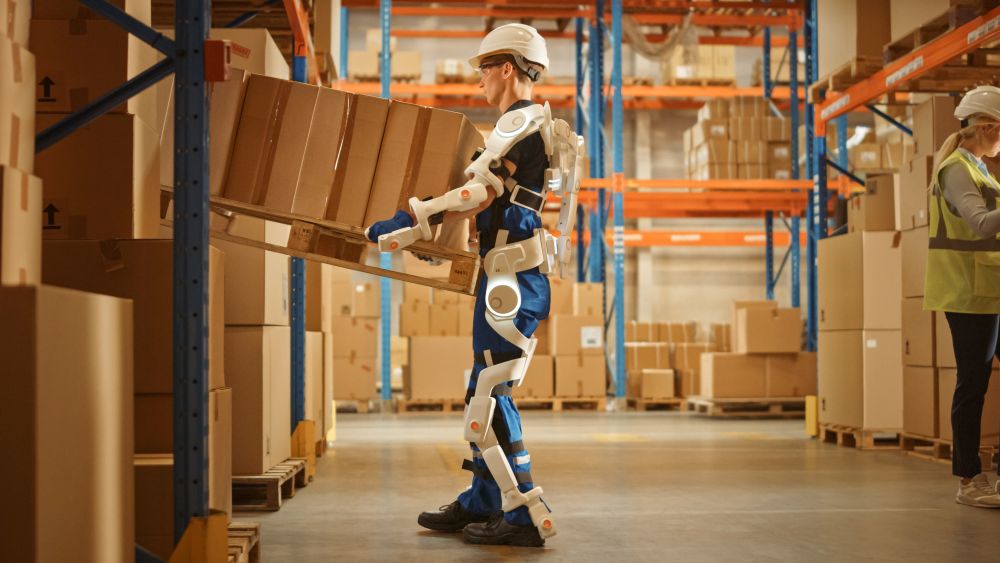 Exoskeletons used to be squarely the territory of the movies but not anymore. Meeting demand in medical rehabilitation, industrial settings, and the military, exoskeletons are increasing their presence and demand is expected to grow at a modest clip, with the global market hitting $1.25 billion by 2030, according to market research firm, Grand View Research.
What is an Exoskeleton?
In general terms, an exoskeleton is a wearable external device around an existing limb that augments or supports human function in some way. Exactly what the exoskeleton does and how it does it depends on the end use case for the device.
Operators choose one from two kinds:
Passive exoskeletons don’t need batteries or a source of external power. Using mechanical components like springs and dampers they store passive energy and release it to redistribute strain away from the user. The exoskeletons from Comau, an industrial equipment manufacturer, for example, fall into this category.
Active exoskeletons on the other hand, are more complex and use a motor to provide forces as opposed to some passive elastic element, explains Prof. Robert Gregg, Professor of Robotics, Mechanical Engineering, and Electrical & Computer Engineering at the University of Michigan.
They sense the user’s intent and execute corresponding relevant actions. To do so, the active exoskeleton must first sense what that intent is, figure out how to act on it and then carry out the necessary actions. Sensors that can read muscle signals in the form of electric pulses and accelerometers help determine user intent, whether that’s to stand, move forward, sit, or even walk up stairs. A control system, usually housed in the body of the suit, acts as the thinking mechanism and calculates the commands it needs to relay to the actuator to move certain joints in the exoskeleton. Finally, an actuator applies necessary force to move the right amount in the right direction.
Use Cases for Exoskeletons
A range of applications in the market is fueling interest in these devices. Potential use cases include:
Medical Assistance
Active exoskeletons that help in medical rehabilitation fall into two categories: fully assistive devices and partial ones.
Fully assistive devices help patients recover from spinal cord injuries or other medical issues that have left them paralyzed. In such cases, the exoskeleton does all the heavy lifting, quite literally, and the patient leans more heavily on the device. Exoskeletons can speed up learning of lost motor functions that are part of muscle memory. By providing repetitive and precise movement patterns to patients, they help recovery from stroke or other debilitative injuries that lead to loss of muscle strength. “These exoskeletons give someone who’s heavily injured the ability to stand upright and to move using their legs, which can have secondary benefits beyond just the psychological,” Gregg says, “it can also help with the rehabilitation of weakened muscular and skeletal structures.”
Partially assistive devices, on the other hand, are meant to augment existing capabilities of muscles that might have atrophied and the efforts of people that have either full or remnant volitional control over their limbs. THKAFO (Trunk-Hip-Knee-Ankle-Foot Orthosis) type walking exoskeletons are like robotic suits that support the user from the trunk down to the feet. The devices can help individuals with age-related muscle loss or reduce pain due to osteoarthritis. Pediatric assistive devices are also effective in medical facilities to help with neuromuscular and gait conditions stemming from cerebral palsy, spina bifida, and a range of other conditions. The ATLAS 2030 is a THKAFO type walking medical-use exoskeleton from Marsi Bionics that is designed for children, and whose dimensions can be adjusted as the child grows. More on advances in these devices, later.
Manufacturing or Asset-Driven Industries
On the manufacturing floor or in large warehouses, workers often suffer from the strain of repetitive motion. Loading and unloading packages, painting, or welding require the same actions over and over that cause muscle weakness, which, if left untreated, can create more serious problems.
Exoskeletons, especially the passive kind, are a good fit in such settings as a way of sharing some of the strain load and easing effort workers need to input. They help reduce strain from repetitive motion and avoid injuries.
“The goal for our industrial exoskeleton is really to help you do the same job you’re doing today but with less effort,” says Alessandro Piscioneri, head of product and solution management, Advanced Automation Solutions at Comau.
Military and Defense
Similar to use cases in manufacturing, military personnel might need to travel long distances over rough terrain while carrying heavy loads. Aiding their operations through exoskeletons helps them preserve energy for longer. For example, lower-body or hip-assist exoskeletons redistribute load and reduce the energy soldiers need to exert during marching or walking long distances. The U.S. army has been testing out different prototypes for many years to alleviate the prevalence of low back injuries within their units.
Barriers to Adoption
Although the use cases for exoskeletons are impressive, a few factors have complicated the path to more widespread use.
Workers in industrial settings sometimes worry about what they perceive as extra weight. “They ask if it’s going to be uncomfortable, there are questions about wearing one for eight hours at a stretch,” Piscioneri says. But passive exoskeleton models are meant to relieve strain and not exacerbate it, he goes on to say.
ROI Calculator
Discover the potential cost savings of robotic automation over a 20-year system life
This calculator compares your current manual labor costs against the total cost of owning and operating a robotic system over its 20-year lifespan.
Employees might sometimes worry about the effectiveness of the control methods for the devices, which can lead to jerkiness in motion. AI control algorithms are helping fine-tune mechanisms here, so actuators and processors together execute more fluid movements.
For powered exoskeletons, battery life can be an issue and its weight adds to the device's bulk. In high-stakes use cases like military operations, having to recharge batteries frequently can decrease the utility of exoskeletons.
In addition, says Piscioneri, exoskeletons don’t have a set of standards as a benchmark for workplace compliance. They are beginning to be recognized as personal protective equipment but not recognized by insurance providers as a must-have to decrease workplace injuries.
“Communication is the most effective way to overcome most of these barriers,” he says. Piscioneri advises against a top-down approach for adoption of exoskeletons in the workplace because it can backfire. “At the end of the day the people in the field really need to use it and believe in it.”
Predicting the Evolution of Exoskeleton Technology
Piscioneri sees new market opportunities for exoskeletons, including in fitness applications. “When you stay and work in one position for a long period of time, that’s a hazard so especially if it involves the upper body, an exoskeleton can reduce that exertion for a number of activities,” he says.
Piscioneri sees the market growing in the near future, as adoption is still scattered. “With greater adoption, we can have more user feedback and a chance for further improvement of these devices,” he says. In addition, as prices drop, they will become standard-issue PPE equipment.
Expect machine learning to play a greater role in active exoskeletons, making context-aware decisions of user intentions faster and more accurately. One of the challenges to be explored is to focus on sweeping task-agnostic execution of human movement while still being able to personalize it for specific users. “If we want the best of both worlds, we will have to figure out how to get generalizable models across activities but also make them more specific to you,” Gregg says.
Exoskeletons might also make inroads in consumer use sectors moving beyond medical rehabilitative use cases in medical facilities. Their ability to augment movement for elders with muscle loss could be an advantage. Comfort and wearability with soft exoskeletons are also on the horizon, making adoption that much more attractive instead of the rigid hard-shells dominating the market today.
“With all the advancements coming down the line, there’s still a lot of potential left unexplored for exoskeletons,” Piscioneri says. “The best part about it is that it’s to make you feel better and work with less strain or it helps you recover. It is not meant to replace humans.”
Advances in Partially Assistive Devices
Fully assistive rehabilitative exoskeletons that provide complete limb function have to provide a lot of force. In addition you don’t want the user's weight to cause back drive in the motors so the joints are more rigid.
In partially assistive devices on the other hand, the joints can move more freely. “They’re very different design paradigms and require different motor and transmission and control design,” says Gregg. Because one of the goals of partially assistive devices is to not let the muscles atrophy, the exoskeleton provides only a small fraction of muscle force needed to augment the patient’s range. Such nuance, where the device has to follow the intent of the user at all times is challenging because evolutional motion has to be continuously monitored and the controller has to predict the biological torque at the joint in real time, using measurements taken practically every millisecond.
To help the devices deliver this biological torque more efficiently, Gregg is developing a machine learning algorithm that trains on reference data collected from unimpaired individuals. The goal is to create a substantial bank of training data that captures various routine ambulatory activities like running, sitting, climbing straits, walking etc. Once the models are trained, they can be used on the embedded computer on the devices and predict biological torque based on sets of input parameters from sensors.
His research on active exoskeletons borrows from design paradigms of legged robots where instead of using high-speed, low torque motors with a high gear ratio, they use high torque, low-speed motors with a small gear ratio. “That design approach gives very back-drivable, dynamic and compliant motion,” Gregg says. The team has successfully borrowed this strategy for their work in partial assistance applications.
Those same legged robots inspire the partial assistance device in other ways. “Because we’re only controlling one or two joints, the classic control techniques for legged robots that we were investigating 20 years ago end up being very useful for informing us about how to control these wearable devices,” Gregg says.
While rehabilitative exoskeletons are frequently task-specific — they can only carry out one function at a time — Gregg and team are developing more efficient task-agnostic equivalents. “The device needs to have a whole continuum of walking patterns based on what the person is doing at a given time. It doesn’t matter what the activity is, it’s just constantly predicting the biological torque at the joints and modifying output accordingly,” Gregg says.
Association for Advancing Automation
Discover how Association for Advancing Automation can support your automation journey with their complete range of solutions and expertise.
Visit Company Website


IUVO to Develop Wearable Robotic Exoskeletons in Co-Operation with Comau and Össur
IUVO, a spin-off company of The BioRobotics Institute (Scuola Superiore Sant’Anna) in the field of wearable technologies, has recently

Collaborative Robotics Puts People First
It doesn’t have to be all or nothing. Humans and robots can work together, safely.