
Industry Insights
Formlabs Blurs the Line Between Prototype and Production with Fuse X1 SLS Printer
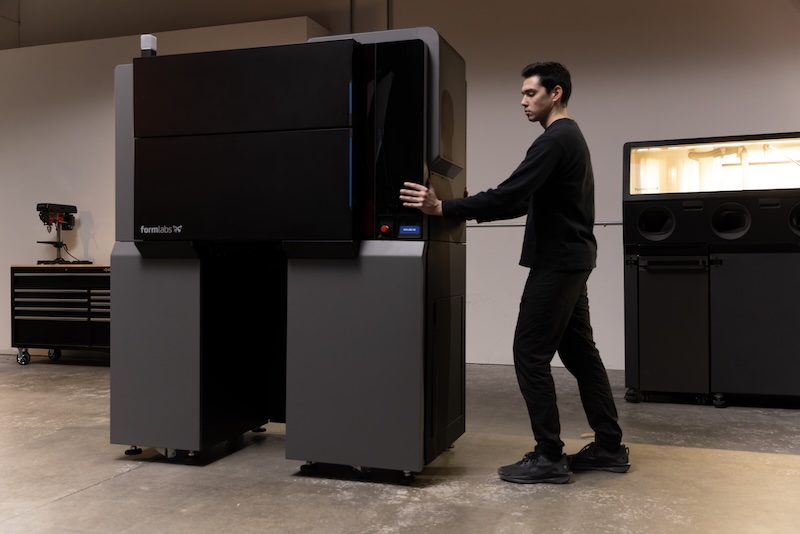
Formlabs is a perennial outlier. The MIT spinout launched amid the desktop 3D printing boom, delivering a stereolithography (SLA) system that vastly outperformed the FDM devices dominating the market. When the bubble burst a few years later, the Sommerville, Massachusetts startup was among the few that not only survived — but thrived.
More than a decade later, one can’t visit an R&D facility without encountering one of Formlabs’ orange tinted systems. In 2017, the company lowered the bar of accessibility for another industrial method of manufacturing with the Fuse 1. Like SLA before it, selective laser sintering (SLS) was formerly the realm of massively cost-prohibitive systems, ranging from $500,000 to $1 million.
Today the company is announcing the Fuse X1, which takes a turn back to SLS’s industrial roots with a massive footprint. Keep in mind, of course, that in the world of 3D printing, bigger often does mean better, as it can equate to larger printing beds and therefore bigger prints. While the X1 matches some of those systems in terms of sheer size, the price point remains (relatively) accessible at $85,000.
If that number gives you pause, you’ve probably never been in the market for an industrial 3D printer. The price is representative of that not fully delineated space Formlabs has always occupied. After launching on Kickstarter, the company was initially viewed as a kind of high-end alternative to hobbyist/consumer companies like MakerBot.
What’s helped it survive a near-industry collapse, however, is the ability to address several key elements of the production process. Prototyping continues to be the machine’s primary focus, owing to questions of speed, scale, and pricing, but the company believes the lines between prototype and production are less rigid, particularly among highly specialized parts in frequently iterated systems.

Get the Training You Need for a Safer Workplace!
Autonomous mobile robots are one of the fastest-growing segments of the robotics industry. During this live virtual training, you'll be introduced to safety protocols and best practices for working with mobile robots in industrial settings.
Learn more and register now for upcoming training dates.
“I think that where rapid prototyping ends and production begins is kind of a blurry line, and we see it more and more that customers are willing to go into production with 3D printing,” chief product officer, David Lakatos, told me last week.
Formlabs has announced Tesla, Radio Flyer (which makes e-bikes in addition to its iconic red wagons), and Autotiv Manufacturing. For the time being, these companies appear to be using the systems for prototyping and tooling purposes.
“Tesla has been using this product in the Gigafactory in Nevada for various applications in the manufacturing process and jigs and fixtures and a number of other ways,” says Lakatos. And I think that what is striking about it is the iteration speed and the scale. They're printing tens of thousands of small parts that are conducive for them to move faster on the manufacturing floor.
Formlabs has no additional partnerships to announce, Lakatos tells me that “I can confirm that we are working with several, you know, the several, several large companies that are active” in the humanoid robotics space. Lakatos notes that the speed of humanoid iteration has made them a prime candidate for these parts.
“Humanoids are obviously evolving incredibly fast right now,” says Lakatos. “There is a lot of competition, people are like non-stop prototyping and coming out with new versions —the body, the dexterity of the fingers. Every single week people are trying out new stuff. There is no time for traditional manufacturing in spaces like these. So they rely heavily, heavily, heavily on 3D printing. And I will say that most of the videos and demos that you see, and regardless of which company, they're very likely to be 3D printed, like the actual things that we see on stage. It's like painful a little bit because we see a lot of the parts that are off stage and we just can't talk about them.”
Association for Advancing Automation
Discover how Association for Advancing Automation can support your automation journey with their complete range of solutions and expertise.
Visit Company Website


3D Printing Customizable Microbots 500x Thinner Than a Strand of Hair
Researchers highlight a method for customizing tiny robots using 3D printed stencils.
3D Print Stainless Steel Curved Piping with ADDere
Watch a timelapse of a 3D printed stainless steel curved pipe. This 22 cm tall part took 3 hours to
ABB enables 3D Printing via RobotStudio® for faster digital manufacturing
New software eliminates manual programming, allowing manufacturers to 3D print products within minutes.