
Industry Insights
CMU’s Dean of Computer Science on the School’s Massive New Robotics Center
At its peak, the Hot Metal Bridge facilitated the passage of some 4,300 tons of molten iron a day. During the Second World War, it saw 15% of the United States’ steel making capacity safely cross the Monongahela River — making it among America’s most heavily guarded infrastructural objects of the era.
In 2008, the bridge underwent a $15 million renovation emblematic of Pittsburgh’s early 21st century transformation. One span was converted to accommodate automotive traffic and the other pedestrian foot traffic and bikes. LED tubes were installed, giving the passage a distinct red/yellow/orange glow after nightfall, evoking the vast quantities of liquid metal that once passed over its girders
Just south, on the river’s east bank, the Jones & Laughlin Steel Company once employed some 12,000 workers, a figure that dwindled to the four-digits, before the site was altogether abandoned in 1997. Major cleanup efforts were launched, zoning was proposed, and for a period following the turn of the millennium, the underutilized industrial space hosted testbeds CMU DARPA challenge entries and Uber autonomous driving.
In 2016, the 176-acre site was rechristened Hazelwood Green, “a historic industrial brownfield site […] transforming into a sustainable, equitable, and inclusive new model for urban development.” When completed, it will include a massive University of Pittsburgh biomanufacturing facility, offices, apartment buildings, biking trails, community meeting spaces, and a sports stadium.
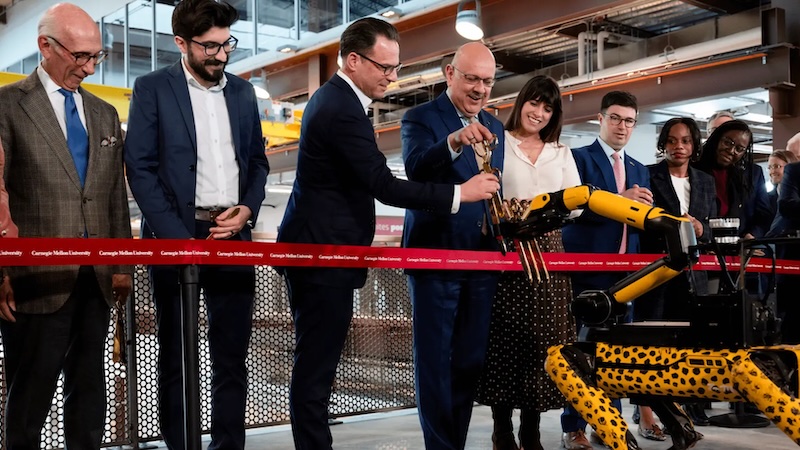
On Monday, Carnegie Mellon University (CMU) marked the opening of the 150,000-square-foot Robotics Innovation Center (RIC), the first major project to call Hazelwood Green home. Among center’s top amenities are a 6,000-square-foot drone cage, a 50,000-square-foot indoor robot test facility, and a 75,000-gallon water tank for testing submersibles.
“We had a smaller water tank here in one of the building basements on campus, but its much, much smaller,” says Martial Hebert, the Dean of CMU’s School of Computer Science. “We are now able to conduct research and conduct projects that we could not conduct before. And this is basically the story of this entire facility, and this is the story of what we're trying to do in robotics — to continue expanding.”
The computer scientist’s accent betrays his French origins, but for the past 42-plus years, Hebert has been a proud Yinzer. After earning a computer science doctorate at the University of Paris, he relocated to Pittsburgh to join CMU’s then-newly founded Robotics Institute in 1984. An emphasis on computer vision saw him joining the Autonomous Land Vehicles, which helped form the foundations of current self-driving research. He was appointed the director of the Robotics Institute in 2014, and five years later named the school’s Computer Science dean.
ROI Calculator

Discover the potential cost savings of robotic automation over a 20-year system life
This calculator compares your current manual labor costs against the total cost of owning and operating a robotic system over its 20-year lifespan.
Over the past 40 years, few American cities have experienced extremes like Pittsburgh. Late-20th century deindustrialization fueled substantial job loss in the proudly blue-collar Steel City. After hitting a nadir in the early-to-mid 80s, the presence of world class universities like CMU and Pitt helped the city shift its economic focus to 21st century technologies, with a focus on health care and robotics.
A 150,000-square-foot robotics center is unquestionably ambitious, but Hebert emphasized the importance of futureproofing the space in a way that accommodates the ever-evolving nature of robotics and physical AI research.
“We need that space to be designed in a way that it can evolve and that it can be reconfigured,” he says. “The testing and development space that we have are, if you look at the building and if you look at the space, they are very open. This was a little bit controversial by the way — we have not prescribed a very fixed configuration of those spaces, with some kind of preconceived idea that this is where we're to test x, y, and z, and this is how the kind of research that we're going to do. We kept those things very open and by construction reconfigurable and changeable over time.”
Among the more unexpected features is a wet lab, where researchers can experiment with material sciences for new form factors. “This building is the School of Computer Science, jointly with the College of Engineering. One of the work that the College of Engineering does in particular, together with our colleagues in robotics, has to do with soft robotics. It has to do with designing new materials, both for tactile sensing, for artificial skin, artificial muscles. There’s all kind of activities around the physical form of robots looking at radically different ways of thinking about what physical devices look like.”
Co-location is also a primary driver. Along with student researchers, the space will lease to startup tenants like physical AI unicorn, FieldAI. “It all boils down to this idea of exchanging ideas,” Hebert adds. “And being able to work together on ideas. It's not just being able to work on systems or being able to be in the same office writing code, right? It's the idea of being able to think together.”
Association for Advancing Automation
Discover how Association for Advancing Automation can support your automation journey with their complete range of solutions and expertise.
Visit Company Website


Researchers Say AI-Enabled Robots Need New Safety Frameworks
CMU and Oxford researchers believe robots need guardrails to avoid harm.