
Industry Insights
Can Exoskeletons Benefit From Situational Awareness?
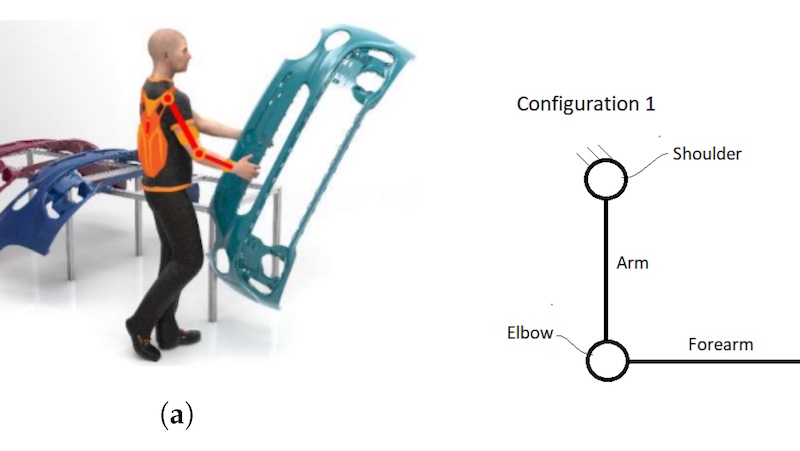
When you attend as many robotics and physical AI events as I do, presentations have a way of blending into one another. It’s not a lack of good insights, so much as the difficulty of introducing novel views of familiar subjects. After watching his talk on exoskeletons on the stage I hosted at the Davos Tech Summit, I pulled Loris Roveda aside for some follow up questions.
What jumped out at me was the IDSIA USI-SUPSI associate professor’s argument for supplying exoskeletons with situational awareness. It’s a fairly novel concept for those of us who generally think of these as assistive systems. Industrial exoskeletons, for example, adapt to their wearer’s movements. Once it senses that you’re lifting up a box, it will imbue your legs with some extra oomph.
Roveda points to an inherent flaw in this design: the amount of time it takes for the sensors to read the motion, and estimate the nature and amount of constructive force required for the wearer to best carry out a task.
“Until now, [exoskeletons] were purely reactive,” he explains. “For example, we have force torque sensors. We apply a force and the robot will follow. This is purely reactive, so we start the motion and the exoskeleton moves after that with the delay. The sensors can be very good, but it will always be reactive.”
Roveda’s pitch involves a system that is intelligent — and fast — enough to offer aid at the outset of such motions. I suggest the word “predictive” to define the approach. The associate professor prefers “proactive.” He offers up an example where in an additional wearable is utilized to determine actions before they occur.
ROI Calculator

Discover the potential cost savings of robotic automation over a 20-year system life
This calculator compares your current manual labor costs against the total cost of owning and operating a robotic system over its 20-year lifespan.
“We have glasses with gaze tracking,” Roveda says. “With the camera we can perceive the environment. With the gaze tracking, we can see where the human is pointing, and therefore if I have two or three packages or objects I need to manipulate, I can with the gaze disambiguate. I can understand exactly which one is going to be manipulated by the human. I can reason about the object so I can understand what the payload is and pre-load this info into the controller.”
In this example, the assistive force goes to work as soon as the wearer puts their hands on the payload, before the actual lifting process begins.
Roveda suggests that these applications can expand beyond industrial settings, into healthcare. Parkinson’s disease offers such potential in the form of a symptom called “freezing.” The Parkinson’s Foundation describes it as “the temporary, involuntary inability to move.” It’s a difficult thing to navigate and often leads to falls.
Roveda is hoping to engage medical professionals. “The idea is really that we want devices that can perceive what's going on and not being purely reactive,” he says. “For Parkinson’s we could find a way to stabilize the patient, or at least put them in a comfortable position.”
Association for Advancing Automation
Discover how Association for Advancing Automation can support your automation journey with their complete range of solutions and expertise.
Visit Company Website


Comau MATE-XB, the new wearable solution to reduce back fatigue
Experience reduced lower back fatigue and enhanced ergonomics with MATE-XB, a passive exoskeleton by COMAU.
maxon Drives Help People Walk Again
Swiss motors are driving exoskeletons all over the world.
maxon and Fourier Intelligence join forces to transform rehabilitation technology
maxon Group and Fourier Intelligence announce that they are entering into a global strategic partnership. maxon's precision drive systems and