
Industry Insights
Advances in Waterjet Applications
The ancient Roman philosopher Lucretius wrote: “Dripping water hollows out stone, not through force but through persistence.” With all due respect to the observant Lucretius, modern industry requires faster solutions.
 Waterjet Applications
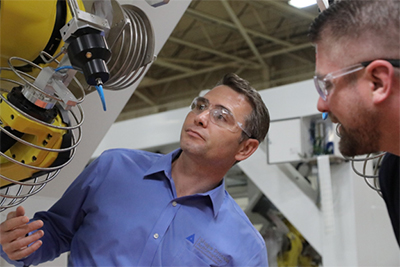
Waterjet cutting harnesses the awesome power of water to cut through stone, ceramics, metals, and, increasingly, modern composite materials. It can do so in a controlled manner, without generating heat-affected zones, and in a fraction of the time it takes nature to hollow out a limestone cave.
Capable of operating at pressures exceeding 90,000 psi, today’s waterjets often incorporate abrasive materials — typically sand of different grades — to achieve complicated cuts with remarkable precision. Increasing integration of automation with waterjet cutting machines has helped to increase efficiency and improve overall quality.
The earliest waterjets were limited to cutting soft materials, but over time, and due to the introduction of abrasive waterjet cutting, the range of materials waterjets can cut has multiplied.
Advantages of Waterjet Technology
“Waterjet is viewed as the most versatile manufacturing process in the world, as it is able to cut virtually any material, at any thickness,” says Tim Fabian, vice president of marketing and product management, Shape Process Automation. “From composite aerospace structures to automotive interiors, to food portioning and production, waterjet is well-recognized for its ability to efficiently cut materials with high precision.”
A waterjet stream is flexible compared to a rigid cutting tool, which makes predicting the behavior of that stream critical for cutting highly accurate finished parts.
“The latest software programs effectively predict with great precision how the stream will behave and are now modeled into the programming software, allowing even an unexperienced operator to cut perfect production parts with limited process knowledge,” explains Fabian.
The Future of the Waterjet Market
Today, the global waterjet market is valued at USD 42.7 billion, according to a report from market analysts Persistence Market Research. The market is expected to reach USD 70.9 billion by 2033, at a CAGR of 5.2%.
Large automotive and aerospace firms were early adopters of waterjet cutting technology, but as the technology has fallen in price over the decades, smaller job shops are getting on board, says Kylie Howard, senior marketing specialist, OMAX Corporation.
Credit: OMAX
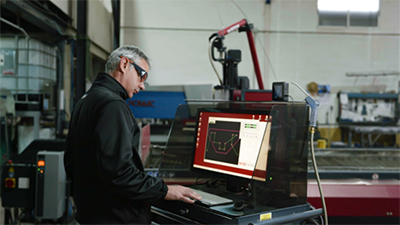
“Twenty years ago, larger companies were the primary adopters, but today we have waterjets that are one foot by one foot, which is ideal for some applications. We have waterjets that are half the size of a football field too, so we run the gamut.”
Enormous waterjets are often found in the ship-building sector, where they are used for cutting giant metal hulls — the waterjet’s size a reflection of the size of the parts it’s handling.
ROI Calculator

Discover the potential cost savings of robotic automation over a 20-year system life
This calculator compares your current manual labor costs against the total cost of owning and operating a robotic system over its 20-year lifespan.
At the other end of the scale, advancements in motion control software enable waterjets to perform cuts with greater precision and accuracy, opening up a wide range of applications in the electronics sector from PCB and component manufacturing to flexible circuit cutting.
“Over the last ten years, waterjet technology has continued to improve and achieve better tolerances, enabling waterjets to cut through lightweight, industrial materials with incredible precision,” says Howard, who notes growing interest from electric vehicle and aircraft manufacturers, looking for an environmentally friendly way to cut everything from carpet liners to the fabrics used for automotive interior flooring.
The emergence of five-axis waterjets is crucial for applications that require complex geometries and multi-dimensional cutting, such as turbine blades, automotive parts, and intricate architectural designs.
Meanwhile, advancements in pump technology have led to more efficient, reliable, and durable pumps. Design improvements to direct-drive and intensifier pumps reduce downtime and maintenance costs.
Waterjets have also become much easier to program. Traditional waterjet deployments required extensive knowledge of G-code, a specialist programming language designed for controlling CNC machines, including lathes and waterjets. Today, intuitive user interfaces are used to simplify the setup process and much of that coding is performed automatically in the background.
Overcoming Workforce Challenges
Despite such usability enhancements, human operators are still required to attend to waterjets during operation — posing a challenge for the industry.
“Having a skilled operator with years of experience is a luxury. It is far more common to have an unskilled operator with minimum experience in a manufacturing environment at the controls of your waterjet system,” says Shape Process Automation’s Fabian.
“This requires increased focus on making systems that can easily be operated in a safe manner for someone with minimal experience. With the challenges we have today finding enough skilled workers, it is essential that the systems are operated by programming software and control systems that act as the process expert.”
Monitoring software that can alert you when, for example, the pressure is too high or too low can make life easier for waterjet operators, but automation is unlikely to fully replace human workers anytime soon.
Achieving fully automated systems is one of the biggest challenges facing waterjet manufacturers, says OMAX Corporation’s Howard.
“We're dealing with water and abrasive and a lot of variables that need to be monitored and responded to. Safety is a major consideration and that places kind of a limit, right now, in terms of how autonomous waterjets can be. While system monitoring and remote operation capabilities are improving, for now, most systems still require an operator to locally control the machine.”
As part of the Industry 4.0 trend, waterjets will eventually become just one cog within a highly integrated smart factory, says Fabian: “Producers of waterjet systems can’t only focus on building a standalone waterjet cutting cell, but must focus on how that cell integrates and communicates with other process running parallel within the same manufacturing environment.”
Association for Advancing Automation
Discover how Association for Advancing Automation can support your automation journey with their complete range of solutions and expertise.
Visit Company Website


